Sunday, 3 March 2019

Nurturing my Chilli babies!

Everyone who follows Mark's Veg Plot knows that I love my chillis! Every year I grow lots of them. Usually I start with good intentions - you know, "This time I'll only have 6 or 7 plants" - but I seldom manage to limit myself to less than 20. This year I have sowed 22 pots, each with 2 seeds in. Some of my favourites (Aji Limon, Aji Benito, Hungarian Hot Wax) are duplicated so that I can be fairly sure of having at least one of those, but I'm conscious that germination rates for chillis can be quite low, and since some of my seeds are a few years old, I'm unlikely to achieve a 100% result. Perhaps I should also mention that I have six over-wintering plants too, some of which may survive.


I try to improve the chances of germination by keeping the pots inside plastic propagators, which serve to maintain a high level of humidity. And since my propagators are unheated, they live temporarily in the airing-cupboard which is always warmer than anywhere else in the house.

Propagators in the airing-cupboard.

I check at least twice a day (usually more often) to see if any of the seeds have germinated, and if they have, I move the pot(s) in question into the light of my trusty Garland "Growlight House".


With chillis it is hard to predict how long germination will take. This year my first ones popped up on the fifth day after sowing, and now after two weeks have elapsed at least one seed has germinated in 10 of the 22 pots. Some varieties of chilli can take a long time to germinate, and I never give up hope before at least a month has passed.

Newly-germinated chillis are very delicate and need to be protected from extreme conditions. They particularly dislike big fluctuations of temperature. They are also very likely to become etiolated (aka "leggy") if they don't get enough light. The oft-recommended sunny windowsill is seldom enough. This is where my Growlight House comes in. It's not designed to provide heat, but chillis seem happy enough with the ambient temperature in my house which is usually about 20C, and its main purpose is to reliably provide suitable levels of light. You might like to see this little trick that I use to maximise the light.


It's a piece of double-sided shiny insulation/packaging material, draped over the Growlight House so that it reflects the light from the strip lights in the roof section. The lights do also give off some heat, and this material helps to retain that too.


I use a simple timer device to keep the lights on for 14 hours a day.


Every day I check the levels of moisture in the little pots, and add water if necessary. I also use the spray bottle seen above to spray the plants and pots with warm water in order to increase humidity.


As you can see, in some cases both seeds in a pot will germinate. In theory, I pinch-out the weaker of the two seedlings, leaving the stronger one to grow on without disturbance, but in practice I often keep both and transplant them to new (individual) pots when they are big enough to survive this. The first of mine won't be ready for this to happen for perhaps another week. Still, everything seems to be going according to plan so far. Let's hope there are no major delays, because in about three or four weeks time I will be needing the Growlight House for the same procedure, but involving Tomatoes instead of Chillis.

Thursday, 28 February 2019

Preparing potatoes for planting

We recently had a spell of several sunny and unusually warm days. Record-breaking weather, in fact. It was hard to believe it's still only February. However, without wishing to be unduly pessimistic, we may not have seen the end of Winter just yet. It could easily turn once more to snow and heavy frosts before Spring puts in its true appearance. I have seen people writing about planting all sorts of things in the gardens already, including the notoriously frost-tender potato. I'm not tempted to join in just yet, and I'm not planning to plant any potatoes for a couple more weeks - and then only under cover.

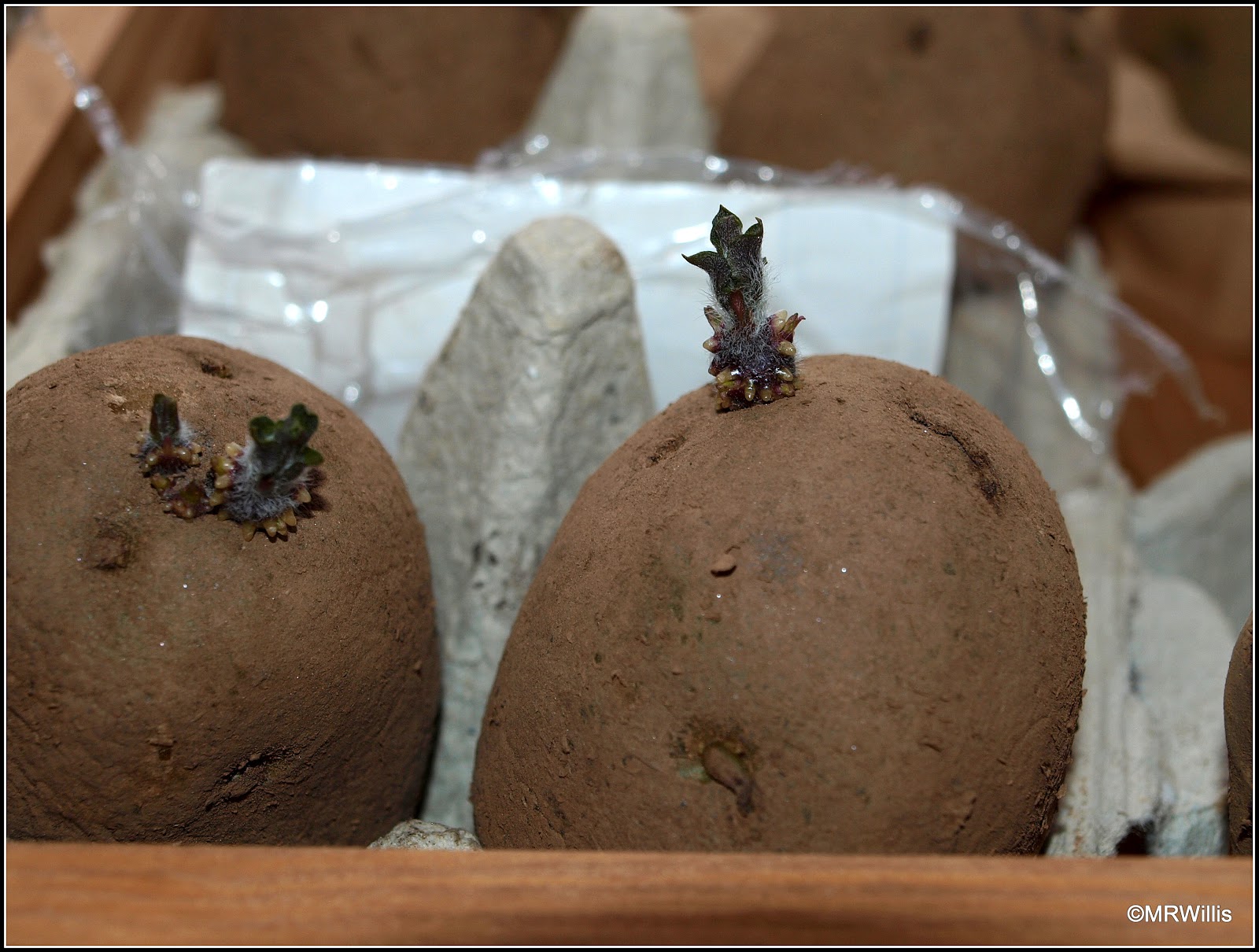
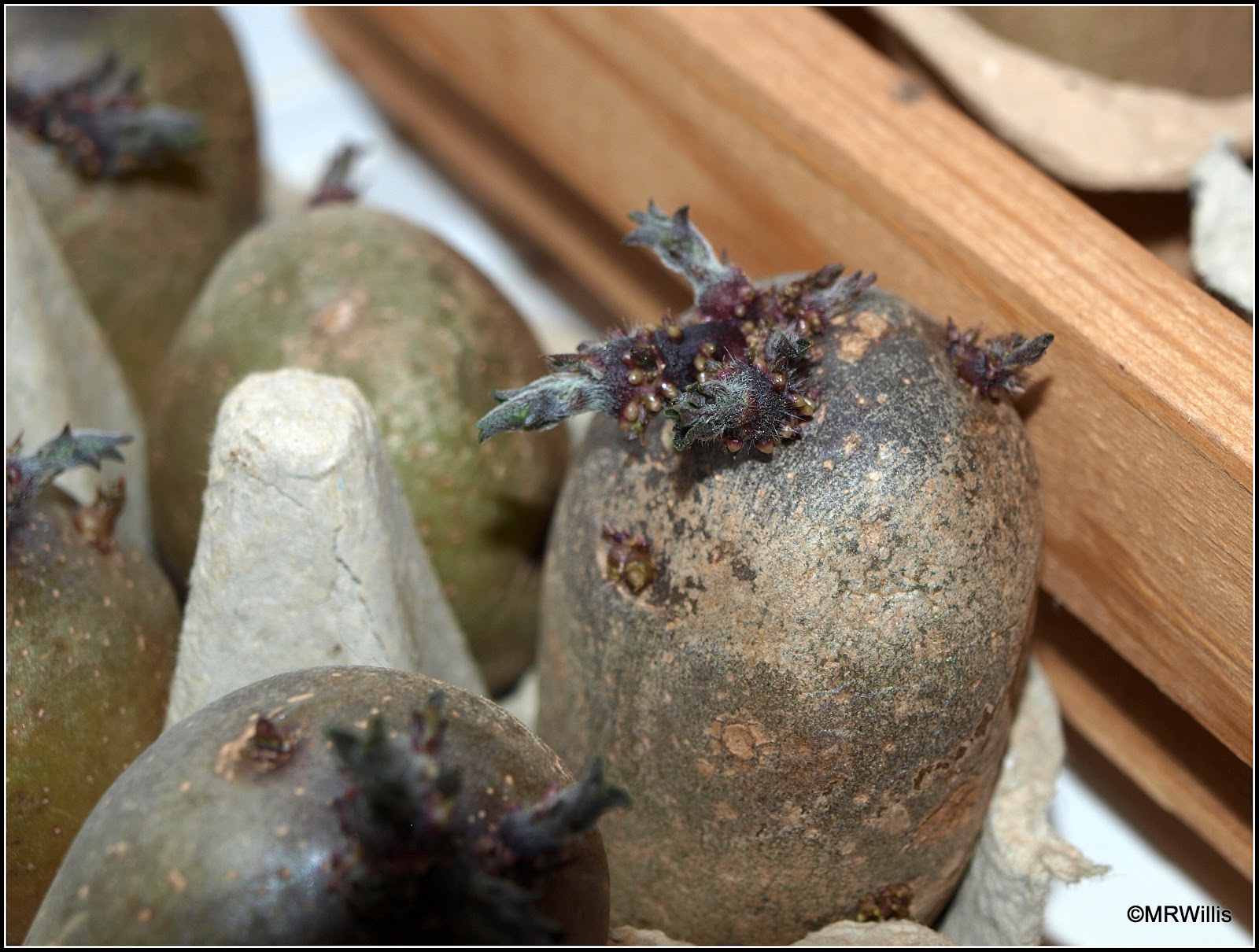
At present, my seed potatoes are happily chitting away in egg-boxes on the windowsill of a cool spare bedroom.


Most of the new shoots (aka "chits") on a seed potato tuber appear at the so-called Rose end - the end of the tuber most distant from the point where it was attached to its parent plant. The egg-boxes serve to keep the potatoes upright with the Rose end uppermost, allowing the chits to develop unimpeded.


This is what a good chit looks like. Short and stout, not thin and leggy, and also a dark colour, not pale.


To achieve this you need to give them plenty of light and not too much warmth. The temperature in that spare bedroom of ours (with the radiator turned off) is about 15C most of the time.

The tubers in this next photo are some of the "Foremost" ones that I have saved from plants I grew last year, and originally from the Courtmoor plot that I was looking after. They look very vigorous, don't they?


For the record, this is the list of the potato varieties I am going to grow this year:-

First Early
Foremost (Up to 10, depending on space available)
Annabelle (4)
Lady Christl (2)

Second Early
Charlotte (4)
Nicola (4)
Belle de Fontenay (4)

Maincrop
Highland Burgundy Red (2)

As you can see, I don't go in much for Maincrop varieties (The "Highland Burgundy Red" ones are just for a bit of something different). This is because I want my potatoes to be harvested early in the year, before blight becomes a problem.

As usual, I will be growing my potatoes in big plastic tubs, protected for their first few weeks by min-greenhouses like this...


More on this at a later date...

Sunday, 24 February 2019

Thinking of making a comeback

My blog has been dormant over the Winter months. Let's just call it hibernating. To be honest, my gardening "mojo" took a big hit in the Autumn. I was discouraged by the rather meagre harvests from that Courtmoor Avenue plot that I was looking after - and it took such a lot of effort too! I also felt that I didn't get much encouragement (and very little in the way of thanks) from the owners, so I "gave my notice" at Christmas-time. I left the plot in better condition than that in which I took it on, so my conscience is clear. This year my efforts will once again be concentrated solely on my own home garden.

The Courtmoor Avenue plot, a few days before Christmas 2018.

I also have to admit that my ever-increasing interest in fungi-spotting has also taken up a lot of my time, to the detriment of my gardening efforts, though to be fair there was not a lot that needed to be done in my garden these last three or four months.

Flammulina velutipes - Velvet Shanks

Now, with the Winter hopefully ending, I find my enthusiasm for gardening returning once more. Whether or not my blog will be resurrected in the same way remains to be seen, but at present my intention is to write a few posts (at longer intervals than previously), and see how it goes. So today, I offer an Update, a Situation Report...

My gardening year began at the end of January as it usually does, when I attended the Hampshire Potato Day event and bought my seed potatoes. This year I will revert to growing potatoes only in containers, and I will grow mostly First Earlies and Second Earlies. Ten days ago I sowed my chilli seeds. I habitually do this on or about Valentine's Day, a date that's easy to remember, and produces decent chilli plants for me year on year. I have also sown Broad Beans (in individual small pots, protected from the mice by clear plastic propagator-lids), and two types of Onions, sowing a pinch of seeds in each of 30 modules. I'll separate the plants when they are big enough to handle.

One of the biggest jobs of the gardening year for me is the emptying of the compost bins. It's hard work and can be very messy, so it's a job that sometimes gets put off and put off. The recent spell of warm sunny weather finally prompted me to get on with the task, and I'm pleased to report that all my raised beds have been topped-up with a very thick layer of rich organic matter. The birds will have a chance to peck this over before I need to sow or plant anything.


I have also reserved quite a lot of the compost for my potatoes, storing it in the big plastic tubs in which the spuds will be grown. I'll not be planting any potatoes for another 2 or 3 weeks at least, and then only if the weather doesn't go cold again.


Back in October I planted some garlic - "Mikulov Wight" - kindly supplied FOC for review purposes by Gerry from Growseed. This has grown steadily over the Winter and is looking quite promising. I covered the tubs with metal grilles (shelves from the mini-greenhouses) to stop foxes digging in them, and this seems to have been successful.


My Endives survived the Winter too. This was never intended; they were supposed to have been eaten during the Autumn, but I sowed them later than I should have done, and the Summer drought meant they grew a lot slower than usual (it's a miracle they didn't bolt!). Still, protected from frosts by my long cloches (and in the severest weather, by a couple of layers of fleece too) they look all right, even if not very big. Now that we have had some sunny and warm days I expect them to do one of two things: put on a growth spurt, or bolt. Hmmm, I wonder which it will be...


Surprisingly, I also have three Beetroot that might finally come to something:


They were sown in one of the big plastic tubs, as a follow-on crop after potatoes, but like the Endives, they never really got going - until now. Even if (as seems likely) the roots prove to be tough and woody, at least the plants are producing some new leaves, which can make a nice salad ingredient.

Another vegetable that I grew in the big tubs was Kaibroc, which produced a very creditable harvest over a very long season. It just seemed to keep on developing another batch of shoots every few weeks, and one pot with two plants in it never officially finished cropping. Now, the two very hacked-about plants have finally managed to set some flowers. I'm leaving these as a little snack for some of the early bees.

Left: Beetroot. Right Front: Kaibroc. Right Rear: Watercress.

So what now? I know this is tempting Fate, but this year I plan to be a bit more conservative with what I grow. I'm going to concentrate on staples like Runner Beans, Carrots, Chillis and Tomatoes, and try to resist growing any "Funnies". If all the dire warnings about shortages of fruit and veg after Brexit come true, I may end up being more than usually glad of the harvests from my garden!

Monday, 17 December 2018

The end of another chapter

Regular Followers will know that for the past 14 months or so I have been looking after another veg-plot in a nearby road called Courtmoor Avenue (hence my many references to "the Courtmoor plot").

November 2017

Well, after a lot of agonising, I have finally decided to cease the use of that plot. I know that 2018 was probably not a typical year, with its exceptionally cold Spring and its loooong hot Summer (though with Climate Change firmly upon us, who knows, this may be the new normal), but I felt that my Effort-to-Results ratio was not good enough to make it worth continuing. Lots of effort (particularly watering) and some rather unsatisfactory harvests (e.g. the potatoes, which were dismal). I also found the traipsing to and fro to be rather wearing. I'm used to being able to just pop outside into my garden any time I like, doing a few minutes' work at a time, rather than a longer stint every few days. Yes, I admit it, I'm set in my ways, but I've established a routine that suits me and I'm happy to continue it. Today I made my last visit to the Courtmoor plot.

This was my final harvest. Three sticks of Brussels Sprouts and all the remaining Leeks (about 25). Everything else has gone.


If I had been intending to continue looking after this plot, I would have left those crops a bit longer, because they were still quite small, but I wanted to make a clean break before Christmas.


I had one last chat with the lady home-owner and she said she had been impressed with how much veg I had managed to coax from the plot. When I said that I thought the results had been a bit disappointing she countered that the Leeks were at least twice the size of anything her husband had ever managed to grow. "His used to be the size of Spring Onions" she said! Likewise, she was more than happy with the Brussels Sprouts I gave her because they had not grown any brassicas for years, due to the presence of Club Root. I never did establish how long ago the Club Root episode had been, but I think it was probably 7 or 8 years ago, and none of the brassicas I grew showed any sign of it.


My final task was to recover all my own bits and pieces (stakes, netting, hoops etc), remove the remaining debris and leave the plot neat and tidy for whoever takes it on next. Considering that I spent most of last Autumn and Winter digging that plot over and extracting all the perennial weeds, I think I can justifiably say that I left it in better condition than it was when I started.

17 Dec 2018

It has been an interesting episode, but overall I'm happy to be returning to my former arrangements.

Saturday, 8 December 2018

The season of crusts and jellies - Part 2: crusts

The other day I described a few of the jelly fungi that you can see during the Winter. Today I'm going to cover some so-called crust fungi. My loose definition of this term includes a couple that are really brackets, not crusts!

A crust fungus is often resupinate for at least part of its lifecycle. This means that it is effectively upside down and lying flat over the surface of its substrate (the thing it is growing on), like this:


Some fungi of this type will grow underneath a log, where they are not visible until you lift the log, but more often they grow in places where their upper surfaces are visible - such as along a horizontal log, or on the vertical surface at the end of a log, as seen here:


In cases like this, the fungus becomes less resupinate, and more like a bracket - that's to say it juts outwards from its substrate and forms cups or ledges. The Stereum hirsutum (Hairy Curtain Crust) seen above is a good example.

Sterum hirsutum is a very common fungus, and grows prolifically in the Winter-time on fallen wood of deciduous trees, such as Oak and Beech. The upper surface of this fungus is very hairy (hence its common name), and brightly coloured in shades of yellow, orange and brown, with a yellowish-cream edge.

Stereum hirsutum upper surface

The undersurface is smooth and lacking in visible pores, as shown here. I pulled off a section to photograph it.

Stereum hirsutum undersurface (Centre)

The undersurface of a crust or bracket fungus is normally a key feature when trying to make an identification. As a general rule, all the Stereums have smooth undersurfaces, whereas the visually rather similar Trametes fungi have (usually white) pores - little holes.

Look at this fungus, which is somewhat similar to the Stereum hirsutum in terms of shape and colour. It is not a Stereum though, it's a Trametes.


How do I know? I looked underneath. It has white pores.


Trametes versicolor - Turkey Tail - is perhaps the best known of the Trametes types, and as suggested by its name it comes in many different colours, with blues and browns being the most common.

Trametes versicolor

Just in case you thought this was easy, if a fungus looks like a pale grey Trametes from the top, yet has blue-grey pores instead of white, it is probably a different thing altogether! It's probably Bjerkandera adusta - Smoky Bracket.

Bjerkandera adusta - upper and lower surfaces

Nothing in the world of fungi is ever straightforward, and most fungi seem to have one or more lookalikes. A prime example is Stereum ostrea, the False Turkey Tail. I think you will agree that when seen from the top it could easily be mistaken for a Turkey Tail.


But you know by now that it has a smooth undersurface without pores!


There is one other fungus that I want to cover in this post. It is Laxitextum bicolor. It doesn't appear to have a common name.

Laxitextum bicolor, photographed on Velmead Common, Fleet,  in December 2017

This is what I think of when the term "Curtain Crust" is mentioned. It actually looks like a curtain, doesn't it? Apparently this fungus is quite rare, or perhaps more accurately under-reported, because it is often misidentified as Stereum rugosum, the Bleeding Curtain Crust, and reported as such.

This fungus certainly grows on Velmead Common, in Fleet, where I have seen it several times, and just recently I saw some in Southwood Woodlands which are also close to Fleet, so it's evidently not rare in North-East Hampshire.

Laxitextum bicolor, photographed in southwood Woodland, Fleet, on 02 Dec 2108.

The types of fungi I have described here are not normally considered edible. Even if they had a good taste, and did not contain toxins, they are mostly extremely tough and therefore not palatable. Some of them do (allegedly) have medicinal properties though. For instance, a tincture made from Trametes versicolor has apparently had some success in slowing the development of certain types of cancer.

If you are interested in this subject and want to learn more, I strongly recommend the website First Nature, which is a mine of useful information.

Wednesday, 5 December 2018

Beginning of December update

So far this Autumn our weather has been comparatively mild. Yes, we've a had a bit of rain and a few very blustery days, but nothing extreme. I think we have had frost only on two occasions. This has meant that some of my crops have kept going longer than usual. I harvested my last tomatoes in mid-November. These last few have been ripened indoors and were consumed only yesterday.

Tomato "Tango"

I moved a few of my chilli plants under cover before the frosts came, some into the garage and some into my big coldframe. They have continued to produce ripe fruit. This one is my "Cozumel" plant, a variety which struggles to produce ripe fruit during a normal year, but with this year's hot Summer and now the protection of the coldframe it's doing OK.


I'll be honest and report that I did pick a few semi-ripe fruit the day before our first frost was forecast, just as an insurance policy. They have ripened and now dried indoors, and will be used for next year's seed.

Out in the open I still have quite a few nice vegetables waiting to be harvested. For instance, my carrots are still going strong, although we have already eaten lots. I'm always surprised by how many carrots I can get out of one 1 x 2.4 metre raised bed. I only pick a small number at any given time, and keep them in a Stayfresh bag in the fridge.


Leaving mature carrots in the ground in a typical Autumn is always a gamble. There is a risk that slugs will attack them, and some are likely to rot in the cold wet soil. Some people harvest their carrots all at once and store them for Winter use in boxes of damp sand, but I've never done that, though maybe I would if I grew them in an open plot rather than in a raised bed, which is easy enough to protect if need be.

Another crop that is just going on and on this year is the Kaibroc. I would have expected it to have finished long ago, but the two plants I have growing in a 35-litre container are still continuing to pump out spears! Yes, OK, they're getting progressively smaller each time, but they are still worth having.

Kaibroc

In one of the raised beds I have 3 Purple Sprouting Broccoli plants coming along.

Purple Sprouting Broccoli

I often grow more PSB than this, but this past Spring we had far too much of the stuff (and Jane doesn't like it as much as I do, so we can't reasonably have it every day when it's in season!), so I've reduced my numbers. Actually this was fortunate, because the bed in which they are growing is my least good one, and I think if there had been more plants in it they would have struggled to survive the hot Summer. The bed dries out very quickly because it is nearest to my neighbour's enormous Leyland Cypress tree, which sucks up more than its fair share of water. Or at least, it used to.... a couple of weeks ago my neighbours had the tree cut down. Hooray!

I've mentioned before that I was late sowing and planting my Endives this year, and I hadn't expected to get any of them to maturity. However, thanks to the milder weather and my trusty Longrow cloches, they are still soldiering on, and may yet turn into something worthwhile. When frost is forecast, I cover the cloches with a double layer of fleece, weighed down with bricks.

Endives under a Longrow cloche

I have a few more Endive plants in individual pots, covered with plastic bell cloches, but these are not looking so good. Many of the leaves have brown tips, particularly where they have been touching the cloche. I think that the cold affects an individual pot a lot more than a group of plants in a tunnel cloche, providing a bit of mutual support for each other.

Endive growing in a 35L pot

To the uninitiated, my bed of Parsnips probably doesn't look very attractive, but as experienced gardeners know, the fact that its foliage has died down means that a Parsnip is ready for eating, and I know that this bed is full of lovely veg! And hopefully it will be nice and sweet, now that we have had a couple of frosts, because the cold promotes the conversion of starches to sugar.


I have decided to use the Parsnips from my Courtmoor plot before these ones, but I did dig up a sample from the bed pictured above, just to see what they are like. First indications are that this year's crop may be a little quirky...


Sunday, 2 December 2018

Classic Winter veg

I haven't been doing much gardening recently. You probably noticed that here on my blog (and on Facebook and Twitter) I have been writing about fungi more often than vegetables. Well, the truth of the matter is that my garden and my Courtmoor Avenue plot haven't really needed much attention. Lots of the veg that I sowed and planted earlier in the season has just been growing steadily away, doing their own thing. Every now and then I harvest something, but there is little else to do.

This week I visited the Courtmoor plot for the first time in over two weeks, and was pleased to see that it was still looking reasonably tidy. All the digging I did this time last year has ensured that there are few perennial weeds and the annual ones are not growing much at present. Each time I visit this plot I bring home any of the bits of "hardware" that are no longer needed up there, such as nets, hoops, canes etc, which I clean up and store away in my garage until they are next needed. The nets have been particularly useful because they successfully kept the pigeons off my second sowing of brassicas (you may remember that my first sowing was stripped bare...). I have ended up with some very satisfactory cabbages - such as this "January King" one:

Cabbage "January King"

The "Red Drumhead" red cabbages have done better than I feared too. Due to late planting (because of the pigeon attack episode) they were never going to be big specimens, but in terms of quality they are not too bad.

Cabbage "Red Drumhead"

This is one of my two rows of Leeks. Again, due to having to struggle to survive during the Summer drought, they are not big, but to be honest in a year like this anything is better than nothing!


You can't see it because most of the foliage has died down, but to the left of the Leeks is a row of Parsnips. The first ones I dug, a couple of weeks ago, were not up to much - very long and thin - but on this visit I managed to get some quite nice ones so maybe they have swelled a bit due to the recent rain. Perhaps the same will happen with the Brussels Sprouts, which are still very small?


This photo makes the sprouts look big, but in reality they are not!

Well anyway, on this visit I came away with Cabbages, Leeks and Parsnips.


Here they are at home, after rough trimming. In the end I brought three cabbages - one "January King" and two red ones. The latter will be braised with apples, onions and raisins to accompany a roast Goose crown (one of our favourite Autumn / Winter meals).


I think you'll agree that these three are all classic British Winter vegetables. It's just a pity I didn't have any Swedes or Kale to show off! I'm as guilty of this as the next man, but isn't it a shame that so many gardeners fail to produce more than the odd one or two Winter-maturing crops when there are so many viable options?