Tuesday, 13 August 2019

Growing "Crown Prince" squash

Before I write anything else, let me just say that I make no claims to be an expert in squash-growing! Last year, when I was maintaining that extra plot at Courtmoor Avenue, I grew three types of squash simply because for the first time I had some space to do so - and space that was mostly in the full sun. I was modestly pleased with the results.


Prior to this, my attempts to grow squash in my own garden were limited to a broadly-unsuccessful experiment with the Three Sisters technique (squash, corn and beans). I tried a variety of Butternut Squash that was allegedly developed for the cool and changeable British climate, but it still didn't do well. I think the reason is that it didn't get enough sunshine in my shady garden.

That all changed earlier this year, when one of my neighbours cut down a huge conifer tree in his garden. This suddenly gave my garden a lot more light, and gave a new lease of life to a patch of ground that had formerly been completely shaded. I decided I'd use it for growing a Crown Prince squash.

In my usual fashion I sowed two squashes, not one, so that I'd have a spare in case anything went wrong. As you probably guessed, nothing went wrong and I couldn't bring myself to discard a perfectly healthy squash plant, so I planted the second one as well. They are seen here, protected by small sticks aimed to keeping the local foxes / cats off them.


Before long the plants had grown huge and put out some very long runners. I had to pinch out these runners to stop them taking over my whole garden.


Soon lots of flowers appeared - mostly males to begin with, and then some females. I was very keen to get some fruits started so I artificially pollinated a couple, using a small paintbrush to transfer pollen from male to female.


I had set myself a goal of achieving at least one mature fruit from each of the two squash plants, but I think this target will be exceeded. At one stage each plant had three fruits that seemed to have been pollinated.


The most promising one decided to take up position in my Parsley patch.


Now, a few weeks later it looks like this:


A couple of others look all right too, although they are still small:


In one spot, two fruit have developed close to one another, though on different runners.


Unfortunately one of the six that had looked promising died when it was about the size of a tennis ball, and one of the pair pictured above looks as it is ailing too. It's the one in the background of this next photo.


Whilst the larger of the two fruits has a nice healthy blue colour, the small one is a dull yellow and it doesn't seem to be getting any bigger now. The local animals also seem to have been investigating both of them too - those look to me like claw marks.

So, the crop may turn out to be a maximum of four fruits, but you never know, there might be more hidden away under all the luxuriant foliage, waiting to give me a pleasant surprise when everything dies down.


In terms of care, I've not done a lot. I have simply watered the plants a couple of times a week and fed them once a week with "Tomorite" at the same time as feeding my tomatoes. As you will have seen in my photos, I have also placed each of the developing fruits on an old terracotta tile. This helps to keep the squash out of contact with damp soil, which could possibly cause rotting.

So, things seem to be progressing well enough, and if I can maintain this for at least another month (maybe 6 weeks) I should end up with a pretty respectable harvest. Who knows, maybe next year I'll be more ambitious and try some rather less well known varieties? There seem to be lots to choose from.

Sunday, 11 August 2019

A peek inside the Brassica cage

I have my brassicas (Brussels Sprouts and PSB) inside a "cage" covered with Enviromesh, to keep the insects off them.


You can't see much from the outside - perhaps just a glimpse of how big the plants are - so I'm briefly lifting the mesh to let you see inside...


You can see that the lower leaves have a lot of holes in them. This is because I made the mistake of planting my seedlings without first checking them for butterfly eggs. Yes, there were eggs. Lots of eggs which hatched, because when I started seeing holes appearing in those leaves I had to duck inside the mesh and pick off loads of little green caterpillars. They were so well camouflaged that I evidently didn't find them all, because a couple of days ago I found three white butterflies flying around inside the mesh! Let's hope they didn't lay any more eggs before I evicted them.

Anyway, after that rather shaky start, the plants seem nice and strong now, and the recent growth is hole-free.

Brussels Sprout "Evesham Special"

Purple Sprouting Broccoli "Red Arrow"

The caterpillar damage is not very severe, and the best thing is that in the case of both my types of plant it is not the leaves you eat. Of course you eat the flower-shoots of the PSB, and the sprouts on the Brussels Sprouts. If the plants had been cabbages, I might have been more upset...


OK now, quick, I need to put the Enviromesh back in place!

Friday, 9 August 2019

Tomato report

In a way, tomatoes are a bit like potatoes (I mean, apart from botanically): the little tiny cherry types of tomato are the equivalent of the First Early potatoes, and mature relatively quickly, whilst the big so-called Beefsteak varieties are the tomato equivalent of the Maincrop potato, typically maturing much later.

Most of my cherry toms have been picked now, though of course there will be some late-arriving stragglers. Here's a typical view of the Dining Room table at present. Notice the dehydrator doing its thing in the background.


The bigger varieties of tomato are often trickier to grow - for instance they usually benefit from pinching-out of sideshoots (in the USA this is habitually referred to as pruning). I always grow mine as upright single cordons, with support from tall bamboo canes.

Most of my plants have a good amount of fruit on them this year, with one notable exception, whose seeds I got from a friend in the Netherlands. I think her tomato-identification (and labelling) skills are probably not of the highest order and these ones were simply labelled "Coeur de boeuf" - "Oxheart", what we in the UK call "Beefsteak" and probably just a generic type-name rather than the name of a specific variety. The plant has produced only 4 or 5 fruit so far, whereas the others have many more than that. Unless it has a late rally, or the fruits turn out to be especially tasty, I don't think I'll grow this one again.


This is "Cherokee Purple", a variety I have grown several times before. It's a very vigorous variety and produces lots of huge fruits.


This is "Marmonde" (NB: Not "Marmande", that's a different one).


This is another from my friend in Holland. The seeds for this one were labelled "Black and Green mini", but I suspect they will ripen to red! The shape is very much like the variety I know as "Italian Red Pear".


This is "Noire Charbonneuse", who seeds were originally from a different friend - this one in Belgium. It's a very gnarly variety, very prone to "cat-facing":


This is the very old-fashioned but well-respected "Moneymaker". I think it is the one that my Dad used to grow most often, back in the 1960s and 70s. He had a greenhouse too, unlike me.


This is "Super Marmande", an improved version of that famous variety so evocative of markets in the South of France.


Furthest behind of all are my two Dwarf varieties. This one is "Dwarf Beauty King", which has some flowers, but no fruit yet. The one I grew last year did well, eventually, so I hope this one has not "missed the boat".


As you can see, the fruits on most of my tomatoes are still green, but a couple of the smaller-fruited varieties are just showing the first signs of colour-change, such as this "Gardener's Delight":


And there's no mistaking the yellow colour appearing on these "Golden Sunrise", is there?


Finally for today I want to show you this lovely plant of "Ferline". I only planted it as an afterthought really. I had run out of the big 35L black plastic tubs in which I grow most of my tomatoes, but I found this old pelleted chicken manure container in the garage and used it to squeeze in just one more plant. I'm glad I did!


The so-called Indeterminate varieties of tomato are basically vines and will try to grow as long / tall as they can. This one is just setting its 5th truss so I have pinched out the growing tip to stop it growing any taller. This will force it to concentrate on ripening the fruit it already has - which is quite a lot. "Ferline" is another one that I grow almost every year. One of its qualities that I like is that it is very disease-resistant. Though it is not really blight-resistant like some more modern varieties are, it is one that will hold out against blight for longer than most.

Wednesday, 7 August 2019

Autumn salads in the pipeline

I've mentioned a few times that I haven't done very well with my lettuce this year - most of them bolted before maturity. However, I'm hoping that I will be able to get a better result with my Autumn crops, namely endives and chicory, with a few more of the Iceberg-type lettuces which were the only ones to do well during the Summer.

In the first week of July I sowed a tray each of endives and chicory. Both included a mix of several different types. They have now reached a good size for potting-on.


Each of the trays had a large number of little plants in it, but I haven't got space to grow them all, so I have transplanted 8 of each into 4-inch pots. This will enable the "chosen few" to develop without competition from their siblings, prior to being planted in their final positions at about the end of this month.

These ones with the serrated leaves are endives.


And these ones with the plain leaves are chicories.


As I said, since these are from mixed sowings, I have no idea what varieties they are, but we like all sorts of endives and chicories, so this is not a problem. It would be quite nice if they turned out to be all different, because that would probably mean they would mature at slightly different times rather than all at once. Most of the chicories are plain green at present, but this one is showing colouration already so it's probably one of the "Radicchio" types.


Generally speaking, endives and chicories are grown in the same way as lettuce, though the endive is particularly prone to bolting if the weather is erratic, and it seems to do better in the Spring and Autumn rather than in high Summer. Many of the chicories are very frost-hardy too and will survive even in cold Winters. Last year I was late sowing my endives and they were not ready to eat in the Autumn, so I covered them with tunnel cloches and over-wintered them. In the Spring they started into growth once more and turned out to be very good. I may try something similar this year too.


Depending on how things go, I may end up with both an Autumn crop and one for over-wintering, but the majority of the seedlings remaining in those trays are probably destined to be eaten as Baby Leaf Salads.


If you haven't tried growing endives and chicory, I strongly recommend that you give them a go. They are a great way of adding to a salad something a bit more substantial than lettuce - and they have the extra benefit that slugs and snails don't seem to like them very much!

Monday, 5 August 2019

Chilli update

Earlier in the year I was hit by weedkiller contamination in compost, and unfortunately it affected almost all my chillis. I nurtured the plants as best I could, and most of them survived. The warm sunny weather during much of July was a great help. Now, the plants have recovered quite well and most of them are looking very good - except that they are way behind schedule. I haven't picked any ripe fruit yet, which is unusual considering that we are into August already.

This plant is my "Chocolate Cayenne", which seems to be in fine condition now, with several good fruits on it.


My aim this year was to produce a bigger chilli harvest than usual, in order to make more Sweet Chilli Sauce, so I have fewer of the "exotic" types and mostly the fairly straightforward Cayenne types. Four of the plants are "Cayenne Long Slim". Two of these seem pretty good, and have regular-shaped fruits like this:


The other two were evidently more badly affected. They still have a fair few distorted leaves, like this:


More worryingly, they also have a lot of weirdly-shaped fruit. Curly ones like this are not particularly unusual:


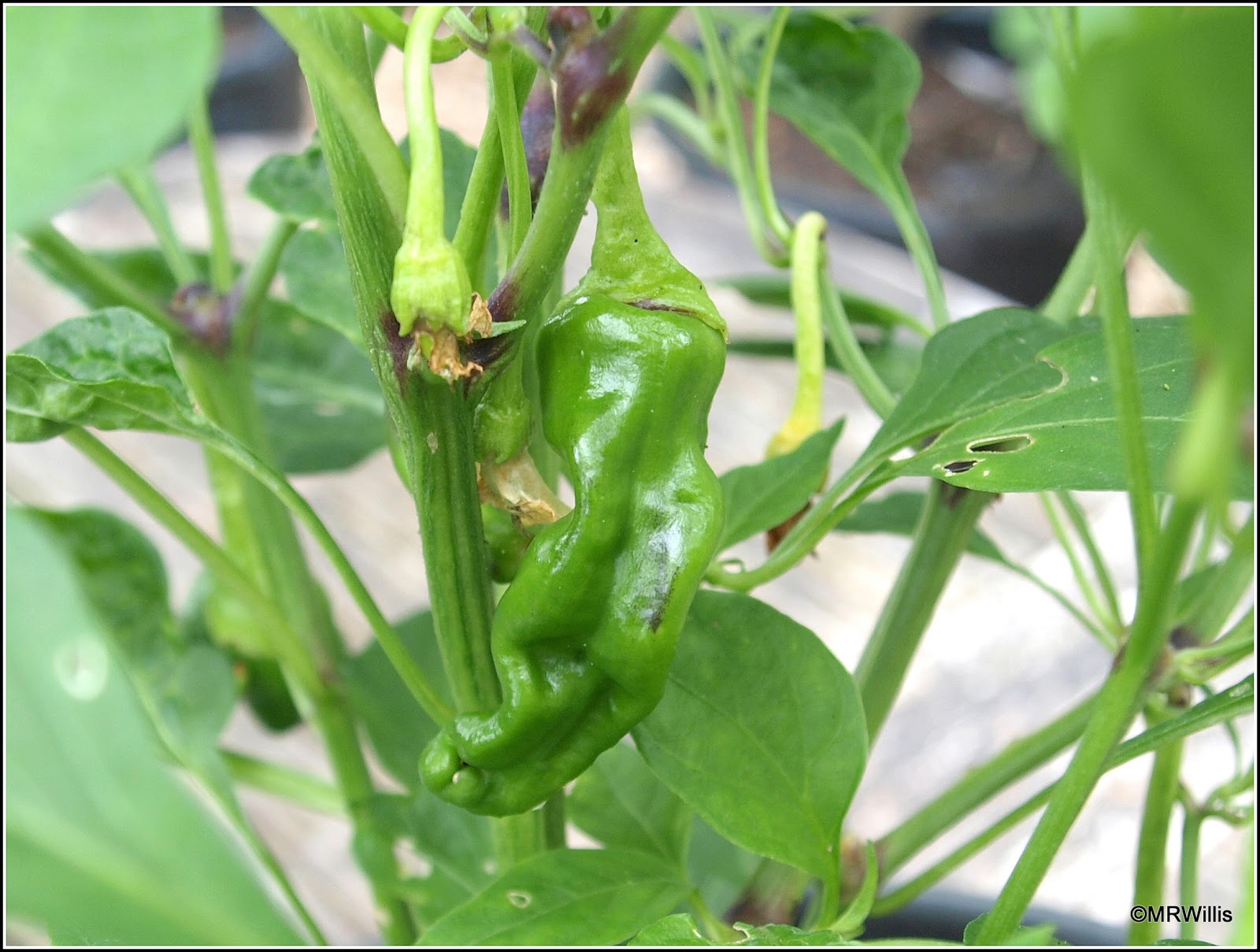
But this is like no other Cayenne fruit I have ever encountered. It looks more like an Habanero!


And of course I have a couple of fasciated ones:


One of the worst-hit plants was this one, seen here in May. I had cut off most of the damaged foliage and wasn't really expecting the plant to live.


However, the plant defied the odds and did pull through. This is it earlier this week:


You wouldn't describe it as big or strong, but at least it has some leaves, and even some fruit! It's amazing how resilient some plants can be...

On 12 May I posted this photo of my very first chilli fruit of the year, an "Hungarian Hot Wax":


Unfortunately it never got much bigger than that, and it dropped before reaching maturity. The parent plant was very sick. It lost most of its leaves and those that remained went a very strange bronzey colour. I fully expected it to succumb. It didn't. It now has healthy leaves once more and even a couple of of these beautiful flowers, though I fear it may be too late for any fruit to ripen.


I think the moral of this tale is "Don't give up". Some plants are a lot more resilient than we give them credit for! My 2019 chilli crop would have been a lot better without that awful herbicide stuff, but it's certainly not a washout. As long as we get a reasonable amount of sunshine in the next five or six weeks I think most of my plants will deliver a decent harvest.

Saturday, 3 August 2019

Harvesting cherry tomatoes

In my experience, cherry tomatoes ripen very suddenly. They stay hard and green for seemingly ages, and then all of a sudden you're inundated with ripe fruit! Just a few days ago, most of mine were like this:


Then yesterday, I picked all these:


In the space of 24 hours I picked 2.24kgs of little tomatoes.

They are mostly "Maskotka" ones like this:


But there are also a few of "Losetto", "Minibel" and "Montello".


The "Montello" ones are very attractive plum-shaped fruits. I only have one plant of this variety, but I almost wish I had more!


Most of the small tomatoes I grow get used in salads, or simply served on their own (with a little salt) as a "Nibble" with a drink before dinner. We seldom cook them, though we do sometimes dehydrate some to the semi-dried stage. This concentrates the flavour and makes them taste even nicer.

This week we did a comparative trial of three different varieties - "Maskotka", "Losetto", and "Minibel". We ate them dead plain, with no salt or anything, so that we could properly assess them. The first of the three is usually our favourite, but this year they don't seem as good. The plants have been rather unenthusiastic and the yield is smaller. The taste was good - pleasantly tart - but the skins seemed quite tough. "Losetto" was OK; the flavour was nice but it had lots of seeds and "jelly" inside, which was not so appealing. The newcomer "Minibel" was our favourite of the three, with a sweet taste, soft flesh and delicately thin skins.

Thursday, 1 August 2019

The benefits of a colourful harvest

Growing vegetables involves quite a lot of preparation, maintenance and above all, waiting, but if all goes well a nice harvest will reward your efforts.


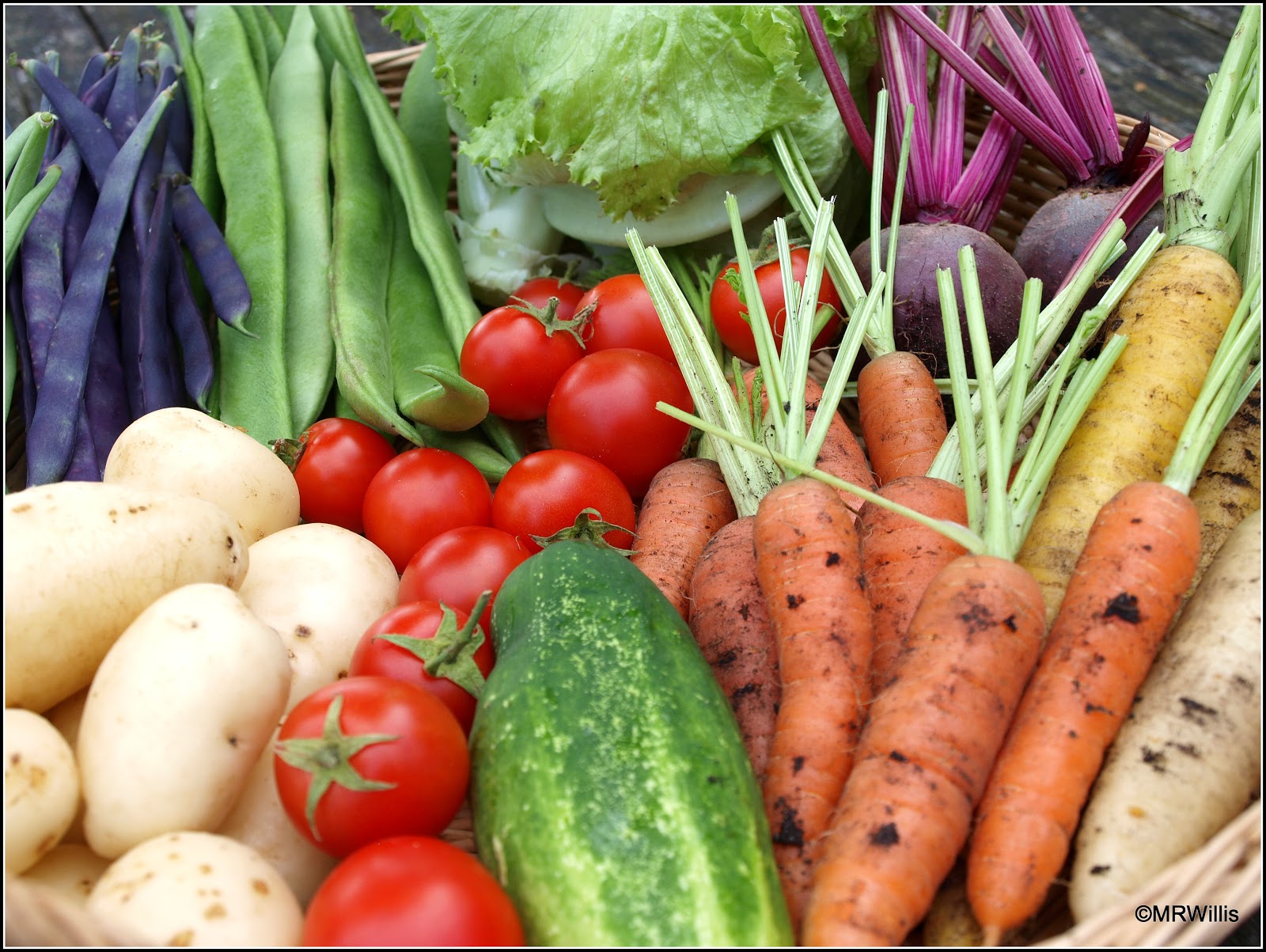
This is my harvest from the last day of July, beautifully diverse and colourful. In the basket are Iceberg lettuce "Great Lakes", beetroot "Boltardy", carrots "Harlequin" and "Chantenay", cucumber "Delikate B", tomatoes "Maskotka", potatoes "Foremost", French beans "Cobra" and "Kew Blue" and Runner beans "Painted Lady".


They say that for maximum health benefits, your food should consist of different coloured items, so I think I should be OK!

Regular readers know that I never have huge harvests of anything, and I prefer to have small quantities of lots of different vegetables. This year there seems to be an exception to that rule - the carrots have done amazingly well, and my 3 x 2.4 metre rows will feed us for weeks. We are working our way through the early-maturing "Harlequin" multi-coloured ones, and the "Chantenay Red-cored", but I haven't yet made a start on the "Autumn King" maincrop ones. It's not all good news though - I am disappointed that hardly any of the purple carrots in the "Harlequin" mix came up (and those that did are tiny), and the "Chantenay Red-cored" ones - nice as they are - don't have red cores!


In my garden July and August are the main harvesting months. Practically every day I harvest something, even if it's only a handful of beans or a couple of tomatoes. I find this much more in keeping with our lifestyle than harvesting a big crop of a particular vegetable all in one go. OK, there are some things for which the all-at-once harvesting approach may be appropriate (e.g. potatoes), but even so, by growing different varieties of each type of vegetable you can spread the harvests over a longer period. For instance, I have five different varieties of climbing bean this year: two of Runners, two of French, and one of Borlotti. Likewise, I have grown seven varieties of potato and sixteen varieties of tomato.


If a novice gardener were to ask me for advice I think the best tip I could give would be "Grow lots of different types of veg". Using this approach you are much more likely to get a good harvest of something. Growing conditions vary from year to year, and some crops will always perform better than others. Likewise, it's not sensible to assume that just because one crop did well one year, it will also do well the next. The biggest factor affecting veg-growing is the weather, and no two years are the same, so it makes sense to hedge your bets.