Tuesday, 21 February 2012

Ends and beginnings

Will it be the end of the line for this potted Rosemary plant of mine?


In the most recent spell of very cold weather this plant got severely frosted, and most of its leaves are brown and shrivelled.


The strange thing is that I have several other Rosemary plants, and they seem to be unscathed. The others are growing in open soil rather than in pots, and are in much more exposed positions than the potted one which has been close to the house and allegedly sheltered. I wonder if maybe the potted one is of a different, less robust, variety? I think all of mine have been bought as simply "Rosemary", without being given a specific variety name.

I think the Catalogna chicory is going to have to go as well.


On the other hand, there are some more encouraging signs elsewhere, such as this lovely Purple Sprouting Broccoli:


And the Chives are beginning to grow strongly now:


Now if only I had some home-grown tomatoes at this time of year....

Monday, 20 February 2012

Iris Reticulata - variations on a theme

In my garden the Irises are usually amongst the earliest plants to flower (beaten only by the Crocuses), so I see them as indicators that the Winter is coming to an end. For me one of their main advantages is that they are short plants and less prone to wind-damage than taller ones would be, and in the Late Winter / Early Spring we often get very strong winds.

This post is simply a collection of photos of my various types of Iris Reticulata, all currently in bloom. I don't have many of them, but as individual flowers I think they are incredibly beautiful. And they come in lots of different colours...


Yes, I think I ought to get a few more of these... Can you get yellow ones? I know that you can get large yellow ones, so presumably small varieties are available too.

Sunday, 19 February 2012

Some under-performers

When I first set out to be a photographing + blogging gardener I undertook to be honest about what I grew (or didn't), showing failures as well as successes. Did you see that I have signed-up to the Bloggers' Voluntary Code of Fair Practice? (Badge in my sidebar now). I believe that being over-selective with which aspects of your garden to show to the world is in a sense being dishonest. It is with this thought in mind that I offer you this post today.

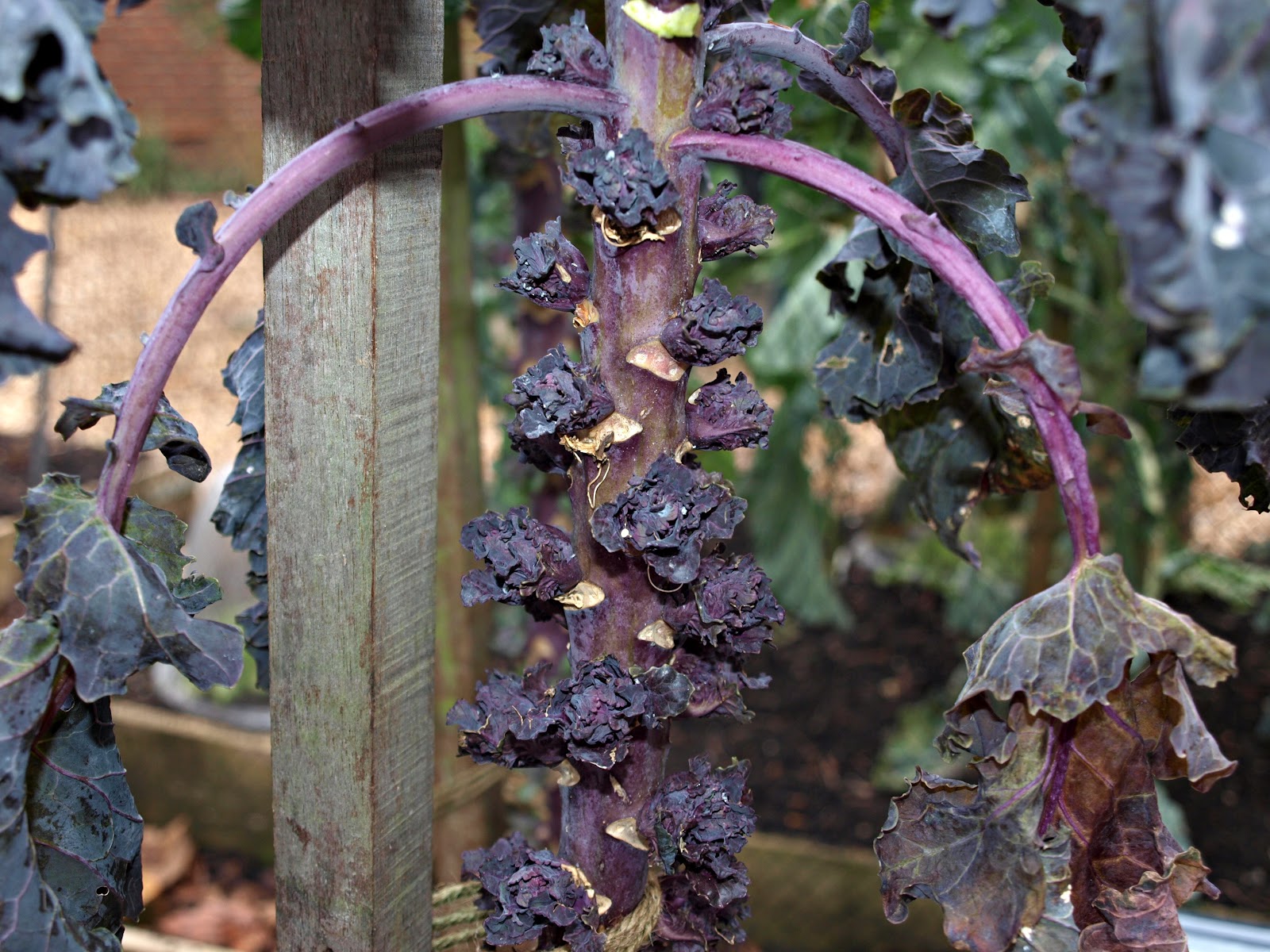
A big disappointment for me this Winter has been the "Petit Posy" Flower Sprouts. I had high hopes of these - they allegedly combine the best features of Kale and Brussels Sprouts. Being billed as exceptionally Winter-hardy and producing their crop at a time when few other vegetables are available, I thought it sounded like an attractive prospect. However...  For space reasons I only have four of these plants, and two were basically "Reserves" planted much later than they should have been. But all four are a lot smaller than I had expected, and I have yet to harvest any sprouts. I haven't the heart to pick anything so small!


Viewed like this, they perhaps appear OK, but compare the size of those sprouts to the size of the supporting stake (25mm square). Not big.

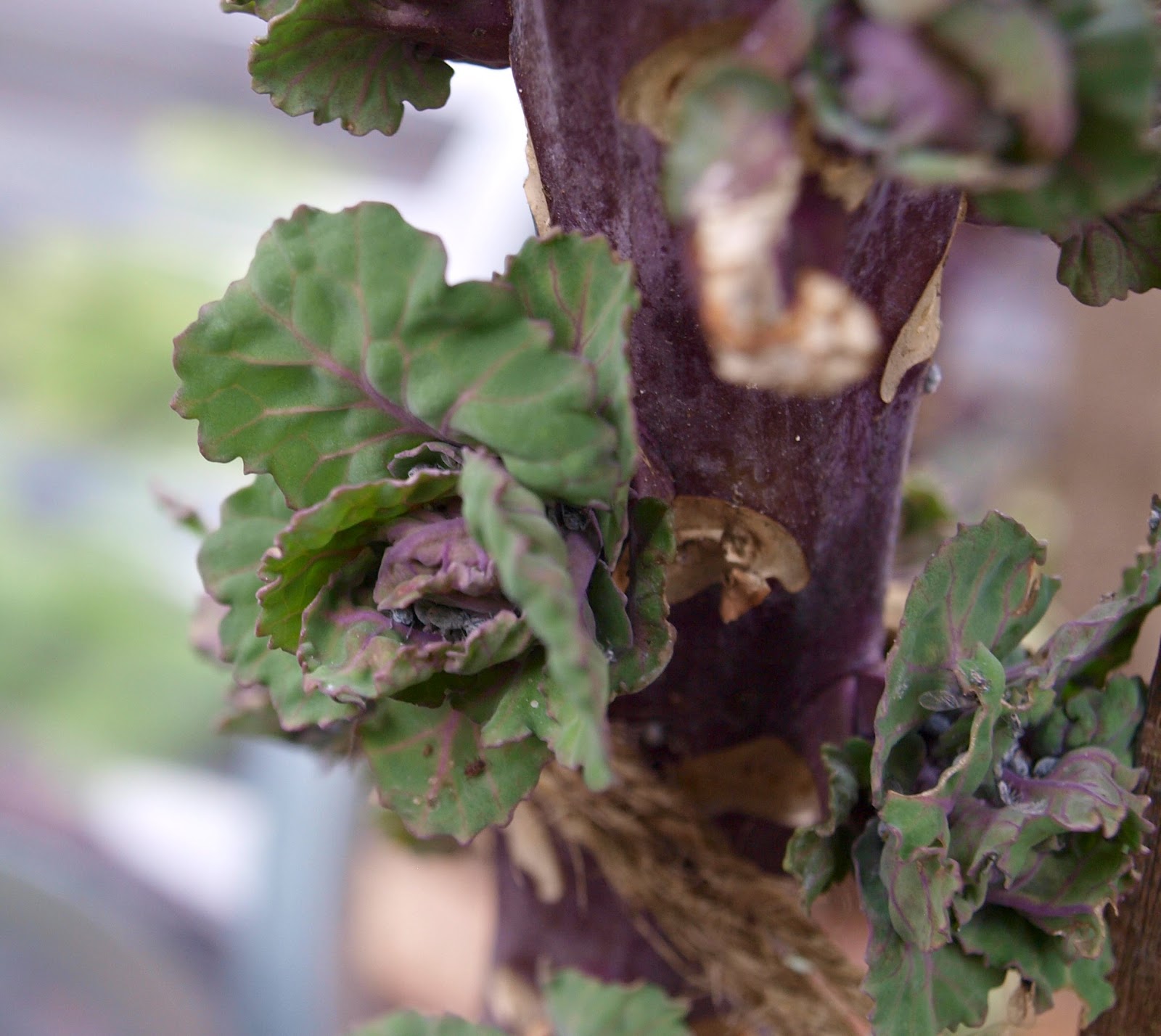
Here's one in close-up. They look like loose or "blown" Brussels Sprouts, or tiny cabbages:-


I also have to report that the aphids absolutely LOVE these things, which makes me like them even less.

I suspect that I will harvest all of the Flower Sprouts in one go, and that they may (if we're really lucky) provide a single serving for the two of us - maybe stir-fried or lightly steamed.

Now look at this:


Yes, it's a Red Cabbage. You might think, looking at my photo, that it seems perfectly normal. You'd be wrong of course, because the whole thing is pathetically small - no more than 6 inches across - and this photo is a close-up. It is a "Marner Langerrot" Red Cabbage, that grew tall and spindly, but never produced a heart. Funnily enough, I have resisted digging it up because I actually quite like it, for its photogenic qualities. Those pale inner leaves are quite attractive, aren't they? This particular plant has featured in several of the "Frozen Veg" style photos I have published recently.

Next, the Hamburg Parsley. This is another one of of those veg that supposedly delivers the best of both worlds - a root vegetable similar to the parsnips, and a herb like parsley. In fact it has disappointed in both categories. The roots were small (particularly viewed in comparison to the lovely parsnips that grew right next door to them), and the herby parsley-like vegetation was a lot less vigorous than the "real" parsley. A bit of a flop all round, I would say.


Disclaimer: I accept the fact that these vegetables, grown by other people, in other conditions, at other times may have been hugely successful, but I I'm just saying that they didn't work for me.

So, what failures will you admit to then?


BTW: I hope to be able to report on some more successful enterprises before too long! :-)

Saturday, 18 February 2012

Signs of Spring?

I must apologise for being less in evidence than usual these last few days. I have been travelling a lot and I have not had time or energy for much blogging, so I have concentrated on producing material for my own blog rather than looking at others. Currently we are away from home on a long weekend in the Cotswolds, and I don't know if I am going to get much/any internet access, so I am relying on Blogger to publish some scheduled posts for me. This morning there have been some problems with Blogger anyway, and although I have tried to comment on several blogs I have in most cases been unsuccessful.

***********************************************************************************

Our Winter has been very unpredictable. We have had a lot of mild weather; less rainfall than usual; and less wind. On the other hand we have had a couple of spells of very cold weather, and the temperatures have fluctuated a lot. Our poor old plants must be very confused. Just when they think that we are never going to get a proper Winter and begin to put up new growth, along comes another few days of bitter cold.

Some of my plants are beginning to produce buds now. Let's hope they don't regret it...

The Blueberries are in pots close to the house and therefore relatively sheltered. Although I have four different varieties which have fruit that ripens at different times, they all seem to produce their first buds simultaneously.

Blueberry

The flowers on the Bay trees are never individually impressive, but en masse they will look good.

Bay

The Wallflowers have recovered very well from the severe frosting they had. I can't tell yet what colour this one is going to be, but it won't be long now. Possibly one of the deep red ones.

Wallflower

There are lots of Crocuses flowering now, though they haven't had much sunshine to enjoy. This one is in a very open position and had opened-up fully.

Crocus

Whereas this clump is in a very shady spot, near the base of the Fish tree and the flowers are remaining firmly closed.

Crocus

Those are what I would describe as "naturalised". Some years ago I planted a couple of corms at the base of this tree, and they have grown and expanded over the years into quite a decent clump.

I have quite a few Daffodils around the garden, and the first of them is showing some colour now. This one is "Tête à Tête", a variety that only grows to a height of about 8 inches, so it is less vulnerable to the strong winds that we so often experience at Daffodil time.
Daffodil

These are taller ones. I've forgotten what type they are.

Daffodil

I have been going out to work very early this week (about 06:30), and it is nice that it's not pitch dark still at that time any more. One morning there was even quite a Dawn Chorus of birdsong. Definitely Spring is not too far away.


Friday, 17 February 2012

Crop-protection

With Spring being in the offing, I'm turning my attention once more to ways in which I can extend the growing season. Without protection of some kind, it would not be safe to plant things out until late May at the earliest, and since we usually expect to see the first of the Autumn frosts in late September or early October, that doesn't give a lot of room for manoeuvre. Today I'm going to show you the kit that I use for protecting my crops.

A couple of weeks ago I took delivery of a fourth one of those Parasene "Longrow" cloches, so that I now have enough of them to cover one complete raised bed. The package has been sitting in the garage waiting for me to get round to assembling the thing. Last weekend I finally knuckled-down and made the cloche.


 The photo shows the new cloche sitting on the soil surface. You can see the legs which are normally pushed into the soil to keep the thing steady. When I took the photo the soil was frozen too hard to permit this.

 I have written about these things before: you may remember my surprise at finding how insubstantial they are. At about £35 each when bought singly, I had expected them to be a superior product, and I must confess to being a little disappointed. The end pieces in particular are very flimsy indeed, and are likely to be the weak point. Nevertheless, I think that the cloches are a necessary addition to my "box of tricks" if I want to extend the growing season by a few weeks at each end.

Just in case you are in any doubt about this, a cloche like this serves two purposes: it protects young/small plants from some of the worst aspects of the weather (snow, frost, wind etc), but it also protects them from animals - which in my case is probably the greatest attraction of them. In the past I have sometimes suffered a lot from the night-time excavations of cats and foxes, frequently wreaking havoc upon a batch of newly emerged seedlings. These cloches have already helped me a lot in this respect. I shall be using them to protect some rows of parsnips and beetroot just as soon as the weather warms up sufficiently for sowing...

Another point to note by the way, is that cloches like this do not raise the temperature unless there is sun shining on them. In fact that is definitely something you need to be aware of in the Spring. When there is bright sunshine the temperature inside one of those cloches can easily get too high for delicate little seedlings, so you need to be careful to provide adequate ventilation. Mine have little opening and closing vents in the end-panels for this purpose.

In the top photo you can also see some of my bell-cloches. The ones on the right of the picture are covering a couple of lettuces. I have been pleased with this type of cloche. They were good value at 3 for £10, and they are nice and tall, so you can keep them in place even when a plant begins to grow quite big. Another advantage of them is that they are stackable, so they take up much less space when not in use. The same cannot be said for the long ones, unfortunately. Last Summer I had to keep them arranged around the edge of the garden because I have nowhere else to put them - though they were at one stage pressed into use as windbreaks to protect the young climbing beans...


At this time of year, my plastic mini-greenhouses start to come into the limelight.


When I start sowing seeds they will be used as part of my hardening-off procedure. The little plants will reside in these greenhouses for a while (perhaps being brought indoors at night if the weather is still cold), until such time as I judge them to be strong enough to fend for themselves in the open air. I find these greenhouses incredibly useful - I couldn't manage without them now - and they are also very good value for money at about £10 to £12 each.
In similar vein is the coldframe. I use this for hardening-off tender plants, but I also use it as a place to over-winter my herbs. Mine is made of aluminium with glass panels, but with hindsight I think polycarbonate panels would be better - they are lighter and safer (especially if you have young children).


I know that lots of people make extensive use of horticultural fleece, but I'm not a great fan of it. I have found it to have the following disadvantages:
  • It is too fragile - the foxes often rip it when searching for food. Heavy snow can also have the same effect.
  • It is not sufficiently water-permeable. I have had to remove it to water the plants underneath, even when we have had heavy rain
  • It is fiddly to remove if you just want a quick look underneath to see how things are doing.


Damage caused by foxes -- Grrrrrr!

So those are the options open to me at present. Now here's my Wishlist
  1. (Proper; i.e. glass) greenhouse
  2. Poly-tunnel
  3. Space for 1 and 2!

Thursday, 16 February 2012

Searching for salad survivors

After a couple of weeks of really cold weather, and some snow, the thermometer has moved sluggishly into positive territory. The snow in our part of the world has all melted now, so I have made the rounds of my veg plot to see what survived and what didn't.


No problems with the brassicas - they will survive much worse - but the salads were my chief concern. This Winter I have had many of them under the protection of cloches, including some lettuces. I have never attempted to grow lettuce in the Winter before, but the combination of choosing hardy varieties (I have Winter Density and All Year Round) and the cloches means that I have a viable crop. And the best thing is that it is available now, at a time when my raised beds would otherwise be pretty bare. These two were spares left over when I planted-up the long cloches, but to be honest they are the best of the bunch now. I think it is because they have had plenty of room.


This is where they live:

One cloche temporarily removed - for photography purposes

They aren't fully mature yet - they have grown very slowly (which is hardly surprising), but they are certainly useable already. Their siblings under the long cloches are OK too, though a bit smaller.

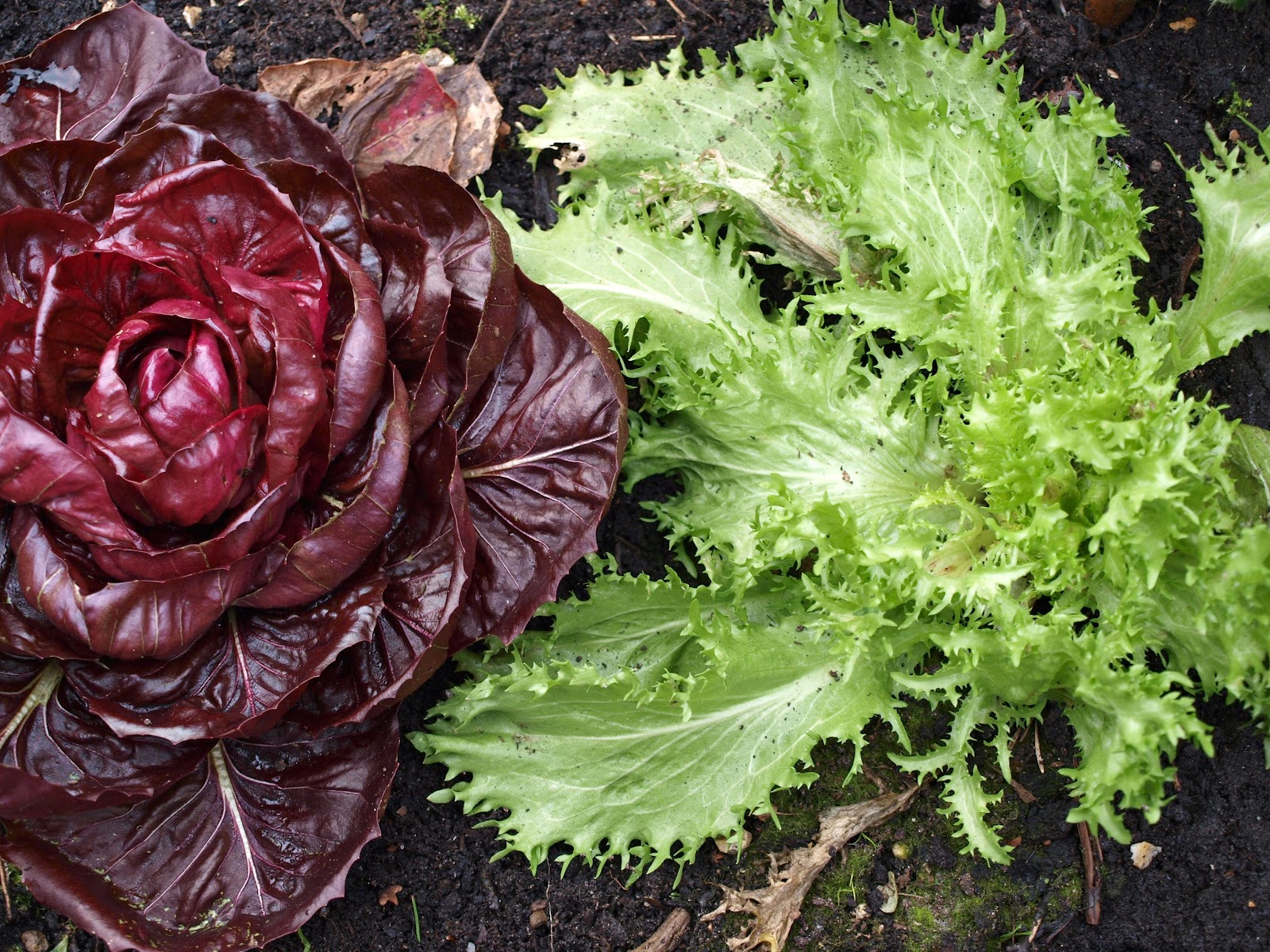
Elsewhere I have some Endives, some protected by individual cloches, some not. The next two photos demonstrate the beneficial effect of the cloche. In the first one you can see two plants growing very close together.


The one on the left is very ragged, but the one protected by the cloche is in much better condition.


This broad-leaved Endive is definitely beyond redemption:


This variegated Chicory is marginal. It might recover, but I somehow doubt it.


Whereas these two beauties were snuggled-up together under a single cloche keeping each other warm, such that they have not only survived, but also thrived.


Unfortunately for them thriving sometimes just hastens their demise!


At least this one has had a happy life!

My little patch of Land Cress is looking happy enough too. It fits conveniently under one of the bigger individual cloches, so it's well protected.


So all in all, things could have been a lot worse. And if I hadn't previously been convinced of the merits of cloches I certainly am now.


Wednesday, 15 February 2012

Some new Veg containers

It grieves me to pay loads of money for something that ought to be cheap. Why do plastic flower-pots, planters and other growing-containers cost so much? It's not as if they are a complex shape, or anything, and most of them are pretty flimsy. I think the assumption must be that gardeners have loads of money to spare and they will pay whatever the suppliers ask! In my case, Not So. I have been looking around for suitable alternatives, and have found a couple.

The first type is the wooden wine-crate. These are relatively rare these days, because most wines are packaged in cardboard boxes, but the "posh" ones still come in wooden crates. Making some enquiries in this respect I found that my local branch of Majestic Wine was prepared to help me. They don't get a lot of wooden crates, but they are not re-cycled either, so the staff were more than happy for me to relieve them of the responsibility for disposal. Unfortunately they only had two boxes available when I visited, but there is the promise of more to come. This is what I got:


As you can see, they are quite attractive items, though evidently made of fairly flimsy unseasoned wood. I don't expect them to last more than one year, but I reckon they will be ideal for growing things like salads, radishes or baby carrots. I have drilled a few holes in the bases and fixed a couple of battens to them. The battens will lift the boxes off the ground and allow excess water to run out better, as well as reducing the speed at which the wood will rot, by minimising surface contact.


My other useful find was a range of rectangular plastic crates sold as storage-boxes by Tesco. At only £1.67 each I thought these were a bargain. You can hardly buy a single pot-saucer for that sort of money, at a Garden Centre. Drill a couple of drainage holes in these, and you have got some very serviceable growing-containers.


Coincidentally I find that two of these will fit neatly into that wooden raised planter that Jane won for me last year:


So that's my carrot-growing arrangements for this year neatly taken care of then...

Some of you will have seen this one before. It is the container which held my Christmas tree.


I got this one (free) from my local butcher's shop. It previously held a huge quantity of Chinese Five-Spice Marinade, but I have washed it pretty thoroughly, and I plan to use it for growing a chilli plant in - I think the colour will be most appropriate!

Has anybody else out there found a good source of this sort of thing?