Tuesday, 7 February 2012

Frozen Veg

I'm re-publishing this post, so that I can enter it for Harvest Monday over at Daphne's Dandelions
I haven't had much of a harvest this week, and the reason is shown below...

*****************************************************************************

The temperature here is very cold still: about -10C at night, and hovering just above zero during the day.
The snow at the weekend was sparse and very short-lived here. A centimetre or so that disappeared within 36 hours - not like the start of 2011!


The soil, though thawing now, has been frozen hard, even under the cloches. This is not a time for gardening! Nor is this even a time for digging the plot. The soil would be very hard to dig. It's best to just wait for warmer times and let Nature do its thing. Actually a good hard frost can be a benefit to the soil, because it tends to promote the breaking-down of the bigger clods into smaller "crumbs", which will make a better texture for air and water retention later on.

I don't have many veggies left growing in my garden now, and those that remain are in a state of suspended animation. These photos were taken at the weekend:

Purple Sprouting Broccoli

Red Cabbage

Flower Sprout

I haven't been able to pick any salads or greens for about a week now. This is why:

Swiss Chard

Perpetual Spinach

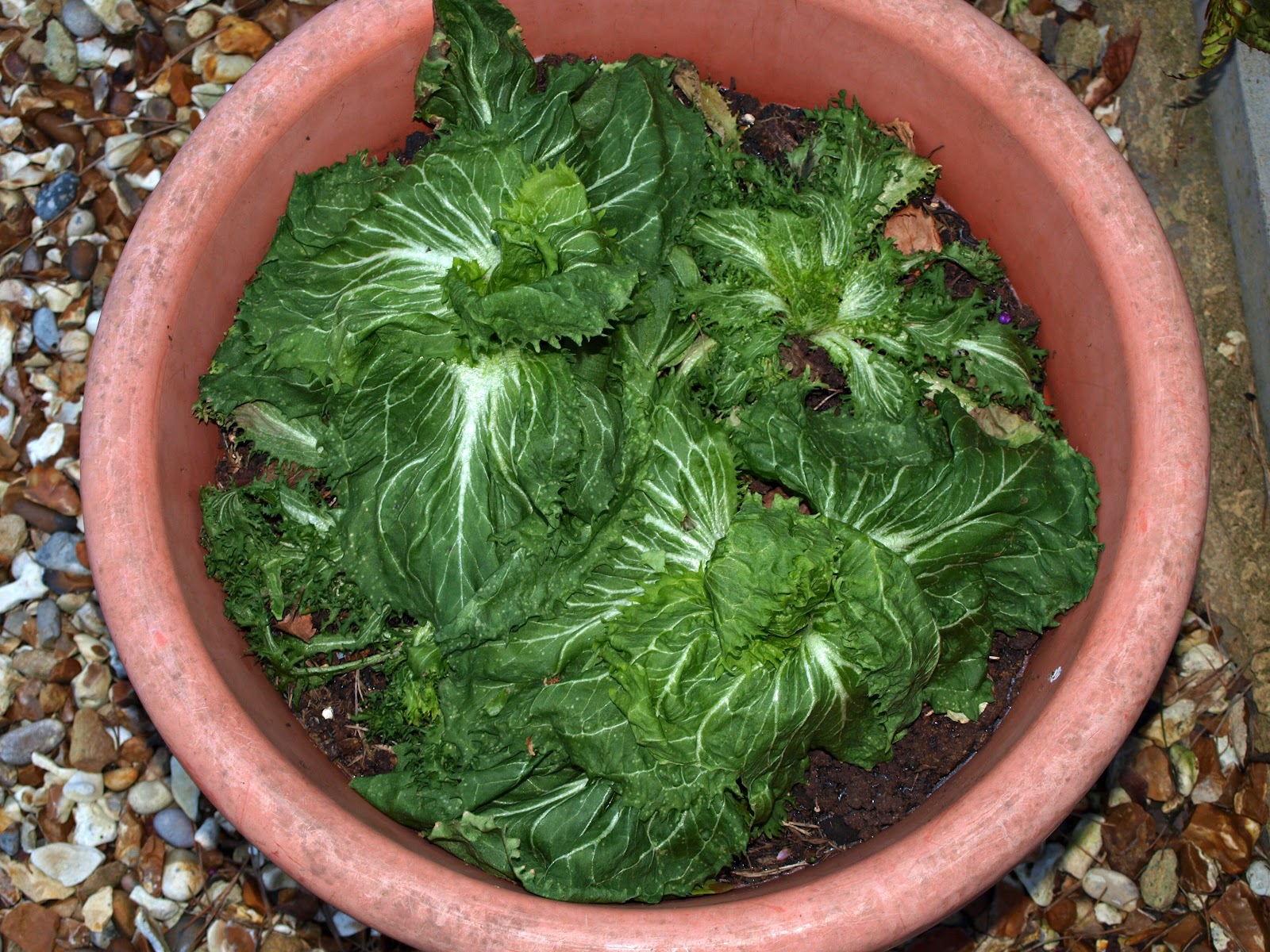
Catalogna Chicory

My pots of Wallflowers were in a similar state:

Wallflowers are members of the Brassica family - a hardy bunch - so they will probably survive.
When the temperatures rise again the hardier ones, like the Purple Sprouting Broccoli, may just de-frost and carry on, but I suspect that the softer ones like Endives and Chicory, may not recover.

There was a time when I would have brought my two potted Bay trees into the garage when the weather was like this, but these days they are so big and heavy I couldn't lift them, so they will just have to take their chances out in the open. Actually they will probably be all right as long as we don't get strong winds at the same time as cold temperatures. When cold and wind combine, Bay trees often suffer badly. Their leaves go brown and fall off, and in extreme cases the plants themselves may die.

Bay

Monday, 6 February 2012

Winter sunshine - a different quality of light

Here in the UK we have been experiencing a spell of really cold weather (by our standards...), but here in Fleet at least we have had a few hours of bright sunshine each day too. Winter sunshine is not like the burning heat of Summer sunshine. Even in its full glare it hardly warms you at all - but it looks nice.

In the morning the sunlight is "thin" and brassy. Not enough warmth in it yet to melt the frost on the grass. The still air in the distance here is full of steam rising from people's central-heating vents. (Very few people burn coal any more, so it's not smoke).


Here the morning sun shines through one of the cloches, illuminating the complex frost patterns:


I think you will understand why I grow Raspberries along this fence, which faces South-East.


This is the morning light catching the Rosemary bushes that you can just see in the foreground of the picture above. Rosemary is a native of the Mediterranean, so it will be wanting to soak up as much sunshine as it can get. It hates cold, wet conditions.


In the late afternoon the light is different. There is a certain quality about the light which makes everything glow, and the intensity of the colours seems to get turned up a notch or two. At this time of day the sunlight comes streaming round the side of my house and illuminates a patch of Dogwood plants in my border, almost as if they were under a spotlight:

Dogwood at the back, Olive at front left

Let me zoom in...


I hadn't consciously thought about the afternoon sun when I planted those Dogwoods, but in retrospect I'm very glad I chose that position for them.

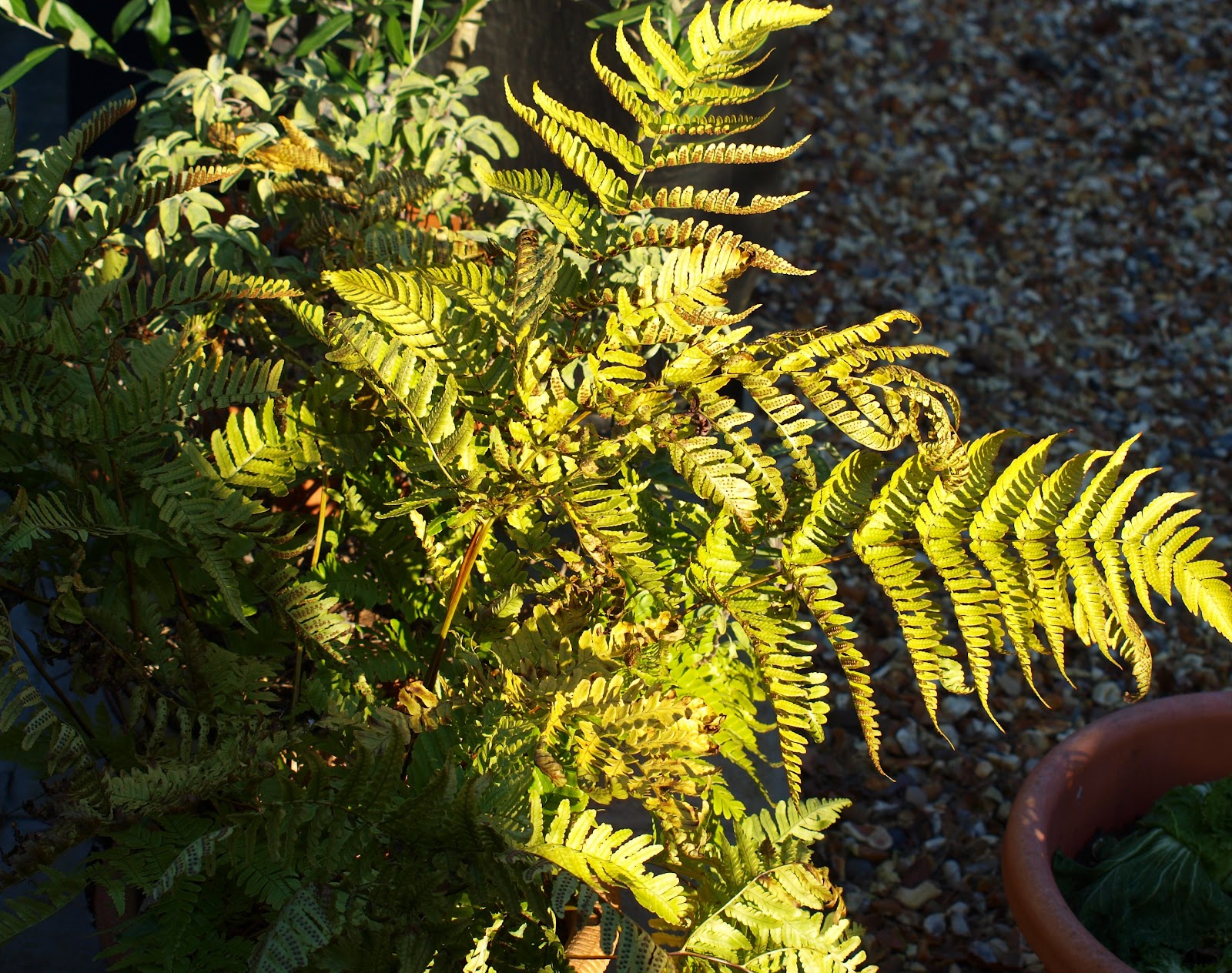
This Fern (Dryopteris Erythrosora) looks pretty green in normal light, but when the afternoon sun falls on it, it is bathed in gold.


In amongst the shingle around the tree-trunks, little Crocuses are poking their heads up. They won't open up unless the sunlight falls directly on them.


Yes, it looks nice, but I'm still very glad I'm sitting indoors with a nice warm cup of coffee while I write this!

Sunday, 5 February 2012

Taking pity on the birds

With the weather currently so cold, most sensible human beings are spending most of their time indoors, protected from the elements and warmed by central heating. Our friends the birds unfortunately don't have that option. Today I have been doing my bit to help them survive.

Female Blackbird


Since I didn't think I could persuade the birds to sunggle down out of the wind inside a fleece-lined box or anything like that, I reckoned that I could at least assist by providing some food and drink. I put out lots of bread, but I augmented this with a big dish of seeds for the ground-feeding birds to enjoy, as well as a handful on the hanging bird-table for the Tits and Finches that prefer to eat at a safe height above any marauding felines.


This seed mix has a lot of sunflower kernels in it, and those are by far the most popular with the birds that visit my garden. I love to watch the Tits feeding. They swoop down, grab a sunflower kernel and take it up into one of the branches of the "Fish tree", where they hold it firmly with their claws whilst devouring it with their beaks. Then rapidly back for another seed... They must eat dozens a day each. The only birds that actually eat sitting on the feeder seem to be the Goldfinches. The others prefer Take-Away.

Bluetit grabbing a seed


It's easy to forget that birds also drink as well as eat, and when the temperature is low it is often difficult for them to find water. My birdbath / drinking-water receptacle was frozen solid today:


I took out a kettle full of boiling water and melted the ice. The trouble is, I'll probably need to do this every few hours, because the water will soon freeze again.

I was I glad I only needed to be outside for a short while. I retreated indoors and made some Butternut Squash soup:


This soup is an old favourite. Very tasty and very quick and simple to make. Cook the Butternut in some light stock with some lightly fried onion and a bit of seasoning (I used a small quantity of Mixed Spice and two small chillis, along with salt and black pepper). After about half an hour, when the squash is really soft, allow it to cool a bit and then zuzz it up in a liquidiser. That's it.

I served mine with garnish of parsley and a little drizzle of our home-made chilli oil.

Saturday, 4 February 2012

Frost patterns - Nature's own artform

Sometimes Nature's form leaves me in awe. With our temperatures having barely climbed above zero for several days now, everything in the garden has been liberally sprinkled with fantastically-shaped frost crystals.


The most spectacular ones have been on the plastic bell-cloches:


The dark side of the Moon?


Stars?


Feathers?


Hairy spiders?


Snoopy's friend Woodstock?


This one shows air-bubbles suspended in a lump of ice:


Champagne Frappé?

  
I think I might make this one into a wallpaper pattern...


Snow is falling now. Nothing dramatic yet, just a few light flakes, but it's settling immediately because the ground is so cold.

Friday, 3 February 2012

Why not to sow too early

As I'm sure is the case with most gardeners, I'm always impatient to start sowing seeds. As soon as Christmas has passed I start thinking "any day now..", but this is idiocy really, because seeds sown that early will never do well in our climate. I suppose if you have a heated greenhouse it's different, but I don't, so I am trying hard to delay sowing until a sensible time.

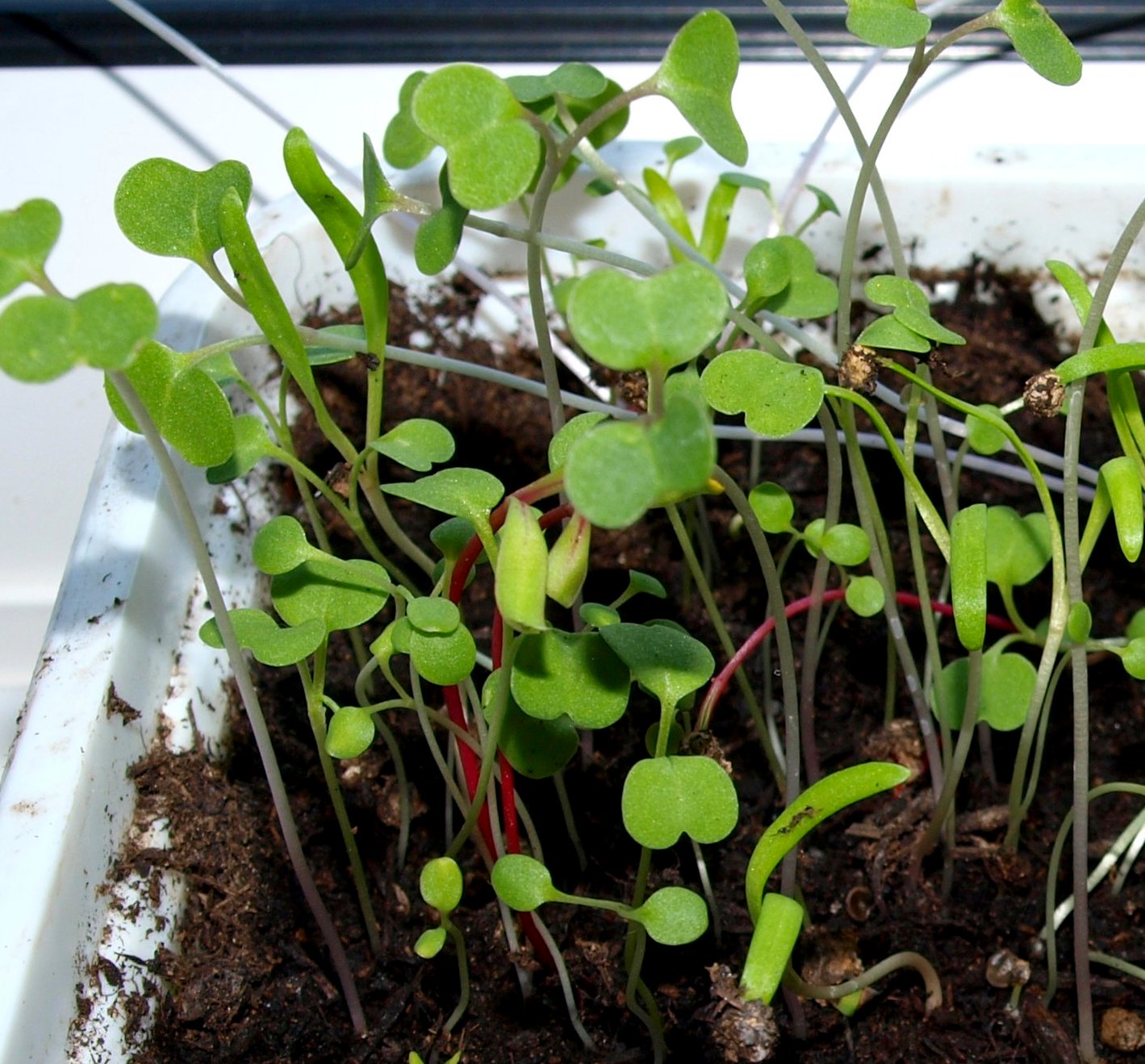
The other day I sowed a small container of Baby Leaf Salad seeds, just to test the situation. (Notice the use of a re-purposed large margarine tub as a seed-tray).The seeds germinated OK on a warm windowsill, but without the aid of artificial light they have rapidly gone leggy.


These are from a packet of "Californian Mix" by Suttons. I don't think this batch will ever be strong. Perhaps I'll use them like Mustard and Cress sprouts, or Microgreens... I think my trial has proved that it is still too early to sow, but at least it only cost me a few pennies to find out. Maybe in a couple of weeks time I'll have another go.


On a related note... The other day when I was sorting through my seeds, planning what to grow this year, I found several half-used packets of things I no longer wanted, or whose viability was suspect, so I tipped out the seeds in the place where I normally put out bread for the birds. Obviously the birds didn't eat all the seeds, because lots of them have germinated:


Looks like mostly Brassicas and Spinach. So does that prove that birds won't eat their greens too, just like some unhealthy humans? Now I bet if I had WANTED them to come up, they wouldn't have germinated at all...

Thursday, 2 February 2012

Brass Monkey weather

In my coarser days (i.e. in the Army) when it was really cold we used to say that it was "cold enough to freeze the b___s off a brass monkey". Well today is such a day. The temperature has certainly not risen above zero today, and I think that last night it must have been several degrees below. This is the "Roman Road" chestnut leaf I showed you a couple of days ago, now suspended in its frozen puddle:


I can usually get a pretty good impression of what the outside temperature is just by looking out of my window. When it is cold, the plants hunch themselves up - just like us humans:

PSP looking cold

The Swiss Chard is probably reminiscing about its Alpine origins (and regretting them):


I rather fear that some of the salads may be irretreivably frosted:

Chicory


Endives

The Euphorbia is also looking a bit sorry for itself, and the bracts are finally beginning to turn brown. Normally by this time of year I have cut back all the previous year's growth to make room for new shoots, but this Winter the plants have been reluctant to admit defeat:


Although it has been cold, there has at least been some sunshine. Here is my Dogwood "Midwinter Fire" illuminated by it:

Dogwood
This Dogwood is not particularly "fiery" in colour this year, so it is on the list for drastic pruning in a month or so. They say that you should prune Dogwood almost to the ground every 3 years or so, in order to re-invigorate it, so that's what I'm going to do.

Snow is forecast for the weekend...

Wednesday, 1 February 2012

Ferns full of potential

I have a couple of potted ferns, to which I have become quite attached. This is surprising really, since they acquired me rather than the other way round. I have had the older of the two for several years now (maybe 10?). It just appeared one day, as a very tiny little seedling. It has gone on to produce several offspring of its own, and it got so big that I divided it into two and re-potted it in the Autumn of 2010. The offspring have been planted out in the border. Right now they are resting:


They don't look very impressive at present. I have cut down all last year's foliage, so all that you can see is a a couple of rather scruffy brown lumps. They have both developed a similar shape. At one side are the dessicated bases of last year's leaves, while at the other are the well-rounded bumps from which new leaves will emerge in a couple of months' time, unrolling like coiled springs. Each bump is well protected from the cold by several layers of reddish tissue, vaguely reminiscent of the outer layers of skin on a dried onion.


I have left the leaves on the smaller plants growing in the border, in order to provide them with some protection from the elements. Unlike the moveable pots, they can't be tucked into shelter against the wall of the house.


Until fairly recently I wasn't very fond of ferns, but I've changed my mind. As long as you are not looking for gaudy flowers they have a lot to offer. High on the list of their advantages is the fact that many types of fern enjoy dry shade. I'm sure many people have patches of dry shade in their gardens and can't think of anything to plant in them, so ferns are a possibility worth looking into. They also seem to need next to no maintenance, and can easily be propagated by division. This type of mine seem to self-seed pretty readily too, so in a couple of years you can get quite a decent patch of them without having to spend loads of money. Ferns also come in many different shapes, sizes and colours, so there's something for everybody.