Wednesday, 25 June 2014

Cooking the first of the Broad Beans

A few days ago I harvested the first of my "Stereo" Broad Beans, and I want to describe here how we ate them.


Well, the first thing to say is that we did not eat JUST Broad Beans. I also used some of my "Red Duke of York" potatoes, and a batch of "Purple Top Milan" Turnips.


The veg was also to be accompanied by some Pork steaks, which I cooked quickly in a very hot griddle-pan:


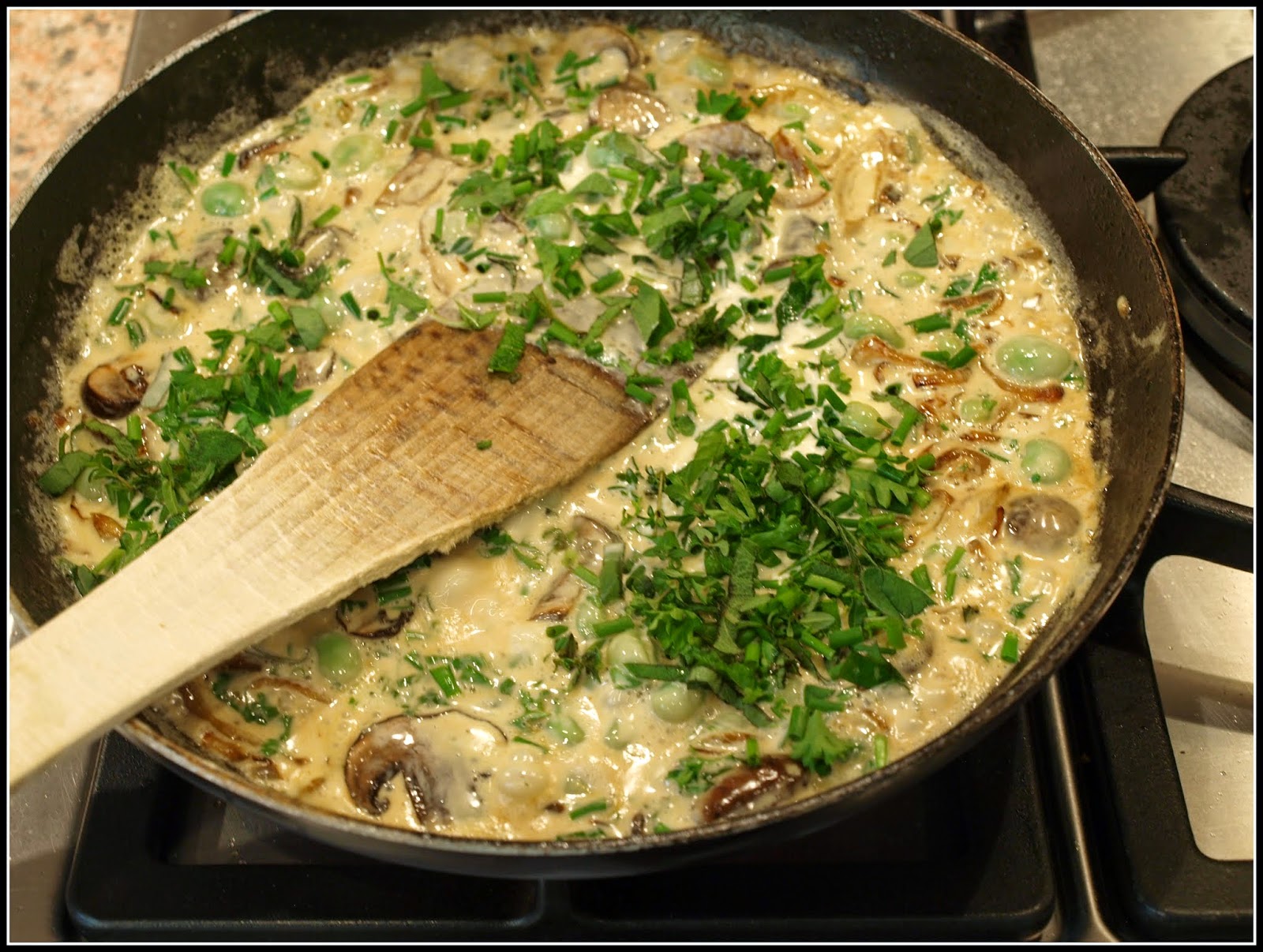
When I trimmed the pork I kept the trimmings and cooked them slowly in a frying-pan so that all the fat ran out. I then used this fat to cook some onions over a very low heat for about 45 minutes, before adding some sliced Chestnut mushrooms and cooking for another 15 minutes or so:


I cooked the Broad Beans in a pan of boiling water, for about 2 or 3 minutes only, since they went tender very rapidly. Actually you can eat them raw if you want. I then added about 200ml of Elmlea (low-fat cream substitute) to the onions and mushrooms to make a creamy sauce, and tipped in the cooked beans.


To this was added a very large handful of chopped herbs.


I used Chives, Sage, Parsley, Oregano, Mint, Thyme and Winter Savory:


While all this was going on, I boiled the turnips until tender - about 10 minutes, I think. Since they were such young ones I didn't peel them, but simply halved them and cut out the stalks. I had boiled and drained the potatoes earlier and left them to cool a little. When everything was ready, I plated up:


It was fortunate that this dish was nice and tasty, because it didn't score many points for "Presentation"! I wish now that I had kept back a couple of sprigs of Parsley for a garnish. The potatoes split a bit, and the red skins had peeled back somewhat, so I think next time I will halve them before cooking, which will reduce this problem.


It was all nice to eat, but the tender young beans in that unctuous savoury sauce were undobtedly the stars of the show!

We'll be having plenty more Broad Beans soon (though never enough!), so I hope to be able to describe some other ways of cooking them...

Tuesday, 24 June 2014

Broad Bean "Stereo"

This past week I harvested the first of my "Stereo" Broad Beans.


"Stereo" seems to be almost universally described as an "unusual" type of Broad Bean. In fact I have concluded that most businesses that sell this bean have started with exactly the same piece of text, and just altered one or two words! By unusual I think they mean "small". The Stereo variety produces plants that are smaller and thinner than any other variety I have grown. Height at maturity is about 4 feet.


The flowers are also unusual in that they are plain white rather than the usual bi-colour.


 When the pods set they point upwards:


The pods never get very big - only about 10 or 12cm long.


They usually contain 4 or 5 beans:


The beans are small, green and very uniform in size:


I found that they cook incredibly quickly - literally about 2 to 3 minutes. The cooking process made them go an even brighter shade of green. I'll describe how we ate them in another blogpost in a day or two.


I have been researching Broad Beans in general, and I was intrigued to see several websites advocating picking pods regularly (e.g. 2 to 3 times a week) to stimulate the production of further pods. Now, I have been growing these things for years and I have always found that the flowers (and hence pods) all come at more or less the same time. Occasionally you get a small second flush if you cut the stalks right down and let them re-generate. Could it be that these people are assuming that Broad Beans operate the same way as Runner Beans or French Beans? What is your opinion?

Monday, 23 June 2014

Harvest Monday - 23rd June 2014

Last week I reported that I had picked the first few of my Strawberries, but had been unable to show you a photo of them. Well, this week I have real evidence!


I have only a small number of Strawberry plants, so I am never able to harvest them in large quantities, so the ones I do have tend to be eaten immediately or perhaps added to a batch of bought ones. I think you will agree though that deficiencies in quantity are compensated for by superior quality. Those ones are certainly fine specimens, and oh did they taste sublime or what??


I have been continuing to harvest Lettuce - by the barrowload! This is another of the "Green Oak Leaf" ones, and it was absolutely enormous:


As well as the "Green Oak Leaf" I have harvested "Cervanek" and "Can-Can". I like to mix several varieties into the same salad if possible, to give a nice mix of colours and textures.

This week has also seen me harvesting the first of my Broad Beans:


That is 552g of Broad Bean "Stereo". This variety produces small pods - these are about 10cm - and they normally have 4 or 5 beans in them. However they are reputed to be the finest-tasting Broad Beans of all. It is often advocated that you eat the pods very young, as if they were Mangetout peas.

I have harvested more potatoes. This lot is "Red Duke of York", the last of my four First Early varieties:


For the record, that is 781g, the produce of two pots, each with one seed tuber.

Since I need the space for my rapidly-expanding tomato plants, I dug up the two pots of "Sharpe's Express" potatoes too. These were the ones I left to grow on after manually removing most of their tubers. The second crop was small, and the tubers nowhere near as clean and blemish-free as the first ones, but it still produced 325g, which is worth having. They will look better after I've given them a scrub.


In addition to all this, I pulled my first few Turnips. These are mostly "Purple Top Milan", but the big, flatter one at the front is "Atlantic":


I'm very pleased with the harvest this week. It's nice to have a wide variety of crops, rather than lots of the same thing.

This is my entry to Harvest Monday, hosted as ever on Daphne's Dandelions, so why not go across and see what everyone else has been up to...?

Sunday, 22 June 2014

Contaminated compost

The other day I was singing the praises of some composted stable manure that I bought earlier in the year, but I have changed my tune now. I am fairly sure that it is contaminated with aminopyralid weedkiller. This type of weedkiller is used by farmers to control weeds on pastureland. Animals grazing this land ingest the weedkiller (which does them no harm), but it is passed through into their manure - some of which evidently makes its way into commercial compost!

I won't attempt to explain the whole saga in detail, because that has been done before - most notably by Sue Garrett on her blog Our Plot At Green Lane Allotments - but I just want to provide some evidence that although this issue is supposedly a thing of the past, it isn't. In theory, according to regulations introduced in 2010 manure which potentially includes this type of weedkiller should be retained on the farm of origin, but it appears that this does not happen in every case. I bought 12 bags of  composted stable manure in March of this year, and used most of it in the big pots I am using for growing tomatoes and potatoes. I also dug some into my raised beds as a soil-improver.

The main symptom of contamination is distortion and malformation of plants stems and leaves, particularly at their growing points:


The leaves are thin and spindly, often described as "fern-like", and are curled inwards.


In potatoes the leaves adopt a distinctive "cupped" configuration.


The plants most susceptible to this type of damage are tomatoes, potatoes, peas, beans, phlox, delphiniums and roses. Fortunately, everyone seems to agree that food crops affected by this type of weedkiller are not harmful to either humans or animals, though it is accepted that yields are likely to be poor and some fruits (e.g. the tomatoes) will be malformed.

As it happens, my potatoes this year have been very good so far (I have only harvested First Earlies, not Second Earlies or Maincrops yet), so I am not too worried if the leaves are a bit distorted, as long as the crop is OK. Tomatoes are another matter. Evidently the weedkiller took a while to be absorbed by the plants, because their lower leaves are normal. However, the upper parts of the plants are thin and straggly, and I don't see them producing much of a crop.


It's not all bad though, because the first truss on each plant seems to be forming OK. Many of my plants this year are Beefsteak varieities, well known for thier irregular shape, so I was fully expecting some ugly specimens! This, for instance is "Noire Charbonneuse".


This is "Dinnye":


And this is "Banana Legs", which has elongated yellow fruits:


My Runner Beans are planted in a raised bed that was treated with the suspect manure, but so far have shown no signs of being adversely affected. I hope they will be OK.

At this present minute I am awaiting a response from the supplier of my compost, so I don't want to say much about them, but I won't be shy of naming and shaming if it appears they are involved in any malpractice. I have also been in touch with Dow AgroSciences (the manufaturer of the weedkiller), who have promised to take this up directly with the supplier.

If you are similarly affected, or just want further information, here are some additional resources:

Dow AgroSciences have an email address for reporting issues of this nature. It is UKHotline@Dow.co.uk
They also have a website giving further information. It is called Manure Matters

The Royal Horticultural Society have some useful advice on the issue. You can find it HERE

And of course Sue has compiled lots of evidence and advice which she has published here: http://ossettweather.com/glallotments.co.uk/manure7.html. If you are affected by this issue, please let her know so that she can add your details to her database.

In the meantime, I shall be doing everything I can think of to mollycoddle my sick plants and help them through their troubles. This begins with adminstering a dose of Comfrey Tea!

Saturday, 21 June 2014

What's in the garden today?

The Philadelphus is late flowering this year. Normallly I expect it to flower in mid-May, but this year it has been about 3 weeks later than usual.


Last year I cut the bush back very hard, and it grew lots of new branches, which are now covered in blossoms.


Near the micro-pond I have three or four Hardy Geraniums. This delicate pale one is flowering at present, in amongst the unruly seed-heads of the Red-veined Sorrel.


This cheeky Purple Sage has decided to spoil the symmetry of the big fern growing next door:


The very first Sweet Pea flower is just showing some colour. My Sweet Peas have grown very slowly, but in the last couple of weeks they have responded well to the higher temperatures. If I grow them again I think I will sow them much later. There is practically no sign of the first ones I sowed; they almost all died, I think because the weather wasn't right for them, whereas the second batch have done a lot better.


I have stopped harvesting Asparagus for this year, and I am just leaving any spears that come up now to form fern. This will allow the plants to regain their strength over the Summer. The crop this year, although not abundant, was the best I have ever had, so I won't be digging up the Asparagus just yet after all.

After their shaky start, the Runner Beans are looking fine now, and the first flowers are beginning to appear.


The Broad Beans are just about ready for harvesting. The yield will probably be OK but not outstanding. I'm not sure whether the "Stereo" pods will get any bigger than they already are - which is small. What I have read about them seems to indicate that the pods will not go above say four or five inches long, and will contain maybe 5 beans.


As they usually do, the Blackfly are wading into the tips of the bean plants with gusto:


I'm not particularly fussed about this, because it doesn't affect the plants much at this stage of their developmment, and we don't eat the leaves so the Blackfly are welcome to them.

Some of my "Purple-top Milan" Turnips are nearly ready too. The biggest ones are about the size of a golf ball now.


I wasn't able to devote much space to Turnips, so we won't be eating many of them, but they do make a nice occasional treat. The "Golden Ball" ones which I sowed between the Carrots and Parsnips have disappeared from sight completely, swamped by the luxuriant vegetation of their neighbours, so I don't think they will bulb-up. They will probably just go long and thin in their frantic search for light.

It also won't be long before a couple of Sweet Peppers are ready. These first two set very early - before the infamous hailstorm - so they will mature well before any of the other peppers or chillis.


Fortunately the other chillis and peppers seem to be recovering quite well despite the considerable damage sustained by their leaves, so I should get some fruits, albeit later than would otherwise have been the case.

"Ohnivec"

Finally for today, I leave you with a photo of this year's first bloom on my "Sunset Boulevard" Rose:


When in tight bud, as here, it looks red, but when the flower opens out it will be much more apricot-coloured inside.

Friday, 20 June 2014

Raising the roof

As you probably know, I'm growing Carrots and Parsnips in my big Woodblocx raised bed. Well, their foliage had become so luxuriant that it was pushing up against the Enviromesh cover. I felt that this would not be good for them, so I decided to "raise the roof".

This is the "before" shot:


And this is the "after" shot:


The raising was achieved by using hoops made of pairs of 1.2 metre length flexible plastic rods tied together to make an overall length of about 2 metres. The ends of these rods are fed into aluminium tubes which are pushed deep into the soil of the bed. When I bought the Enviromesh earlier in the year I deliberately bought a very big piece because I anticipated this expansion, so it was easy enough to unroll a bit more of the mesh to cover the bigger hoops.

Since the cover was off for a while, I took the opportunity to have a good look at the crops underneath. A few of the Carrots (the ones sown first) looked as if they were about to bolt. The stems were beginning to thicken, and I know this means that a flower-stem is about to shoot up. So I pulled them up, reckoning that if we were ever going to eat them it was now or never:


Here's a view that shows the thickening of the stems to which I referred:


Can you see that the stems are about the same thickness as the shoulders of the root? At this stage, they will be edible, for sure (I've tried one!), and they will go into a "Risotto Primavera" that Jane is going to make, along with some Asparagus and some Broad Beans. A week later they would probably be tough and woody.

I'm not illustrating any Parsnips, because so far there is nothing much to see apart from leaves, which I feel may be too unexciting! Having said that, it was nice to see that the leaves are still largely unblemished. Often by this time of the year they are criss-crossed with the tunnels of Leaf Miners, but not so this year. I don't know how Leaf Miners arrive, but maybe the Enviromesh has kept them out?