Saturday, 7 May 2016

Basingbourne Park

Regular readers will have seen me post once or twice about Fleet Pond, a very high-profile local amenity (in fact, the main reason for the existence of Fleet as a town), and our local piece of heathland called "Velmead Common", but surprisingly I have not hitherto written about Basingbourne Park, which is more-or-less right on my doorstep.


Basingbourne Park is a piece of green space in amongst residential properties, just two or three hundred yards from where I live. Today I explored it - something I have failed to do in the past. I have often scratched the surface of it, but until now I hadn't realised how extensive it is.


Walking around this park you see glimpses of what the area must have been like before the 20th Century houses were built...


Until recently this area has been relatively inaccessible because it is quite boggy, but there are now some proper made-up paths which make it much easier to get around. The paths seem to be made from "chips" of recycled vehicle tyres!


In places, the ground is still very boggy. This area looks almost like a padi-field with the bright green grass coming up through the soggy ground:


Some areas have been cleared to let more light in...


But it's nice to see that most of the mature trees have been retained. I particularly noticed how many of the big trees had been equipped with nesting-boxes for birds (or perhaps bats?)


Although this park only extends to a few acres, I was amazed by how diverse its flora is. As well as large Pines and the ubiquitous Birch, almost all the traditional old English trees are represented - Oak, Ash, Beech, Chestnut, Hazel...


Oak

Mountain Ash or Rowan

Beech in amongst Birch

Chestnut

Hazel


Because the park is surrounded by residential areas, there are lots of "feral" plants, many of them edible...


Currant

Raspberry

Cherry


Of course there are lots of lots of wild edible plants too...


Garlic mustard or "Jack in the Hedge"

Nettles

Hairy Bittercress


Brambles / Blackberries


There are lots of flowers too...


Bluebell

Dandelion

Herb Robert

Stitchwort


Gorse / Furze

Finally, a couple of photos that don't fit neatly into any category...


Oak galls, aka Oak Apples

Ivy


This modestly-sized area of woodland is a fine example of what we call a "Green Lung" in our very built-up neighbourhood. Much of its maintenance is done by a group of volunteers, to whom all credit is due. Who knows, now that I am retired, I might join them...


Hart District - in which the biggest settlement is Fleet -  has several times been voted in a national survey the best place in the UK to live, and this is partly due to the existence of parks and open spaces like the one I have described here. Our area is under enormous pressure from Central Government to build more residential housing. I just hope this will never be done at the expense of precious resources like Basingbourne Park.

Friday, 6 May 2016

Shuffling things around

The advent of some warmer weather has prompted me to do a bit of re-arranging in the garden. Until now, my First Early potatoes have been in the two "seedling greenhouses", but with the risk of frost much reduced I felt that it was time for them to give way to more deserving occupants - chillis and tomatoes.


Potato plants in the seedling greenhouses


So now I have put all my potato containers in a row, in such a way that I can easily run a length of fleece over them if  the night is going to be very chilly.


The potato plantation!


As regular readers know, I potted-on my tomato plants a couple of days ago, and now I have done the same with the chillis, which were beginning to outgrow the little 3-inch pots in which they had been raised up till now.


Of course this means that they take up more space than before, and it would be a lot more difficult for me to bring them indoors now. From now on their home (at least during the night) will be one of the seedling greenhouses.


The tomatoes will "sleep" in the other greenhouse. During the day the greenhouses can get very hot, even with the covers open, so I prefer to put my plants out in the open. Furthermore the greenhouses are positioned next to the house, so the amount of direct sunlight they get is limited. If I put the plants on the patio table they get sunlight almost all day long.


I will be keeping a particularly close eye on the weather forecast over the next week or ten days, because I generally like to pot-up my chillis and tomatoes into their final containers in mid to late May, but I don't want to do it if the weather is going to turn cold again.


These are some of my chilli plants:


"Ring of Fire"

"Puma"

"Panama 4"


Thursday, 5 May 2016

Some decent weather at last!

After a cold, gloomy April, the first few days of May have been a welcome contrast. Daytime temperatures have been about 10 degrees warmer than last week (that's Celsius, too, not Fahrenheit!), and although the nights have not been warm at least we have had no more frost. I'm still bringing my tomato and chilli plants indoors each evening, but during the daytime I have an unfamiliar challenge - stopping them getting too hot!


As you know, I have some little plastic mini-greenhouses, in which I normally keep my seedlings during the day in Spring-time, but they do get very hot very quickly when in direct sunlight and unless you are careful the plants could easily suffer. On Tuesday, for instance, we went shopping during the morning and I left the greenhouses partially closed because the air temperature was only about 10C. When we got home at about 1130 the temperature in one of the greenhouses was 44C. The plants inside it were chillis and tomatoes, which like warm conditions, so they don't seem to have come to much harm, but I reckon if I had left them an hour longer they would probably have died. Less heat-tolerant plants would not survive that sort of temperature.
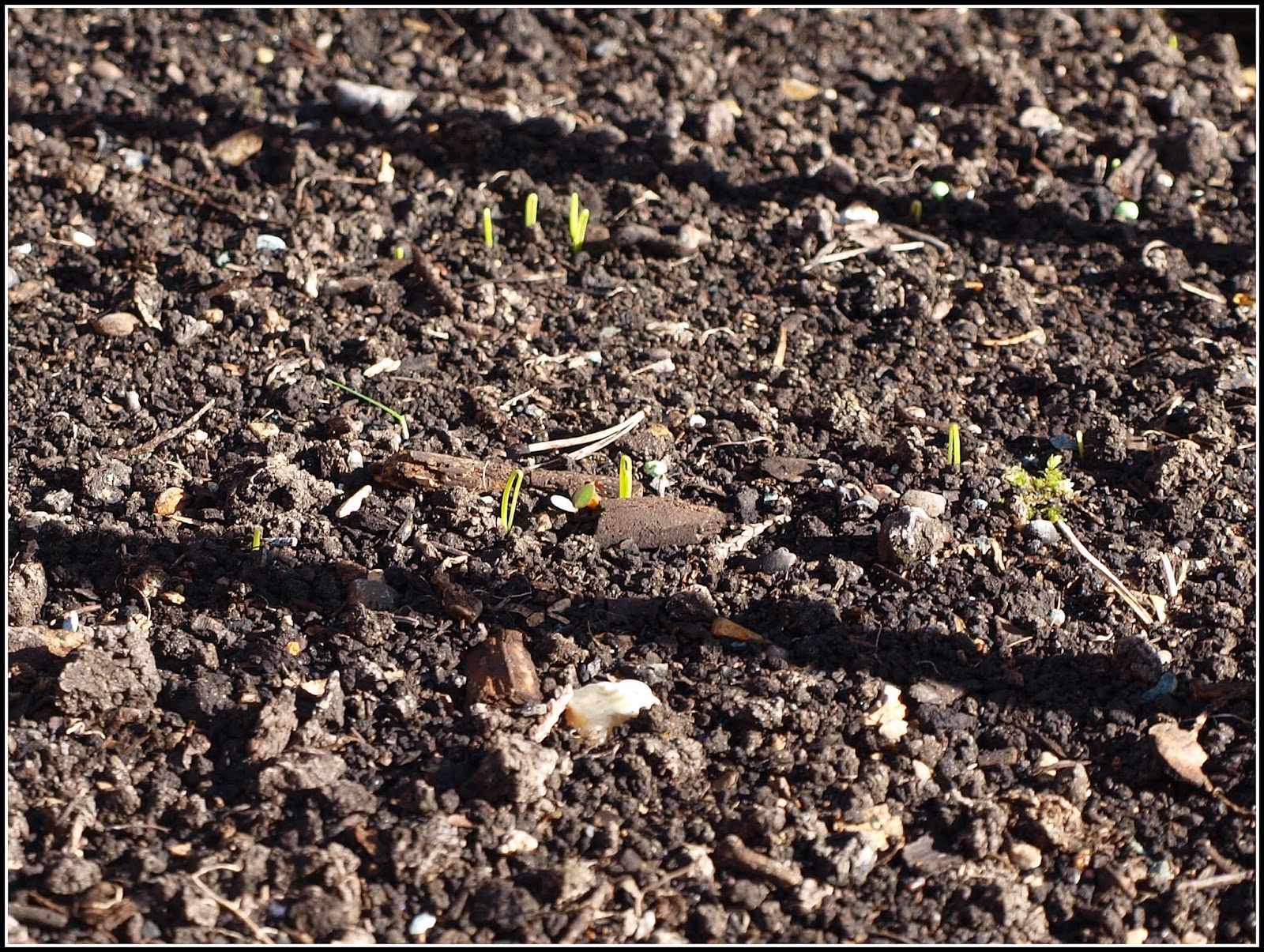
The rising temperatures have spurred into life some of the seeds I sowed last month and at the end of March, like these Spring Onions:


I sowed three short (1.2m) rows of Spring Onions on April 9th, protected by a cloche, and for the past couple of weeks I have been anxiously scanning the soil for signs of their arrival. Well, there's no doubting it - they're up now.

In the past I have not had a lot of success with Spring Onions (they seldom reach a good size), but last year I grew some whose seeds I had bought in France, and they did much better, so I have sown the rest of the pack this year. They are "Rouge Commun" by Vilmorin seeds. I think perhaps one of the keys to success with Spring Onions is ensuring they get enough light. I have often tried to squeeze them in amongst other salad plants, which have swamped them a bit, so this year I'm trying hard to avoid this.
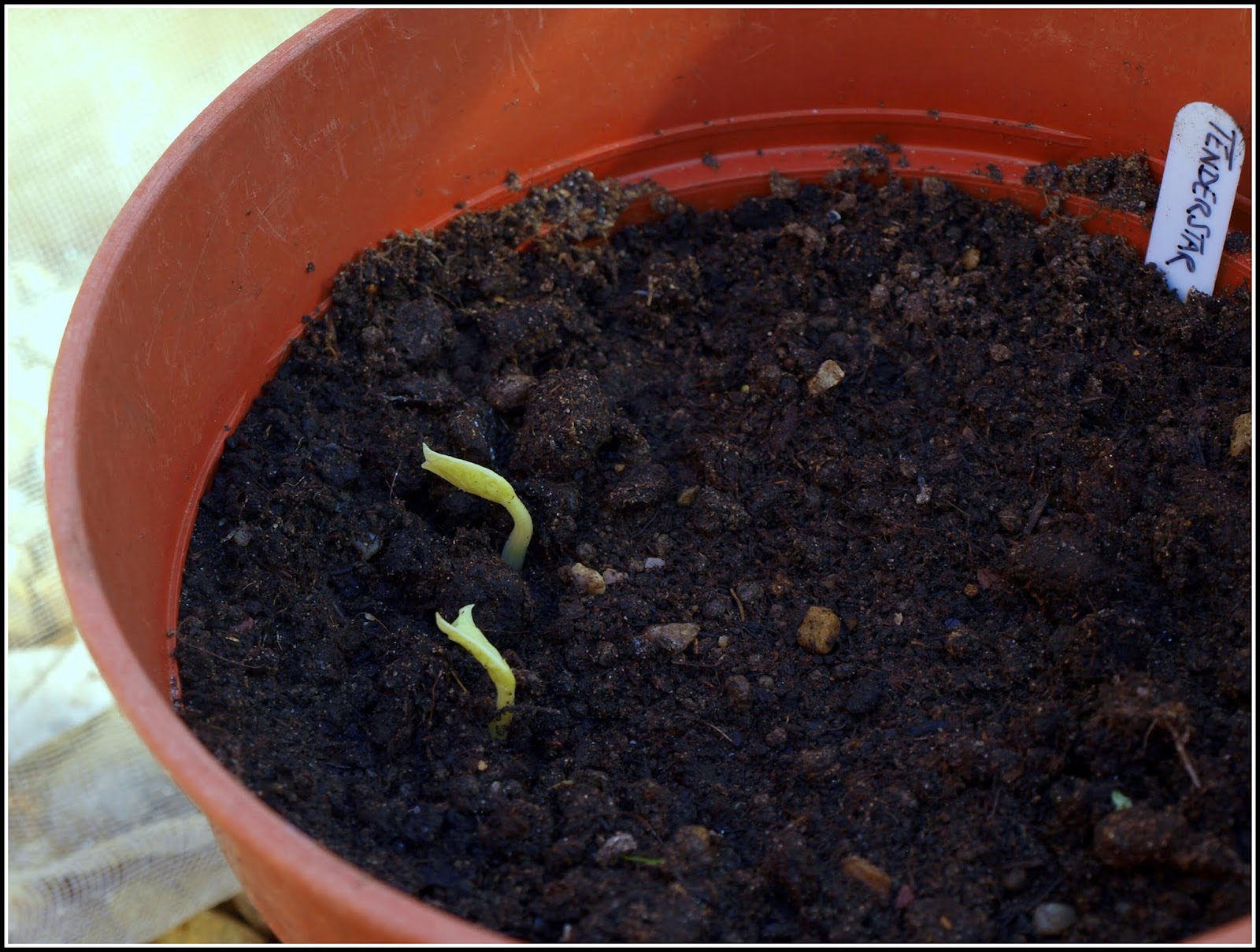
I am also pleased to report that my beans have begun to germinate. As described a couple of weeks back, I sowed seeds for five different types of bean. The first ones to show through are the Runners - "Tenderstar" and "Streamline".


My reason for starting off the beans in pots is that I can protect them from frost better than if they were out in the open - in other words I can bring them indoors if necessary. It's hard to predict with any degree of certainty when our last frost date is likely to be, but it will probably be mid- to late-May. If I were to delay sowing my beans until the danger of frost had passed, my harvest would be about a month later - and of course, like all gardeners, I'm keen to get harvesting as soon as I can!


Next on the list of recent germinators are my cucumbers. In true Mark's Veg Plot style, I have hedged my bets by sowing three different varieties - "Diva", "Passandra" and "Mini Munch" - plus a couple of Cucamelons (aka Mexican Gherkin). I'm not sure about the latter, but last year I saw many people writing about having grown them, so I thought I ought to see for myself what they're like. More to the point, the lovely people at Marshalls sent me a pack of seeds to try, and it seems churlish not to give them a go.


The cucumbers are understandably very small still, but then I don't plan to plant them out until at least the first week of June, and even then it will be under cloches.


Yesterday I mentioned that I had begun to see butterflies in my garden, mostly Brimstones. Well, today I spotted this tiny blue one resting on a potato leaf.  Having looked this up, I reckon it is a female Small Blue - apparently the UK's smallest butterfly.


Wednesday, 4 May 2016

The Brussels Sprouts are in

My Brassicas bed is fully planted-up now - 12 Cabbages and 3 Brussels Sprouts.


I have planted my 3 Brussels Sprouts down the middle of the bed, spaced about 50cm apart. They are one each of "Napoleon", "Bosworth" and "Brilliant". Even when you're growing a small number of plants it makes sense to "hedge your bets" and have plants of several different varieties, so that if one type doesn't do well it's possible that another will. My three will mature at different times as well, which spreads the harvest over a longer period.


As you can see, my seedlings had reached the stage where they had two pairs of proper leaves, which I think is the ideal size for transplanting. If you leave them in little tiny pots for too long they can sometimes run out of nutrients and go weak and spindly.


Each plant is protected with a home-made collar cut from scrap cardboard, offering some protection against Cabbage Root Fly.


Once the planting was complete, the net went back on, to keep the butterflies off. With the advent of warmer weather these last couple of days I have begun to see the odd one or two butterflies, though thankfully no Cabbage Whites just yet. The ones I have seen are mostly the yellow Brimstones.


Tuesday, 3 May 2016

Potato progress

Here's an update on how my container-grown potatoes are faring.


Unsurprisingly, the ones under cover are the furthest advanced:


"Lady Christl" 2 x 2

I have two plastic greenhouse things (officially called "Seedling Greenhouse"), each with two big 35-litre pots in it. Each pot holds two seed potato tubers - 2 x "Nicola", 2 x "Nadine" and 4 x "Lady Christl".


Curiously, the Second Early varieties are a lot bigger than the First Early ones which were planted a week earlier. This is "Lady Christl" (First Early). One of the plants (bottom right) is particularly small or slow to develop:


"Lady Christl" x 2


This is "Nicola" (Second Early):


"Nicola" x 2


The potatoes that have not benefitted from protection are a long way behind the protected ones. This is predictable and deliberate, because I want to be harvesting new potatoes over as long a period as possible.


This is another pot of 2 x "Nicola", with the shoots just a couple of inches tall. I'll be earthing them up in the next couple of days. They were planted 8 days after the other two of the same variety. Compare this photo with the previous one and you'll see the effect of providing protection.


"Nicola" x 2

Meanwhile, the other Second Earlies (the later-planted "Charlotte") and Early Maincrops ("Pink Fir Apple") are only just showing through:


"Charlotte" x 2

"Pink Fir Apple" (one per pot).


April has been a strange month as far as the weather is concerned, with temperatures much colder than average for the time of year, lots of wind, and surprisingly little rainfall. In conditions like these it is particularly important to water container-grown potato plants frequently. They will not do well if their soil is too dry.


Things are going pretty much according to plan in the potato department, and I think we're on track to be harvesting the first tubers in early June. The first week of June is my target.

Monday, 2 May 2016

Tomatoes - the "intermediate" stage

My way of growing tomatoes has the plants living in three different containers at three different stages of their lives, which of course means two transplanting operations. I have just carried out the first of these on this year's batch of plants.


I sow the tomato seeds in those tall thin Elmlea pots, of which I am so fond, and keep them in a warm place (the airing-cupboard usually) until germination (about 4 days later).


After spending about two weeks in the Growlight House, the young seedlings get their first taste of Outdoors when I take them outside for a couple of hours on a still sunny day (if there is one!).


At this stage, light is even more important than heat. Without it the plants will go long and thin. Mine are borderline this year - certainly skinnier than I would like, but then I don't control the weather...


For the next three weeks or so the plants spend as much time as possible outside, weather permitting, and are brought in at night. By this time they will be starting to outgrow the Elmlea pots, and the nutrients in their compost will be fading, so it is time to do the first transplanting.


Ideally, the plants should go into pots that are deep enough to allow them to be submerged right up to the level of their first leaves, but unfortunately if I were to use pots of that type they would be too big to conveniently allow me to bring them indoors when necessary. For this reason I usually put them into pots that are 15cm in diameter, like this:


These are "conventional" pots, and are about as tall as they are wide. Most pots you see on sale in Garden Centres and supermarkets are of this type. The Elmlea pots are 11.5cm tall, so when my tomato plants come out of the Elmlea pots, their roots already go down about 10cm+, so in the new pots they are at approximately the same level in relation to the soil surface  - although of course they have a lot more room to spread out. This is not ideal. Deeper would be better, because tomato plants will develop additional roots from any part of the stem that is under the soil, and more roots make for a stronger plant.


What I really want is pots like this, especially the green one.


These two pots are much taller than usual, in relation to their diameter. The green one is 23cm tall and 15cm wide. The black one is 20cm tall and 18cm wide. In other words, both pots would allow me to plant a tomato much deeper than usual. I have looked for pots like this, with a view to buying some, but I haven't seen any on sale. I have a suspicion that the green one once held an orchid plant purchased from Tesco or somewhere similar! I think I must search on the internet and get some before this time next year (it's too late for this year).


So, for the time being, my tomatoes have to go into a miscellaneous collection of pots of various sizes:


Fat ones, thin ones, black ones, green ones, terracotta-colour ones - whatever is available!


In another two or three weeks the tomatoes will go into their final homes, and a second transplanting operation must take place. The exact timing of this depends a lot on the weather, because once they go into their enormous containers (with their 1.5m canes) I will definitely not be able to bring them indoors any more.


This next photo is from 11th May 2014. I think this year's plants are not going to be that big in just ten days from now.


I've started preparing the growing medium for filling the big pots. This year I really don't want any more problems with contaminated compost decimating my tomatoes, so I am not having any products from Westland! I am making a mix comprising three elements: some of the Norfolk loam (for bulk), some home-made compost, and some of that "Sylvagrow" peat-free compost I wrote about the other day. I will also add pelleted chicken manure and "Growmore" general-purpose fertiliser, so if there is any justice in this world I should have a good crop of toms this year!

Sunday, 1 May 2016

Slow progress with the peas

Well, I suppose the good news is that we (unlike most parts of the country) have not had snow this week. Hail, yes. Wind, yes. Freezing temperatures, yes. But no snow. Phew. But the plants in my garden are growing very slowly, and who can blame them. It's hardly like Spring just yet.


My peas are the classic example. I had been hoping that by now they would be romping away up those pea-sticks I gave them, but No, they are still just a few inches tall.


Some of the earlier-planted row are beginning to make a few tentative steps towards climbing, and I have done my best to encourage them by tying them to the sticks with some soft string:


Others are sending out speculative tendrils, looking to support themselves upright in the face of the seemingly incessant wind.


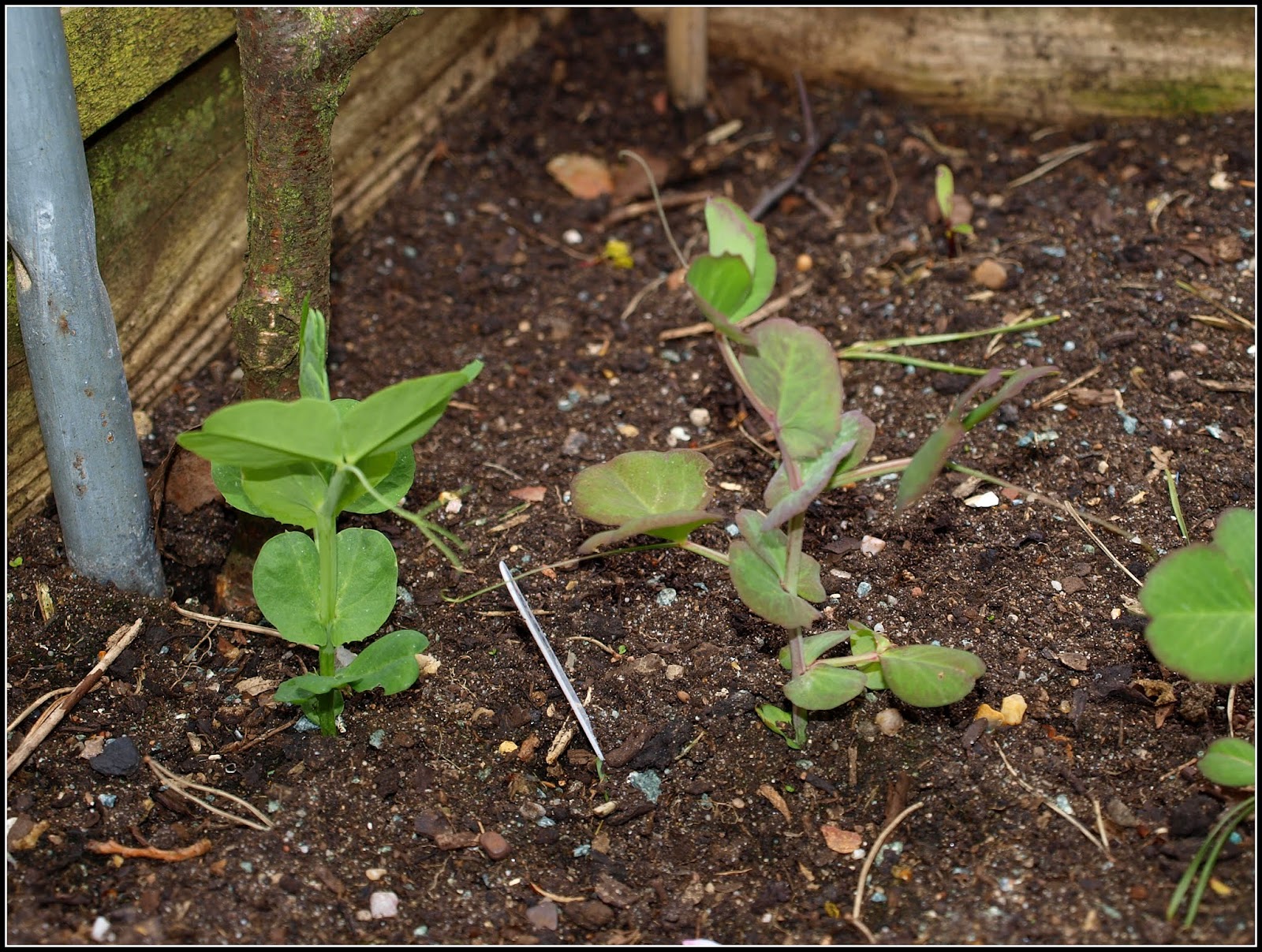
I had a shock the other day when I saw that some of the plants had turned blue. I thought it must be caused by the cold - but them I remembered that some of them are "Desiree" purple-podded peas, and their foliage is purple-ish too!

"Desiree" on the right; "Terrain" next to the metal pole


Spring is the worst time of year for badger-inflicted damage, so I have protected my peas with chicken wire. It hasn't been 100% successful, because the blessed things still manage to get their snouts in at the corners!


One of the pea plants looks like this:


I'm not sure what has caused the browning of the leaves. It could be frost I suppose, but if that is the case, why has it only affected one plant and not the others?


You may remember that most of my peas are ones that I grew in pots prior to transplanting them. I did however sow two complete rows direct in the soil of the raised bed. Only a very small number of these ever germinated (I think it was 5), and they look very weak plants. You can see two of them here:


One is at the base of the stick at left of photo, and the other is near the stem of the purple "Desiree" plant in the centre. Pathetic, aren't they? If the peas go on to produce a decent crop I shall certainly be using the "sow in a pot and then transplant" method again next time.


If I had more space, this is the time when I would be sowing another batch of peas, to extend my harvest, but everywhere is either full or "spoken for". One of the big new raised beds is still empty, but it's soon going to have beans in it. ["Soon" is a relative term, you understand...]