Saturday, 6 September 2014

Chillis - a September update

My chillis didn't like the cold wet weather in August. They would have been expecting some nice warm sunshine to help them ripen fruit, but they didn't get it. I'm hoping that September will be better!

Most of the plants have managed to ripen one or two fruits, but none have had many yet - with the exception of the two "Nosferatu" plants I kept from last year, which of course had a head start. The one plant of this variety which I grew from seed this year has been the slowest of all to develop fruit, and none of them are ripe yet.

"Nosferatu", on a plant from last year

Immature "Nosferatu"

This is "Ring of Fire", which I had planned to be my "Maincrop" variety, producing regular red chillis of a decent heat for use in the kitchen. One of the two plants has produced only a very small number of small, mis-shapen fruits. The other has fruits like this:


I had expected them to be longer and thinner. Certainly that's what the seed-packet suggests. I think both plants must have been badly affected by the contaminated compost issue that has given me so many issues this year. In fact the same can be said for all of the chilli plants. This is one of this year's Nosferatus - not a pretty sight!


This is "Aji Limon", whose fruits will eventually be lemon yellow, though at present they are green with brownish purple streaks. Apparently this colouring may be the result of a significant temperature drop. I think that sounds very likely.


These are "Ohnivec". Lots of big sturdy fruits, with a nice level of heat. I like them! The ripening process takes them from creamy yellow, through purple, to orange and then to red. Very nice.


 This is "Red Jalapeno". The first fruits, ripe now, were almost spherical, but the later ones have developed into longer, fatter specimens. I haven't tried eating any, but they look good.


This is "Red Habanero".


I'm particularly pleased to have got some of these to ripen, because I thought the plant was going to die. It is one that I kept from last year (bought very cheaply in an end-of-season sale), and it got seriously lacerated in a hail storm, subsequently shedding all its leaves and starting again. The rip fruit in my photo looks as if it is round, but it isn't. It's just that it is angled away from the camera.

This is the one I nicknamed "Redfields Small Red", subsequently identified as "Demon Red"

"Demon Red"
 It is a very compact plant, and has a mass of tiny fruits, many of which are now turning red via brown.

"Demon Red"
This is "Explosive Embers", another very decorative plant, small enough to be grown indoors on a windowsill.

"Explosive Embers"
 Some of the fruits are turning red now - although I don't think you can see any in my photos.

"Explosive Embers"

This is another one grown from seeds brought back from Turkey. For want of an official name, I have called it "Turkey Small Thin Red", which describes it pretty well!

"Turkey Small Thin Red"

"Turkey Small Thin Red"

Then there is this "Bird's Eye" chilli, the one rescued from the pack of chilli-related food products that Jane won.

"Bird's Eye"
It has never been a particularly strong plant, and at one stage it came within an ace of being thrown in the compost bin. However, it has belatedly produced a large number of tiny flowers, and has set a couple of fruits. Whether they will ripen before the Autumn arrives in earnest is another question...

"Bird's Eye"

 This is "Piment d'Espelette", basically a sweet pepper with just a tiny bit of heat.


I'm not keen on eating peppers, and Jane only eats the odd one or two, so these will probably end up being given away, but I liked growing them. They are just a bit different. The seeds came from a Facebook friend in Belgium, and I don't think you can buy them in the UK (certainly not easily.)

Now we have "Turkish Sweet Pepper" (my nickname). These were popular with my family last year, so I grew two plants. One has been very late to develop, and one has been OK. This fruit is on the OK one. Looks like it will be red very soon.


The other plant set some fruit at a reasonable time, but they have just sat there doing nothing at all. Not rotting or falling off, but also not expanding or ripening either. They are still tiny, and I don't see them coming to maturity before the frosts come along.


Finally, there is the sweet pepper "King of the North".

"King of the North"

This plant is also very compact. I'm not sure whether this is normal. And the fruits look a bit pointier than others of this variety whose photos I have seen on the internet. Anyway, Jane seems to think it tastes OK, so that's the most important thing.

"King of the North"

Friday, 5 September 2014

Radishes - a minor success

I'm usually able to grow radishes fairly successfully in my raised beds, but I often struggle to get them to grow in pots. They usually bolt before bulbing-up. A few weeks ago I had sudden urge to sow some radish seeds, but there was no room in the beds, so I rather reluctantly sowed some in some pots of compost. I sowed one on 27th July and another on 2nd August, hoping to get a staggered harvest. Each pot only held about 20 seeds.

Whether it was due to the weather (August was awful), or whether I used two different types of compost, I don't know, but they fared very differently. The first lot was initially nibbled by a caterpillar when they were still small, which nearly wiped them out, but fortunately they recovered though they then developed very slowly, producing some very dense, strong-flavoured radishes that were only just edible. The other lot, sowed a week later were completely different and very much better. Here is photo of the two pots side by side:


Since Jane is going away this week to spend a few days with our daughter in France, I wanted to harvest the radishes before she disappeared, even though they are mostly still on the small side. Here you see the evidence that I did indeed grow them in a pot:


There were only about a dozen that were worth picking, but in my eyes that is nonetheless a significant victory!


See, there are a couple of very nice ones in that bunch. They are "Cherry Belle", by the way.


I don't think this is going to persuade me to regularly grow radishes in pots, but at least it proves that it can be done.

Thursday, 4 September 2014

Clipping the Lavender

Clipping Lavender after it has finished flowering helps to keep it compact and less "leggy". Even as the last of the flowers fade, new growth will be appearing beneath the old foliage.

Here you can see the tall straggly flower-stalks towering above the foliage. These need to come off at a level just below the top of the leaves. The best way to do this is with a pair of hedge-shears. It only takes a moment that way. A more precise way to do it, if you have only a few plants, is to cut each stem individually with secateurs.


In this next photo you can clearly see the difference between the old and the new foliage. The old leaves are long and yellow, whereas the new leaves are small and silver-grey.


Despite your best efforts to keep them trim, it is more-or-less inevitable that after a few years your Lavender plants will develop long tough woody stems, and it is probably best to replace them.


Some varieties of Lavender self-seed quite readily, such as this "Hidcote" (below).


 These are little seedlings of "Hidcote" that I recently extracted from a nearby pot of Blueberries.


As you can see, I have put the seedlings into separate 3-inch pots, in which I will grow them on, under cover in a coldframe if necessary, until they are ready to go into bigger pots next Spring.


Another way to propagate Lavender is to take cuttings. All you need to do is cut some woody shoots about six inches long, strip off their lower leaves and push them into some moist compost, and just leave them in a sheltered place until they take root - which could be anything from a couple of weeks to a couple of months.


For some unknown reason cuttings placed around the edge of a pot tend to root better than ones placed in the centre. Does anyone have a theory about why this should be?

This year I have more than doubled my stock of Lavender plants, and at no cost at all. Next year I expect to get a good display.

Wednesday, 3 September 2014

Sausage and lentils with roasted squash

Saturday is normally my day to prepare Dinner. During the week Jane does most of the cooking because I'm usually out at work. This is last weekend's offering.


For quite a while now I have been wanting to do a dish involving green lentils. I had nothing specific in mind - I just wanted lentils. They don't have a lot of flavour of their own, but they are very good at taking on flavour from other ingredients, and of course they have high nutritional value and contribute lots of fibre.

My lentil dish started off 8 hours in advance, by soaking the dry lentils. I then simmered them gently for about 35 minutes until they were soft. (Remember, don't add salt to pulses like lentils until after they are cooked, otherwise they never go tender). I rinsed the cooked lentils and then put them in a pan with enough chicken stock to cover them to a depth of about an inch. Meanwhile I cooked up a "soffritto" of finely-diced carrots and onion, with the addition of some of the mature stalks of my Celery Leaf plants. Normally of course, one would simply add "proper" celery!


Once the vegetables were cooked but not browned, I added them in with the lentils and stock. I then brought the stock to the boil and turned off the heat. This meant that the lentils would slowly absorb the flavours, without cooking any further. I am a big fan of home-made chicken stock, which we always make with the leftovers whenever we have a roast chicken. In my opinion good stock is the key factor in most soups, stews and casseroles.

Meanwhile, I prepared some polenta. I made it up very thick (NB: use a non-stick pan if you are doing this), so that it would solidify when it cooled. I added a generous quantity of snipped fresh chives to give it more flavour. When it was done I turned it out onto some non-stick paper arranged on a baking-tray, and roughly flattened it to a depth of about an inch, before putting it in the fridge to cool.


Later, just before dinner-time, I cut the polenta into large rectangles prior to frying it in vegetable oil until crisp and golden on the outside, but still soft in the middle:


Before serving it I grated a little Parmesan cheese over the top of the polenta.


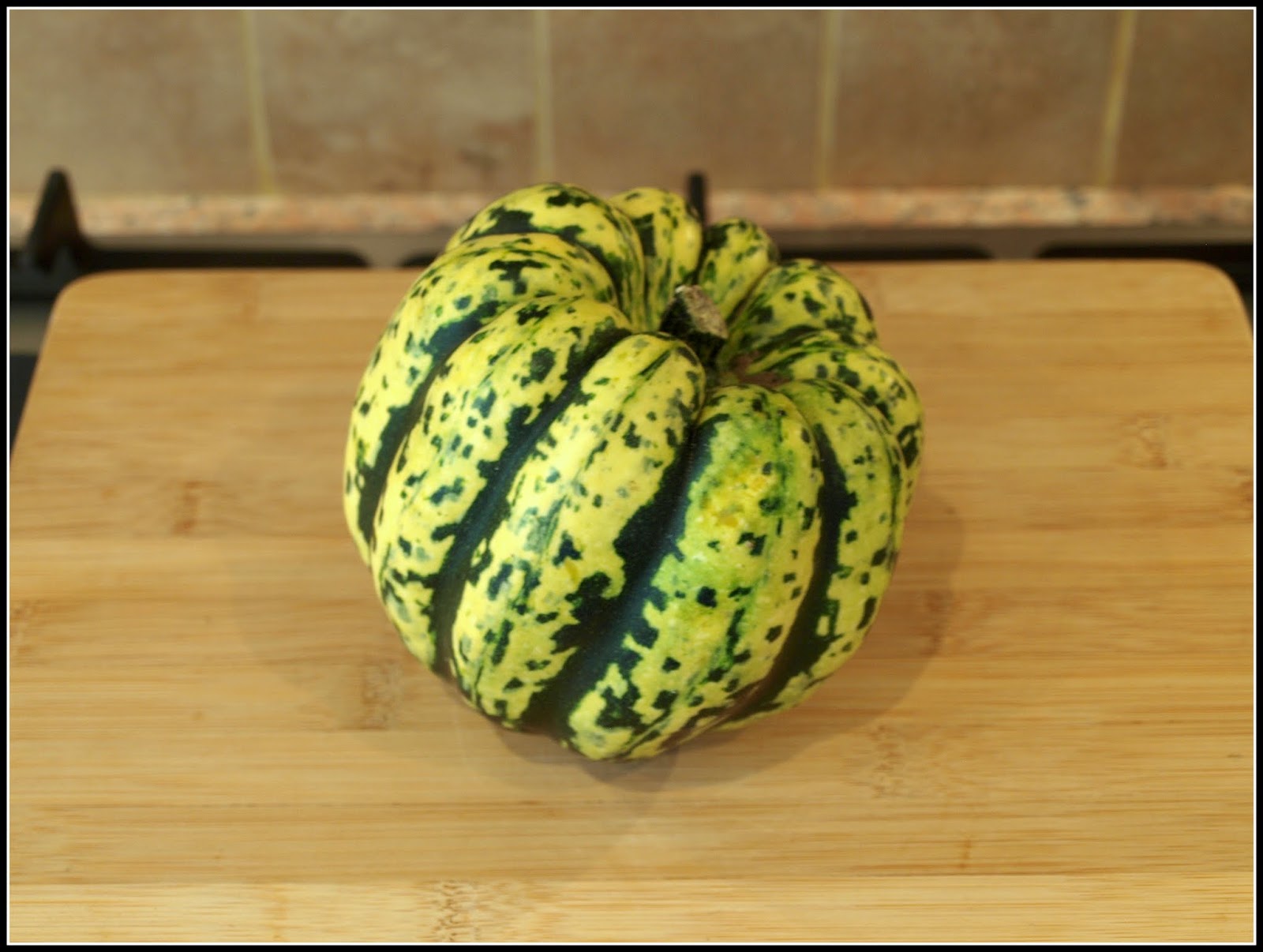
The third main element of the meal was some roasted squash. I confess that I bought this one, because I have not got any squashes in my own garden. It is a "Harlequin":


I cut it, using the ridges as a guide, into thick wedges, which I then doused in olive oil, before placing them on a baking-tray and adding ground black pepper and a few chilli flakes.


The squash was then roasted at 170C for about 40 minutes, by which time it was nicely brown.


I didn't know exactly what to expect from a Harlequin squash, because I have never cooked one before. I had expected it to go quite soft - like Butternut would - but it didn't. It remained firm, rather like the texture of a nice baked potato, and the flesh was dryish and nutty in flavour. Even though the skin went very brown, it was good to eat - just like potato skins.

About a quarter of an hour before serving time, I started to slowly warm up my lentils, and at that time I added the sausage:


This was pre-cooked ready-to-eat sausage, the smoked version (made by Mattessons, and widely available in supermarkets). Incidentally, this is a great product to have in your fridge as a stand-by, because it has a very long shelf-life.


Although the preparation of this meal may have sounded complicated, each part was very easy to do. Furthermore, none of the timings was critical. For instance, the polenta could easily have been kept warm for a while if necessary, and the lentil and sausage dish likewise.

So here we are then - the finished dish:


In retrospect I wish now I had done something green to go with it - maybe some beans or a few florets of broccoli - because the overall effect is a bit "monochrome", but nevertheless I was very happy with the tastes and textures. The crispy cheesy polenta contrasted nicely with the soft lentils, and the nutty, floury squash with its crunchy skin was an interesting addition to the overall effect. I have to say though, that without the depth of flavour contributed by the chicken stock, those lentils would have been much less satisfying!

Tuesday, 2 September 2014

Vegetable art

I enjoy making my harvests look good, and presenting them nicely. I don't produce a lot of anything, and I feel that some good photographs can help to compensate for this! Here are some photos of my harvest from a couple of days ago. See what you make of them...


This is the sort of harvest I like best - a mixture of lots of different vegetables.


What do you think of this double-headed beetroot? I've never seen one like that before.


My style of gardening doesn't involve growing vast quantities of any particular crop. Instead I like to have just one or two of several things. There are some exceptions: this year I had 26 pots of potatoes, though I deliberately chose many different varieties so that they would mature over a long period. I also usually grow more Runner Beans and Tomatoes than we can consume fresh, so some of those get preserved - either by making into sauce (tomatoes), or freezing (beans).


This is the sort of basketful of goodies with which you could tempt a novice gardener to have a go at growing veg, surely?


The baskets I use for posing the photos come from our local charity shops, and seldom cost more than a pound, but I think they add a certain attraction to the photos, don't you? This big shallow one is especially good because it allows me to spread things out so that everything is visible.


Someone suggested recently that I should go into business selling photos like these printed onto canvas and framed. Do you think people would like something like that hanging in their kitchen? And more to the point, would they buy it?

Monday, 1 September 2014

Harvest Monday - 1st Sept 2014

Over the Bank Holiday weekend and the early part of last week, we had really atrocious weather. Prolonged heavy rain, and temperatures much colder than normal for this time of year. We had a night-time temperature of 3.7C one day last week! Autumn has come early this year, it seems.

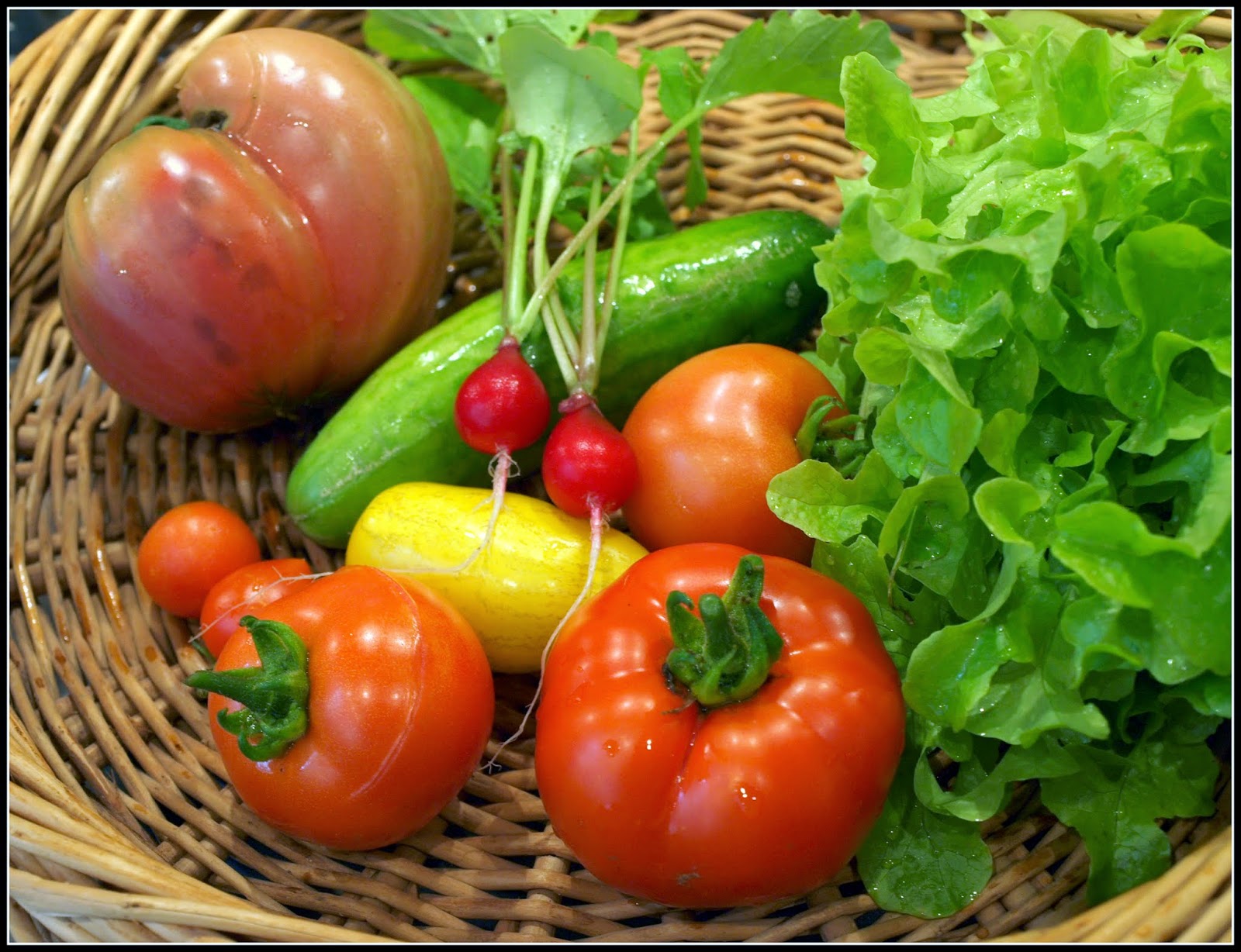
Despite all this, I have continued to harvest salads, even though it feels as if I should be harvesting Leeks, Swedes and Brussels Sprouts:


The tomato harvest this year has been slim (you already know why, I'm sure), but the Lettuces keep on coming, as do the Cucumbers.


As you can see, I also picked two Radishes. Well, I know that doesn't seem too impressive, but for me it's a significant victory, because they were grown in a pot. In the past I have had little success with growing Radishes in pots. They generally bolt before bulbing-up. This time it looks as if most of them might (might) be OK. Let's hope those first two are a sign of things to come.

I had to pick some of the tomatoes before they were ripe, because they had split after the heavy rain. I felt that it would be better to bring them indoors and try to ripen them in slightly warmer conditions. This one is a "Noire Charbonneuse" beefsteak, grown from seeds sent to me by my friend Eddy in Belgium. When ripe (as I hope it will eventually be), it should be a deep brownish red.


The "Autumn Bliss" raspberries are trickling in again. Never enough of them, but individually mostly  nice specimens, although a few of them have been attacked by the Raspberry Beetle, which leaves them with dry brown patches. This batch was only about 100g.


This batch was a bit more like it - 270g.

"Autumn Bliss"

I picked what will probably be the last significant lot of Blueberries, since there are only a few berries left on the plants now. This lot was 420g.


On the day when I picked that last batch of Raspberries, I also picked some Runner Beans, a Radicchio and a "Predzvest" Cabbage.


The Cabbage was not a brilliant specimen. It hadn't really formed much of a heart, but it was beginning to go tall and lanky (shielded from the light by a bigger sibling), so it had to come out. The Radicchio ("Palla Rossa di Chioggia") was a decent one though. Its crunchy texture will make a nice change from Lettuce in our salads.


And then there were the Leeks... Ta dah!!


I'm very pleased to have been able to produce those. I know it's not a big achievement, but it does feel good when you manage to grow something that you have not grown before, and they turn out right!


This is my entry for Harvest Monday, hosted as ever by Daphne's Dandelions, so pop over now and see what everyone else has been up to...