Monday, 7 July 2014

Garden Share Collective - July 2014

Well, if May was a planting month, June was certainly a harvesting month. It was the month in which I got my first big harvests of the year. Stars of the show this time were the potatoes. The quality of the tubers this year is amazingly good, which I put down to the fact that the potato plants have been grown in composted stable manure. Not a sign of Scab, and hardly a blemish of any sort.

My favourite is "Charlotte", a very reliable and prolific Second Early, with waxy oval tubers. An excellent salad potato.


In the Good Looks department, "Red Duke of York" probably wins:


But "Blue Kestrel" is also a strong contender.


Early in the month I had a few "Purple Top Milan" Turnips - tasty, but far too few!


The Lettuces this year have been amazing. Some of them scored very well in terms of size, like this "Green Oak Leaf" one:


Whereas others were more notable for their quality - such as this "Devin":

During the month I had the first of my Carrots. Just a few though; they were ones that were in danger of bolting. I'm leaving most of them to mature further before harvesting them.

The Broad Beans were all harvested within the month. I had a good crop this year, and we particularly liked the variety "Stereo" (on the right, below), which produces small but very tender and tasty beans.


In the UK everyone associates June (and the Wimbledon tennis tournament) with Strawberries!


I don't have much space to devote to Strawberries (I grow them in black plastic crates), so I'm never going to have a big harvest, but what they lack in quantity they make up for in terms of quality.

The biggest news this month from my garden is unfortunately not good. As I'm sure many readers are already aware, I have had a major issue with weedkiller-contaminated compost which has caused all sorts of deformities to occur in many of my plants, particularly the beans, chillies and tomatoes.

Tomato plant deformed by weedkiller contamination in compost

Chilli plant deformed by weedkiller-contaminated compost
This issue has definitely been a big setback, but it's not a disaster, and I expect to get at least a small crop from even the worst-affected plants. We had had high hopes of a bumper harvest of tomatoes (dreaming of such a glut that the freezer would be stuffed full of tomato sauce...), but sadly that is not going to happen. Nevertheless, these don't look too bad, do they?


There's lots of promise elsewhere too. The Runner Beans have reached the tops of their canes, and have produced loads of flowers. No pods yet, but I'm fairly sure that this time next month I'll be reporting that I have harvested a decent quantity.


You can also see in that photo above that I have stopped harvesting Asparagus, and am now leaving it to develop fern so that it builds up strength for next year.

The Brussels Sprouts are continuing to develop nicely, protected by their net from the Cabbage White butterflies.


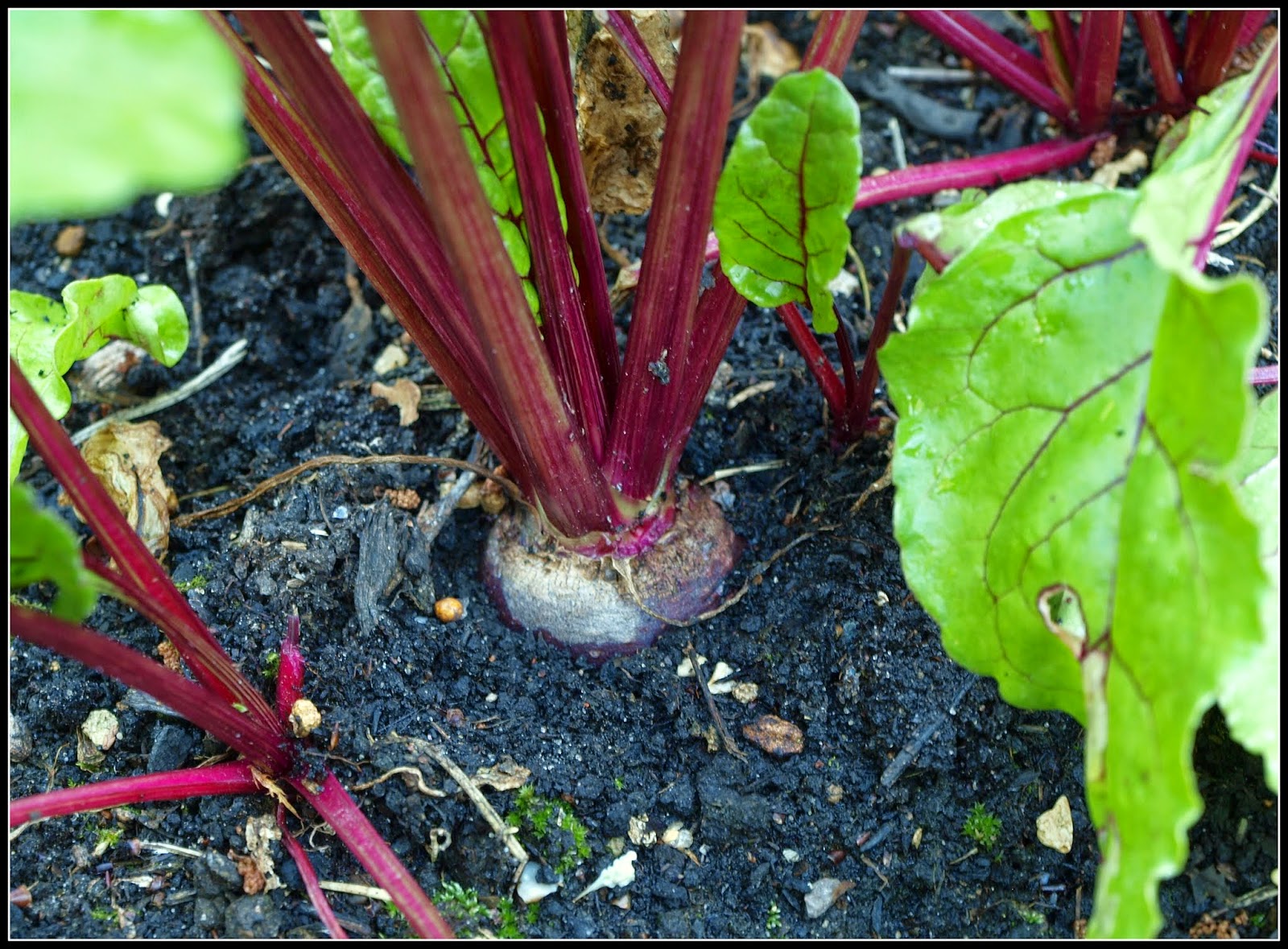
This is the "Winter Veg" bed, with Swedes (left), Leeks (centre), and Cabbages (right). There's a row of Beetroot visible in the nearer bed too.


This is a part of the "Nursery", where I have lots of little Lettuces, Endives, Chicories etc coming on for successional planting when space becomes available. Growing space doesn't stay idle for very long in my garden during the Summer-time!


Harvested in June:
Potatoes
Lettuce
Broad Beans
Strawberries
Turnips
Spring Onions
Asparagus
Lots of herbs

Planted in June:
Lettuces
Endives
Radicchio
Swede Turnips

Sown in June:
Lettuce
Endives
Radicchio
Mesclun

This is my monthly entry for The Garden Share Collective.


See you here next month!

Sunday, 6 July 2014

Potatoes. Not all good-looking ones!

This year I have been trying several varieties of potato that I have not grown before, just to see what they are like, and to judge whether they are ones I would like to grow regularly. This is the latest one, "Balmoral":


They look even nicer when they have been washed...


"Balmoral" is a Second Early potato, with a waxy texture. Apparently it is particularly good for baking or boiling. The ones I have grown have produced tubers much bigger than any of the other First Early and Second Early varieties, so they will probably be ideal for baking.


 Although I am not personally into "Growing for Showing", I think this variety would be a good candidate for the showbench.


At the same time as lifting these "Balmoral" potatoes, I also harvested some more of my old favourite "Charlotte":


As you can see, although most of this batch were as clean and unblemished as all the others I have grown this year, there were two VERY wierd ones. These are the good ones:


And these are the wierd ones. Aren't they disgusting?


Naturally, my inclination is to conclude that they are the result of the same weedkiller contamination that has affected my tomatoes, beans and chillis. However, it seems strange that (thankfully) so far it is only these two that have been anything other than perfect, so could this be caused by some sort of disease, maybe? What do you think? Ever had anything like this before?

Saturday, 5 July 2014

The King is dead. Long live the King!

I'm trying hard to achieve seamless succession of the salad crops this year (hence the title of my post). I have already written several times about my lettuces, but now I want to introduce a couple of new members of the dynasty.

This is "Little Gem" - a classic Cos or Romaine type. Not mature yet, but beginning to heart-up:


This is "Fristina", a frilly "cut-and-come-again" type.


This is something that will go well in a salad with those lettuces - Beetroot "Boltardy".


The photo makes it seem quite big, but right now that beetroot is only the size of a large marble.

This is a tomato type that I have nicknamed "Japanese Purple". The seeds were given to me by a friend. The wording on the packet is in Japanese (which I don't understand), and the picture shows tomatoes that are distinctly purple in colour - hence the name.


And most salads benefit from the inclusion of a cucumber or two, so here's "Iznik F1":


And here are few of the junior members of the family, awaiting their turn...


Just visible at the bottom of the picture is a green pot with some Landcress seedlings in it, and above that, in the black pot, are a few Lamb's Lettuce / Corn Salad seedlings. Most of the others are Endives, Radicchio and Lettuce.

These are the babies of the family...


That's four different types of Endive. Notice how many seedlings there are. That's because the last lot I sowed did not germinate well. I thought "This time I'll sow LOADS of seeds and some of them are bound to come up." I think they ALL came up. I'll have to drastically thin them out very soon, because they won't enjoy being crowded like that.

Friday, 4 July 2014

Some strange tomatoes

The weedkiller contamination in my compost is causing a few deformities in my tomatoes.  However, looking on the bright side, at least it looks as if I will get at least some tomatoes, even if the yield is poor.
Many of the varieties I am growing this year are Beefsteak ones, well known for the irregular shape of their fruits, but "Gardener's Delight" is NOT one of those. Despite some very strange-looking "flowers", this plant is still managing to set some fruit.

"Gardener's Delight"

Many of the "Orkado" fruits, normally regular and round, are developing a waist!

"Orkado"
"Ferline" is also usually quite conventional, but this one has got a nose:

"Ferline"

This delectable beauty is "Cherokee Purple", which last year produced some of the best-looking tomatoes I have ever grown. Not this year....

"Cherokee Purple"
 
"Cherokee Purple" - 2013


This "Giant Syrian" doesn't seem too bad. I think it would have been a bit "rugged" even in normal circumstances.

"Giant Syrian"

This fruit of "Orkado" looks as if it is ripening already - which is very early - but if you look closely you will see that it is unfortunately developing Blossom End Rot. The dark brown patch on the underside betrays this.

"Orkado"

The disfigurement of the growing-points of the plants is if anything worse now than before. It doesn't look as if many more flowers are going to be produced.


This is a typical leaf:


The prospect of a freezer full of tomato sauce for Winter use is receding rapidly!

Thursday, 3 July 2014

The Net effect

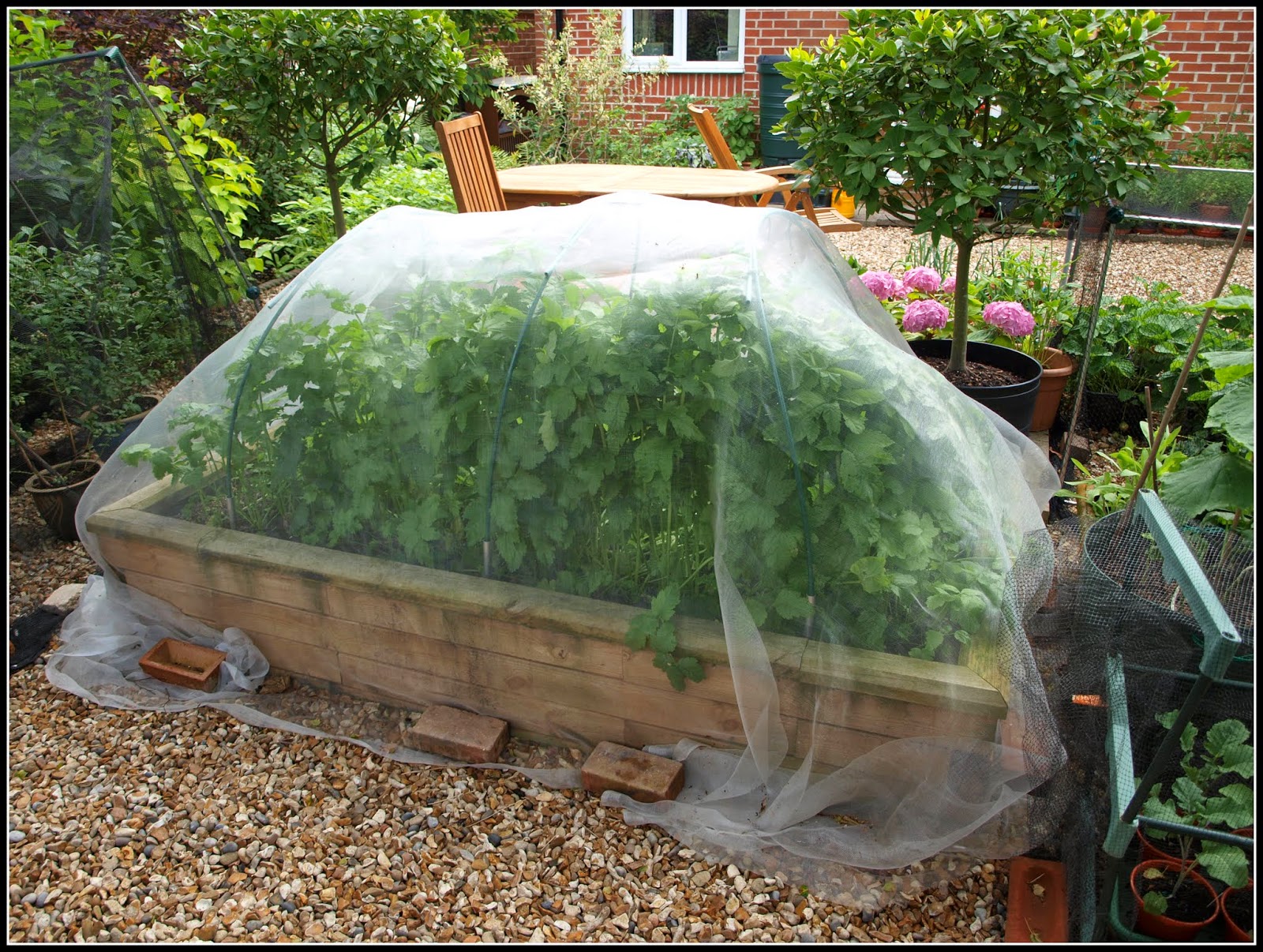
My garden is mostly covered in nets now. Not beautiful, but necessary. I am beginning to notice Cabbage White butterflies in significant quantities now, and I know that if any brassicas are left unprotected the butterflies will find them and lay their eggs on them, leading in due course to a plague of caterpillars that would make short work of my few plants.

At the weekend I erected this net over my cabbages. It is supported by flexible plastic hoops, and pegged to the soil with wire staples.


I also made this "quarantine area" for my PSB seedlings, which are awaiting their turn to be planted (which will come when the Broad Beans are finished). It consists of the frame of one of my mini-greenhouses with some netting draped over the top and held in place with clothes-pegs. It doesn't need to be anything fancy, because it only has to last a week or ten days.


Elsewhere, the Blueberries are also protected by a net. You can see that the berries are colouring-up as they ripen, and I'm sure that the Blackbirds will have noticed this too! Without netting, these berries would disappear very rapidly. The Blackbirds are less fussy than we humans are, and will often pinch berries that are very under-ripe by our standards, so that they can get in before us.


Then of course there are the Brussels Sprouts:


And the Carrots and Parsnips. Will those Parsnips ever stop getting taller??? It was only the other day I raised their Enviromesh cover by about two feet, and now it looks as if I need to do it again! It's a good job I bought a huge piece of mesh.


These days I don't think I would manage to get a viable crop of anything if I didn't have nets. It makes me wonder what I did before I had them, since it is only relatively recently that I started using them. I suppose in the "old days" I would have been less demanding, and perhaps happier with a small (and often damaged) crop.

Wednesday, 2 July 2014

Another way to eat Broad Beans

Broad Beans are definitely "In Season" in my garden right now. Here's another way to eat them...


The main ingredient of this meal was actually not Broad Beans, but chicken - a whole chicken bought from our local butcher, at a price of  just over £6. You can buy two chickens (sometimes even three!) at a supermarket for £10 these days, but they won't be as good as the ones reared on small and more welfare-conscious farms, and we like to support local businesses whenever possible.

I jointed the chicken and used only the "supremes" (breast and wing portions) for my dish. The leg portions were reserved for another meal, while the carcass was roasted and made into stock. I suppose you could call my dish "Butter Chicken", because I smeared the meat all over with softened butter into which a large handful of fresh Thyme leaves had been incorporated. I roasted it in the oven for about 40 minutes, basting it from time to time with the melted butter, until the skin went golden.

I cooked the Broad Beans in advance, boiling them in water with some sprigs of Savory, a herb that seems just perfect for these beans:


While the chicken was cooking I fried some smoked bacon and some onions, and then at the last minute added to them the cooked beans:


In my opinion, this is another amazingly good combination!


I also served some of my home-grown new potatoes - more of the "Red Duke of York" ones. This time I cut them in half and steamed them rather than boiling them, because I thought this would help to avoid having them break up. I still found that they went very quickly from not cooked to very soft. Another minute in the steamer and the would have fallen apart!


This variety of potato is probably better for baking or deep frying...

To complete my meal I made some Parsley Butter and some really rich gravy, the latter using the stock from the chicken. The stock was especially good this time because I had added to it some Leaf Celery, which gave it a really intense savouriness - very "umami".

OK, so here it is all together:-


I can't claim any credit for the carrots, by the way. They were shop-bought ones. Soon I will be able to use home-grown ones though. Just you wait!


You have probably noticed that I don't often include a specific recipe in my posts. I think this is because I am the sort of person who likes to "be inspired by" a dish rather than to slavishly follow a recipe. I am hoping that you will in turn be inspired by my dishes, but want to adapt them to your own requirements. I know that sometimes you HAVE to follow an exact recipe (e.g. with baking), otherwise a dish won't work, but when I'm cooking I like a bit of room to manoeuvre!

P.S. For dessert, I served home-grown Strawberries.


They were presented in a way I have been meaning to try for ages. It's something I once saw Hugh Fearnley-Whittingstall do. The Strawberries are macerated in Balsamic vinegar, with sugar (in our case, Sweet Freedom) and black pepper. It sounds strange, but it works. Very nice.

Tuesday, 1 July 2014

Flowers!

Here we are with some more evidence that Mark's Veg Plot is gradually widening its range of plants...

This is the Hydrangea that my friend Rosemary gave me for my Birthday. Thanks, Rosemary, I love it!


My recently-acquired Dahlia "Bishop of Llandaff" is living up to expectations, flowering profusely now.


This is a Hypericum, which volunteered itself into my garden some years ago.


When the Hypericum flowers fall, they leave behind these beautiful berries, which start off white but eventually turn a deep pink colour:


My Sweet Peas ("Spencer Mixed") are producing flowers now. Not a huge number so far, but there are plenty of buds, and the flowers that have opened are in a range of really gorgeous colours.


I'm going to count this as a flower too. It is my Olive tree, which is currently covered in flowers.


Of course an Olive tree in England is never going to produce a viable crop, although this one does usually set a few fruits each year - tiny things about the size of a Blueberry. It is not intended as a food plant though, simply an ornament on the patio. You can't see this in my photos, but it grows in a large terracotta pot. It helps me to imagine that we live in the Mediterranean!


Finally for today, I want to show you this Harlequin Ladybird larva. I have only seen a couple so far. Perhaps they are not numerous in my garden this year because there have been few aphids (their primary prey).