Friday, 14 March 2014

Carrots - protective measures in smaller scale

Following on from the construction of my Anti-Carrot Root Fly carrot-growing structure (as described on Tuesday), I have decided to apply the same approach to my arrangements for growing miniature (i.e. salad) carrots.

Photo from August 2013

I am using two large plastic storage-boxes (purchased at Tesco - approx £2.49 each), in the bases of which I have drilled several drainage holes. I filled the boxes with a mixture of home-made compost and sand. In them I have sowed three types of miniature carrot: "Mini Finger", "Mignon" and "Amsterdam III Sprint", all half-packets left over from last year. In amongst them I sowed a small number of "White Lisbon" Spring Onions, which are supposedly a deterrent to Carrot Root Fly. The two boxes fit neatly in my wooden planter, standing each on two bricks to raise them to the right height.


The hoops for the protection system are made from wire coat-hangers chopped at the appropriate places with a pair of sturdy pliers.


Over the hoops I have draped a small piece of Enviromesh cut from a length of the stuff that has been sitting in the garage for several years, awaiting just such an opportunity. The big piece had several holes in it (courtesy of the local feline population), but I found a bit that was OK.


The mesh is secured to the wood of the planter with brass drawing-pins:


I think I stand a better chance of getting good carrots this year than ever before!

Wednesday, 12 March 2014

Sowing and protecting Carrots

This year I SHALL have good carrots! Well, even if I don't, it won't be for want of trying. For the last two or three years I have grown miniature (aka "finger") carrots, in some plastic boxes raised up above ground level in a wooden planter in order to escape the ravages of Carrot Root Fly. This method has worked well, and has given me a decent crop of baby carrots:

"Amsterdam 3 - Sprint" (August 2013)
Baby Carrots are all very well, but I want Maincrop Carrots too! I know from previous attempts that growing carrots without proper protection is doomed to failure. They would just be be riddled with flies and unuseable. So this year I am going all-out for "proper protection".

So the maincrop carrots are going to be grown in my premier raised bed - the big Woodblocx one. They will share it with some parsnips. This bed now has a good depth of soil consisting primarily of home-made compost, but since it is going to play host to the carrots, I  have added a bit of sand to improve the drainage:


I dug-over the bed with a hand-trowel, removing any twigs or other debris I could see, and then raked it "to a fine tilth" as they say - in other words until all the lumps were broken down. Conditions seemed perfect for sowing. The soil was damp but not wet, and seemed quite warm to the touch.

I made a wide (6 inches / 15cm) drill and sowed in it three varieties of carrot: "Early Nantes", "St.Valery" and "Autumn King". I sowed fairly thickly, in the full knowledge that if germination is good thinning will be required. Next to the carrots I sowed two types of parsnip in a similar wide drill. They are "Duchess" and "Guernsey Half Long". Separating the two types of vegetable I sowed a single line of "Cherry Belle" Radishes.

After sowing the seeds I erected the protection. First I pushed in six aluminium tubes from my "Build-a-Ball" kit, and then slotted into them three flexible plastic hoops:


Then over the top of the hoops went that large piece of Enviromesh that I bought the other day. It is way too big for this present configuration, but I deliberately got a piece that will allow for a taller configuration if I decide to grow something like Brassicas. The excess mesh was rolled up and secured at ground level with a number of bricks.

So now I just have to wait... Hopefully this setup will exclude foxes as well as Carrot Root Flies.

Tuesday, 11 March 2014

New growth everywhere you look...

Things are certainly starting to move in the garden - Spring is stirring the plants into action.

Look how much these Chives have grown:

19th Jan


16th Feb
 
9th March
 The Lettuce seeds I sowed have germinated quickly and well. Many seeds need heat to germinate, but Lettuce is one type of plant that likes cool conditions for germination. This is why it is often difficult to get it started during the Summer-time. I have seen some seed-packs advise you to sow lettuce in the evening, for this reason (on the assumption that the night will be cooler).


These are the mixed ones - the Best Winter Lettuce collection from Sarah Raven. I sowed a "pinch" of seed in each pot, so I can't be completely sure of the germination rate, but it looks to me like 100% or very nearly so!


In this pot, six seeds have germinated (one of them showing a red tinge, so almost certainly "Marvel of Four Seasons"), but I will remove all but one. This year I am going to try to be more disciplined with growing salads. I will aim to avoid having gluts and shortages, by sowing successionally and not having a huge number of plants all at the same stage.


The potatoes are chitting nice and evenly out there in the garage, where the temperature (cool but definitely frost-free) and light level (next to the window) seems ideal for the purpose.


The chits (shoots) should be short and dark coloured. Pale spindly chits are not desirable.


This is my patch of Wild Garlic, which seems to have spread a fair bit since last year, exactly as I wished. Hopefully this year there will be enough of it to justify picking some for use in the kitchen.


This is Lemon Balm, looking very enthusiastic. We don't use this plant as a herb (though of course we could), but I grow it for its ornamental properties, and the bees love its flowers.


The Purple Sprouting Broccoli is definitely purple and definitely sprouting:


My second batch of Sweet Peas is just about ready for pinching out. I still haven't decided where they will grow... I had better hurry up and decide because they will be ready for planting out within the next few weeks. Maybe I'll put some of them in a large pot, with some bamboo canes, and then mix the others in with my climbing beans (yet to be sown, of course).


Ridiculously, some of the Alpine Strawberries have decided to flower, and one of them even has a red ripe fruit!


I think we can safely say that Spring has arrived.

Monday, 10 March 2014

PSB - nearly ready?

My Purple Sprouting Broccoli, having been in the ground for many months, is finally about to deliver its crop. This year it won't be a big crop. The four plants I have are very small by normal standards.


One of them is VERY small...


Maybe this is a good thing. Last year I think we had more PSB than we needed. It doesn't keep very well and is best used as soon as possible after picking. When frozen it goes very mushy - not worth having, in my opinion. So having too much is probably a bad thing. Just enough is better.


Regular readers will know that PSB is one of my favourite veg, and I am not going to be easily discouraged when it comes to growing it. If this year's harvest is small, then I'll put that down to experience and try again next year.

Maybe I'll try a couple of different varieties. I was surprised to see that this year my biggest PSB plant is the only one of the four which is an old traditional one ("Early Purple"), whereas the others are newer modern varieties ("Red Arrow" and "Red Spear").

Sunday, 9 March 2014

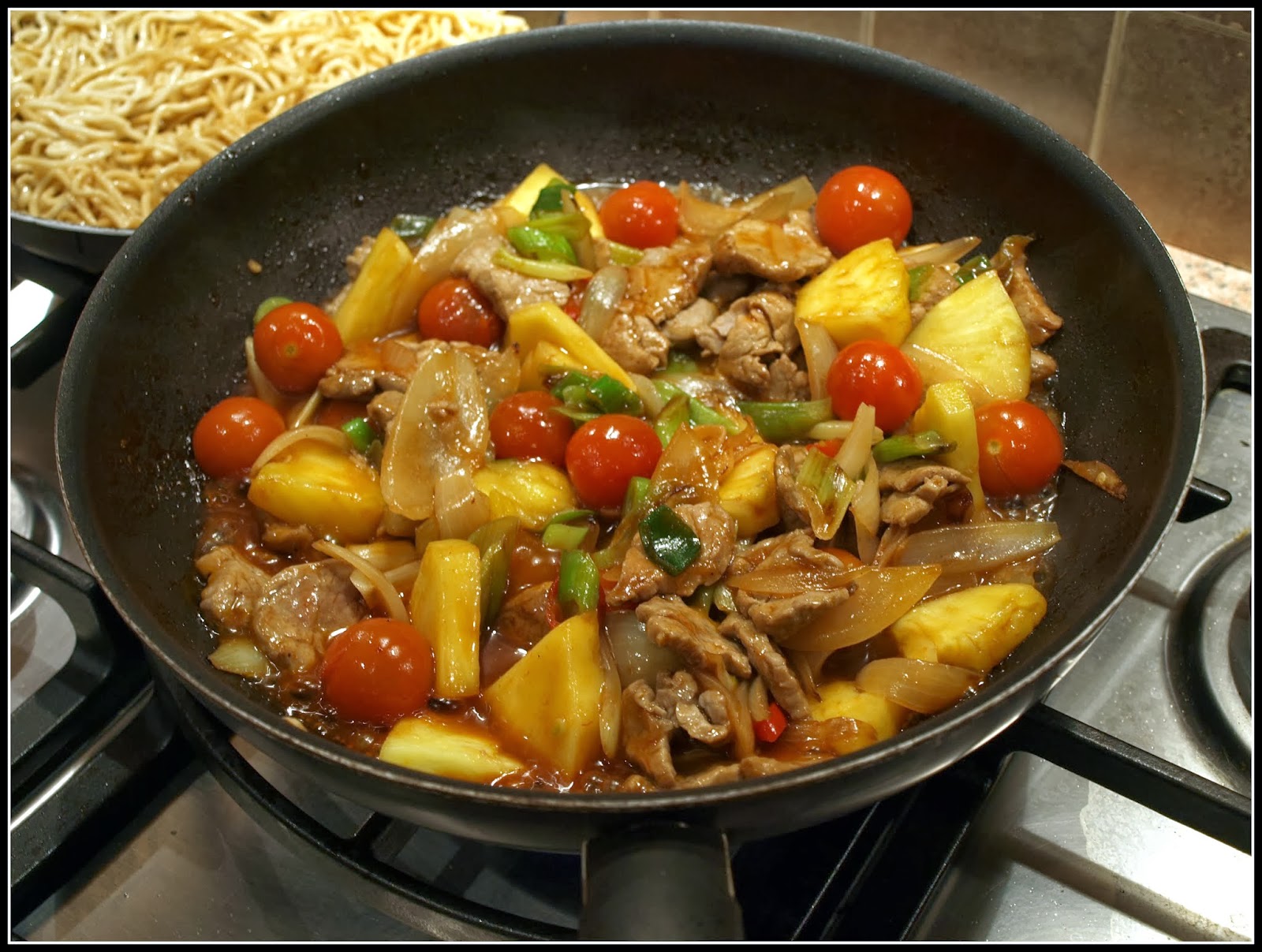
Sweet and Sour Pork

I hadn't really intended to write about this meal, because it seems so simple, but it looked so gorgeous that I just HAD to post about it!


This is my take on Chinese-style Sweet and Sour Pork, with fried noodles.

I marinated in the frridge for 6 hours some thinly-sliced pork tenderloin with garlic, ginger, chilli and soy sauce. I also pre-cooked some Chinese egg noodles, and prepped some onions, Spring Onions, fresh Pineapple and cherry tomatoes.

A few minutes before Dinner-time I stir-fried the pork (including its marinade), vegetables and pineapple for a few minutes then added a sachet of commercial Sweet and Sour sauce.


Meanwhile, I fried the cooked noodles in a little vegetable oil, with some added soy sauce and a tiny splash of sesame oil.


Here they are together...


The star of the show was probably the fresh pineapple. To be honest it wasn't very fresh, since it had been hanging around since the previous weekend, but that meant that it was 100% ripe and it was amazingly tasty.

This fabulously tasty meal was ready in minutes!


The meal reminds me of one Jane and I ate many years ago in Sarawak. At the time, I was serving in the Army, in Brunei, and we went on one occasion for a weekend into the hinterland of neighbouring Sarawak. We stayed for a couple of nights in a very remote little town called Marudi. It didn't have much in the way of restaurants, so we ate at a market stall. Our command of the Malay language was rudimentary, but we did remember the word for pork - "babi", and the word for rice - "nasi" - as well as "tidak ikan" (no fish) so we managed somehow to order pork with rice, and it came with loads of cherry tomatoes. Probably some other ingredients too, but the memorable features were pork, rice and tomatoes. We both remember it as one of the best meals of our lives!

Makanan Siap*, Jane!

*"Food is ready"

Saturday, 8 March 2014

Travels through the Hampshire countryside

This past week I had to deliver a training course in the town of Eastleigh, a few miles North of Southampton. Since the client's premises were very close to the railway station I decided to save myself the hassle of driving and take the train. It turned out to be a very good decision. For a start, the road route involves motorway driving most of the way, which is never pleasant at the best of times, but the main advantage of the train was that it gave me an opportunity to observe the countryside. Unfortunately, since I was travelling to work (suit, tie, laptop bag, briefcase etc) it wasn't appropriate for me to take the camera, though I almost wished that it had been. Today however I'll have to rely mostly on the written word to get my message across. I have put a few random photos into my post, but they are not specifically relevant to what I have written here.

See what I mean? (about lack of relevant pics...)

Each of the three days I made this journey, it was really cold first thing in the morning, and on two days it was sunny too, so the countryside looked lovely with frost-rimed trees and grass sparkling in the sunshine. Despite the relentless expansion of the towns like Basingstoke and Winchester, Hampshire is still predominantly rural, and from the train you appreciate this more than when you are in a car. The railway is often raised up on an embankment so you get to see distant views that are not available from road level. There aren't many big hills; it's gentle rolling countryside.

With all the rain we have had over the past three months, it was not surprising to see that there is a lot of flooding. All the rivers and streams are two or three times their normal size, and in some cases it was difficult to see them at all, since the fields next to them are completely under water. It is highly likely that foodstuffs will be in short supply this year, because farmers have just not been able to sow and plant. I think it will be many weeks before the soil dries out, even if there is no more heavy rain. It was depressing to see how many houses - particularly the isolated farmsteads - must be experiencing great difficulties with physical access, with the small roads and tracks under so much water. The livestock must have been suffering too; I was particularly aware of how many unhappy horses I saw. You can tell when a horse is unhappy: it stands very still, with its head held low!

This horse is not unhappy!

Talking of livestock, I saw lots of wildlife too. A hare, lolloping along on its gangly legs in the middle of a frosted field.; several rabbits scuttling about in the undergrowth next to the railway line; some deer shyly nibbling on the grass at the edge of a patch of woodland; birds of prey circling and hovering in the clear sky looking for those unfortunate little furry rodents in the grass below; a stately heron gliding gracefully over a stretch of flooded riverbank looking for a good spot for a day's fishing - or more likely frog-catching. You don't see that sort of thing in the city.

I was interested to see that several farmers are going to some lengths to foster the wildlife and give it some space of its own. Many of the fields in NE Hampshire are big and rather exposed, but they have thick hedges round them - ideal wildlife habitat. Some farmers augment the hedges by leaving unploughed a strip about 10 metres wide round the field margins. This develops into a tangle of grass, weeds and wild flowers which provide food for beneficial insects - and maybe bees? In a few places I saw new plantations of young trees. One of these was on the crest of a hill, an obviously windy spot, so it is presumably intended not just as a wildlife refuge, but also as a windbreak. During our very stormy Winter a lot of trees were lost, so I imagine that lots of new such plantations will be necessary.

One other interesting thing I saw was an ostrich farm. That's not something one particularly associates with Hampshire, is it? The poor birds are probably most unimpressed with our dismal weather! Have you ever eaten ostrich meat? I've had it once. To me it seemed almost like beef - definitely not in the poultry bracket, despite its avian origin. It's not something I would seek out, but I have read that it is becoming quite popular here, presumably in the "trendy" restaurants.

No it's not an ostrich, and no, you're not allowed to eat swans.

Well, that's it from me for today. Fancy the trip to work being the high spot of the week! Thursday meant a return to the London route. The dingy outskirts of New Malden, Raynes Park and Clapham Junction are a big step down from the delights of rural Hampshire, in my opinion!

Friday, 7 March 2014

More news on chillis

Some of you will be aware that I am a bit keen on (some would say obsessed with) growing chillis. I have been overwintering some plants which I bought last year, but didn't want to lose. I started with 5, but 2 of them have not survived. However, the remaining 3 are looking OK. There's not much wrong with this "Red Habanero" is there? I think you could reasonably describe it as "vigorous".

"Red Habanero"

The other two plants are both of the variety "Nosferatu", which has foliage that begins life green, but gradually darkens as it matures, eventually becoming more-or-less black. Likewise, the fruits start off being a sort of chocolatey purple, but ripen to dark red.

"Nosferatu" - immature fruit

This is what the "Nosferatu" plants look like  - thin and tatty lower down, but with lots of bushy new growth at the top. I would like to emphasise that this one has been brought into the kitchen purely for the sake of photographing it. It normally lives on a windowsill in our guest bedroom.


As you can see, the old, dark-coloured leaves are looking very disreputable, starting to go brown and curl up. Not very handsome at all!


However, from each leaf axil a tiny new green leaf is appearing:


Since taking these photographs I have snipped off most of the big leaves, which will probably stimulate the small new ones to grow even quicker.

Up at the top of the plant there is plenty of new growth too, and I have started to pinch out a few shoots, in order to persuade the plants to become bushy rather than tall and thin.


Wherever you pinch out a shoot, the branch produces two new shoots.


You might be wondering why I am bothering with overwintering these plants at all. Well, the overwintered ones will hopefully produce flowers and then fruits much earlier than their cousins that I am growing from seed, which is desirable because chillis take a long time to mature. Unless we get a particularly hot sunny Summer it is usually September before many of the fruits are ripe, and it would be quite nice to have a few before then.