Thursday, 14 June 2018

The Courtmoor plot in mid-June

Well, it wasn't long ago that I was saying "In a few weeks' time this bare soil will be covered in green." Of course my prophecy has come true - if only because about half of the green is weeds! This is what the plot looks like now:


In the foreground are my potatoes, which are a definite case of "You win some, you lose some". There have unfortunately been more losses to Blackleg disease, but at least these "Desiree" and "Setanta" plants are looking OK.


This side of the potatoes, and not visible in the first photo are the Broad Beans, many of which are reaching maturity right now.


To be honest the crop is a bit patchy. Even allowing for the fact that there are four different varieties of bean, some of them are reasonably good, and some are rubbish. None of them are as good as the ones in my own garden, but this is understandable since the ones in my own garden get a lot more TLC - especially watering!


Beyond the potatoes are some shallots and onions. They look pretty good to me - though I expect some more rain would be very beneficial to them.


Beyond the onions I have parsnips, beetroot, leeks and green cabbage.

L to R: onions, parsnips, beetroot, leeks, cabbages, beans

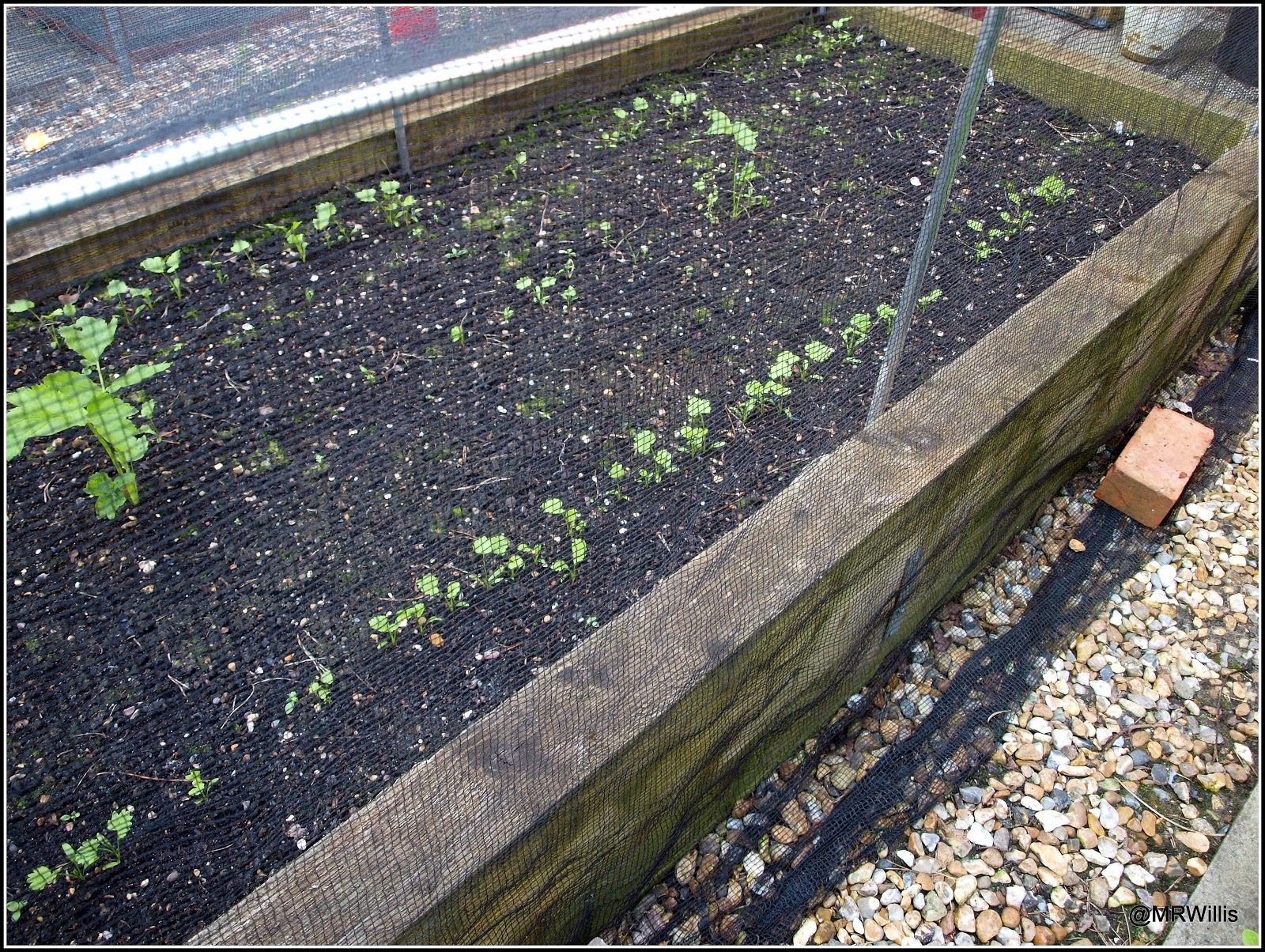
The germination rate of the parsnips was very poor; indeed a stretch of about a metre at the near end was completely bare, so I have recently given up on it and sown a few radishes in it, just to make use of the space.

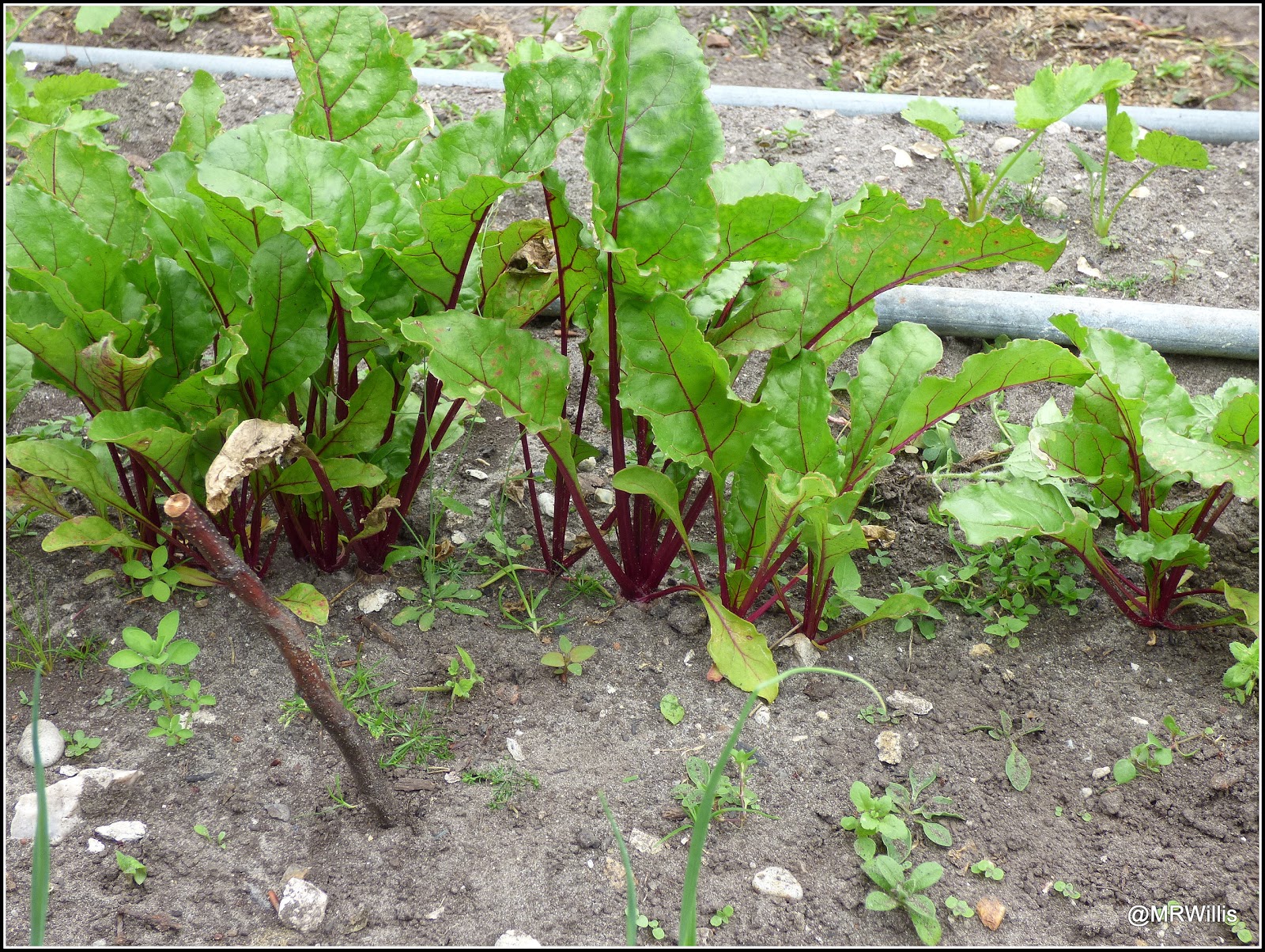
Germination of the beetroot was better, though still patchy (I think the foxes may have "re-arranged" some of the seeds). However they are looking all right and some of them are just beginning to "bulb-up". I suppose I really ought to thin them out a bit more to make room...

The improvised wire cages I made to protect the green cabbages proved to be ineffective, particularly since the ends were still almost completely open. The pigeons have ravaged the cabbages pretty comprehensively, and furthermore I have been unable to weed around the plants - at least, not easily. I have learned a significant lesson here: if I want to grow brassicas on this plot, they will HAVE to be netted.

The red cabbages may yet recover from the pigeon assault. They seem to be growing a fresh set of leaves, so I'll leave them alone and hope for the best.


The climbing beans are looking good too. In the photo below you can see the "Cherokee Trail of Tears" ones climbing up their wigwam, and to the right the other three types on the X-shaped supports. The "Tunny beans" look particularly strong, and the "Cobra" French beans are OK, whilst the "Jean's Beans" Runners are relatively weak. I don't expect a big harvest from the latter; I just need a few good pods to help me keep this variety in existence. My main crop of Runners will come from the plants in my own home garden.


Beyond the beans are more brassicas. The recovering red cabbages, the cauliflowers and the Brussels Sprouts. I am particularly hopeful of the latter, which seem good at present.

Brussels Sprouts

Alongside the netted brassicas is a row of "Ailsa Craig" onions, and in between a catch-crop row of radishes. I don't think this batch of radishes will be much good as the ground is far too dry for them. They will probably bolt or at least be tough and woody!


Beyond the onions are two patches each with 9 New Zealand Spinach plants, and one group of 13 Dwarf French beans. Right down at the far end is a small open space in which I plan to squeeze a few more beans.


Seen on the right in the previous photo are the Raspberry canes. They are covered in immature fruits, boding well for a decent harvest - though again I bet they are desperate for a good drink.


The blackcurrant bushes along the fence-line are laden with fruit too, and some of it is just beginning to turn colour.


There is also one rather neglected Blackberry bush (or is it a hybrid berry of some sort?).


Whatever it is, it seems to have plenty of fruit on it, so this is something else to look forward to - if the birds don't strip the lot first!


Over the other side of the grass path, the "pumpkin patch" is filling out nicely. All six of the squash plants seem healthy and some are even producing their first flowers.


One of the "Uchiki Kuri" plants has an tiny embryonic fruit on it - or perhaps more accurately, a female flower yet to open.


The final thing to report (though not strictly within my remit) is the state of the venerable old "Bramley" apple tree. It's laden with fruit!


When I first became involved with this plot last Autumn, the Bramleys were, in the words of the plot-owners, "nearly over", yet there were still vast quantities of fruit available, even though most of them were windfalls since the plot-owners had been unable to harvest them before they fell. This year, I will probably "offer some assistance", if you know what I mean...


Tuesday, 12 June 2018

A time of 'potential'

Right now, my garden is full of young fruit and vegetables, growing rapidly. Apart from Broad Beans and the usual herbs, there is not much I can pick just yet, but lots of the plants are looking promising.

Several of the chilli plants are setting their first fruits - like this "Golden Cayenne".


I have now arranged my chillis (in their 10-inch pots) in their usual position, next to the raised beds:


Nearby, my four cucumber plants are growing away strongly:


The first little embryonic fruits are appearing too:


The tomato plants (reduced now to 18 in my garden with 4 more at Courtmoor Avenue) are looking OK, though some of them are showing that distortion of the leaves which so characteristic of the weedkiller poisoning that struck me some years back. This problem is getting less severe each year, but there is evidently still some residual contamination in my homemade compost.


The first tomato plants to produce flowers are the "Maskotka" ones:


As I mentioned at the start, the Broad Beans are cropping now. With only 20 plants, I'm never going to have a glut, but they are lovely beans and having them just outside your back door means that you can harvest them as and when you need them, at the peak of condition and absolutely fresh.


The Runner Bean plants have reached the tops of their supports, and are now putting out their first flowers, so hopefully I'll be picking some pods by about the end of the month.


Even the Parsnips have finally decided to grow! Most of what you can see in my photo are ones from the second sowing, with just one or two (I think literally 5) from the first sowing.


Within the next few days I expect to be harvesting some First Early potatoes. The foliage on these "Annabelle" ones is definitely dying down now, indicating that they are just about ready:


I don't think I have mentioned these before - "Finger" carrots, sown in a large flowerpot:


Again, a pot like this is never going to produce a huge yield, but even a few of the slim crunchy roots of these "Amsterdam II Solo" will make a fabulous addition to a salad, or a pre-dinner Nibble. If you are planning to grow carrots like this, just remember that they do make long roots, so choose a pot at least 20cm deep.

As well as the vegetables, I also have some apples and pears forming:

Apple "Winter Banana"

Pear "Concorde"

I'm particularly proud of this little chap - which is probably going to be my "Bramley" tree's first-ever fruit.

Apple "Bramley"

Planning ahead for the future, I have several more trays of young plants awaiting their turn. I have Chicories, Lettuce, Aztec Broccoli (aka Huauzontle) and several types of brassica.


I'm going to finish today's post with a little tip. I have been keeping a pot with six Runner Bean plants in it, as spares in case of casualties. They had got very tall - the leader shoots were probably about 3 feet long - so I have prolonged their usefulness to me by cutting out those shoots.


The plants will continue to grow, and the side-shoots will now take over the lead. Within a week or ten days they will also reach about 3 feet, but by that time I will definitely know whether any of them are needed in their intended role. If not, I'm afraid they will end up in the compost bin.

Sunday, 10 June 2018

Beechenwood Farm

I'm sure that many of my readers (those who live in the UK, particularly) will have heard of the National Garden Scheme (NGS), a charity that raises funds for good causes with a nursing connection by means of charging admission to visit the gardens of selected private properties. These gardens typically open for just a few days in the year, normally at times when they are expected to be at their best. You can find out about these places via the NGS website, or the famous "Yellow Book" (NGS Garden Visitor's Handbook).

We visited one such garden a few days ago. It is Beechenwood Farm, near Odiham in Hampshire (less than 6 miles from our house).


This delightful property is in a very secluded location, approached down some very narrow country lanes with scarily few passing-places. I was very worried about meeting a farm vehicle coming the other way, because with my Fibromyalgia I have limited neck mobility and find reversing the car very difficult!

The NGS's description of this place begins "2 acre garden in many parts". This is definitely true. Almost every different aspect of gardening is represented: formal beds and borders, informal and "wild" areas, a vegetable patch, a herb garden, a pond, lawns, an orchard, statuary and garden art, even a so-called "Belvedere" - a raised platform (with plentiful seating) from which you can admire distant views of the surrounding countryside.


View from the Belvedere, looking North towards Odiham.

Right from the start I was impressed with how neat and well-organised this property is. Everything seemed so under control. Owner Michael Heber-Percy greeted the visitors, sold the tickets, issued the photocopied maps and presided over the array of homemade jams and pickles offered for sale, courtesy of the local Womens' Institute Market, while his wife Sarah ran the plant sales area. We found both of them utterly charming and most welcoming. I'm not quite sure who was manning the "Teas in the Garden" side of things...

One of the aspects of the gardens which we liked best was the profusion of benches on which to sit and admire the views both near and far - a sure sign that the garden is there to be appreciated! As you would hope, the garden was a-buzz with bees and hoverflies, making the most of the exuberant flower borders.


We saw lots of red Damselflies enjoying the water features. The soft burbling of the fountain in this little pond near the garden entrance added a tranquil note to the surrounding Herb Garden area, filled with a profusion of flowering and foliage plants.

The circular pond.

There is no denying that Beechenwood Farm has a wide range of very beautiful flowers.


However, if you know me, you probably know that I'm not hugely impressed by flowers. I often prefer the other features of a garden. I loved the Woodland Garden area, which is populated with a mix of mature native trees and smaller specimen trees, surrounded by very natural long grass and Cow Parsley in amongst which you could see the faded seed-heads of Alliums, and the yellow leaves of long-departed Daffodils. Many of the big trees here are Ashes, which have relatively thin foliage, and this allows in a very pleasing amount of dappled sunlight.

The Woodland Garden

This is another feature that I loved:


I asked what it was for, and was told that it is primarily ornamental (and it's good at that!). It was originally a rack for drying re-used milk bottles.

On the opposite side of the lane to the house and gardens, there is an 8-acre area of woodland, much of which was planted by the current owners back in 1992. It has a wide range of tree types, making it full of interest. A 1/3 mile circular walk is well marked out with red-painted wooden pegs to help visitors navigate this area. Fortunately for us the weather was perfect on the day we visited - bright and sunny but not too hot - and walking through the woodland was truly a delight. I was even more delighted to find a number of interesting fungi, including a couple of types that I have been hoping to find for ages, such as this (rather elderly) Polyporus squamosus (aka Dryad's Saddle), which was right by the car-park!


No post about this property would be complete without a mention of the resident cat, Amber. Apparently she likes to get into cars, and a sign in the car-park asks people to check their vehicles for stowaways before leaving! She evidently believes that the road / lane belongs to her too (no surprise there!).


Having said earlier that I'm not overly-impressed by flowers, is this the point for me to admit that I did succumb to temptation at the plant sales area...? This lovely Geranium was only £2 (not including the pot or home-made trellis), a bargain not to be missed!


If you are within reach of this property, I strongly recommend a visit. Full details are on the NGS website, but here's the address:-

Beechenwood Farm
Hillside
Odiham
Hook
Hampshire
RG29 1JA

Admission is £4 for adults, free for children.

Friday, 8 June 2018

Potato Blackleg disease

Some of the potato plants up at my Courtmoor plot are showing the classic symptoms of Potato Blackleg disease - specifically "Yellowing stems, stunted growth and black rot at stem bases" (Credit: RHS)

Definitely "Yellowing stems and stunted growth"!

Blackening at the base of the stem.

There is no cure for this disease, which appears rapidly and without warning. All you can do is pull up and discard the affected plants to stop the disease spreading. Fortunately, only 2 of my plants appear to be infected so far - one "Jazzy" and one "Sarpo Una", but I'm mentally prepared for further casualties.

I have disposed of the affected plants - but not via the compost bin!

On a brighter note, many of the other potato plants look fine, if a little small by the standards of the ones in containers back at my home garden. These are "Maris Piper" - a Maincrop variety, so hopefully they will get bigger.


I think all of the potatoes on the plot are suffering from lack of moisture. It's easy enough for me to water the ones in containers in my own garden, but the ones in open soil are a different matter. I have watered them with a hosepipe a couple of times, but this is no substitute for a proper soaking of rain. It keeps the plants alive, but doesn't allow them to thrive.

As you can see from the photo above, the weeds are managing to grow well enough, despite the lack of rain. I have done a bit of weeding every time I visit the plot, but it's a never-ending battle to keep them in check. In the next photo you can see some "work in progress". I was working my way along one of the rows of potatoes, removing weeds and then earthing-up the spuds before moving on.


The most promising-looking potatoes are the red-skinned ones, "Setanta" and "Desiree". This row has five plants of each, but the annoying thing is that I can't remember which ones are where!


Both varieties produce similar-looking flowers, so I can't tell you which one this is.


All I can say is that the presence of flowers on a potato plant is normally taken to indicate approaching maturity, so to see either of these Maincrops flowering now is a bit odd, considering that I have not yet lifted even my First Earlies! I think that early flowering can be caused by lack of moisture, and this in turn is likely to mean a small crop this year, because the tubers won't have had much time to swell.