Wednesday, 30 November 2016

It's COLD!

This week has brought us some bright but extremely cold weather. Night-time temperatures have been about -4 or -5, and day-time ones still in single figures. Fortunately it has been dry and not very windy, with lots of sunshine - the sort of weather often described as "crisp"!

I actually like this type of weather. It is certainly preferable to milder but wet and windy weather. Also, as a gardener, I know that cold weather helps my garden. For a start, the plants expect it. Some plants need a period of very cold weather to produce flowers in the following season. If you are unfamiliar with this, have a look into Vernalization. I know too that prolonged spells of very cold weather help to kill off some of the insect and mollusc pests that inhabit our gardens.

Today, the garden is covered in a thick layer of frost, and despite the sunshine our maximum temperature for today is predicted to be 3C. The droopy and hunched-up posture of the Purple Sprouting Broccoli shows me even from a distance that it is mighty cold outside.


The leaves are covered in complex patterns of ice crystals:

PSB


Sage


Beetroot

Funnily enough, although the PSB droops when it gets cold, this Brokali doesn't:

Brokali


Brokali

Earlier today I went out to feed the birds and to refresh the (frozen) water in the bird-bath, and while I was doing this I was bombarded from above by falling berries from my Cockspur Thorn tree, where a couple of Blackbirds were busy stuffing their beaks. Blackbirds and Pigeons seem to love these berries, but they are messy feeders. Pulling one berry off the tree dislodges three or four others, which fall to the ground below:


For some reason, the birds seldom eat berries that have fallen. These ones will probably remain where they fell.

About a fortnight ago I filled my bird-feeder with seeds for the first time since early Summer. During the warmer months I think it is fair to make / let the birds forage for their food, avoiding over-dependency on artificially-provided fare, but in the Winter I think they deserve some help. I now see a steady stream of little birds coming for a free meal. I was particularly pleased to see TWO Nuthatches feeding together one day - no photos though, because they are very wary birds, very difficult to photograph.

Monday, 28 November 2016

Harvest Monday - 28th November 2016

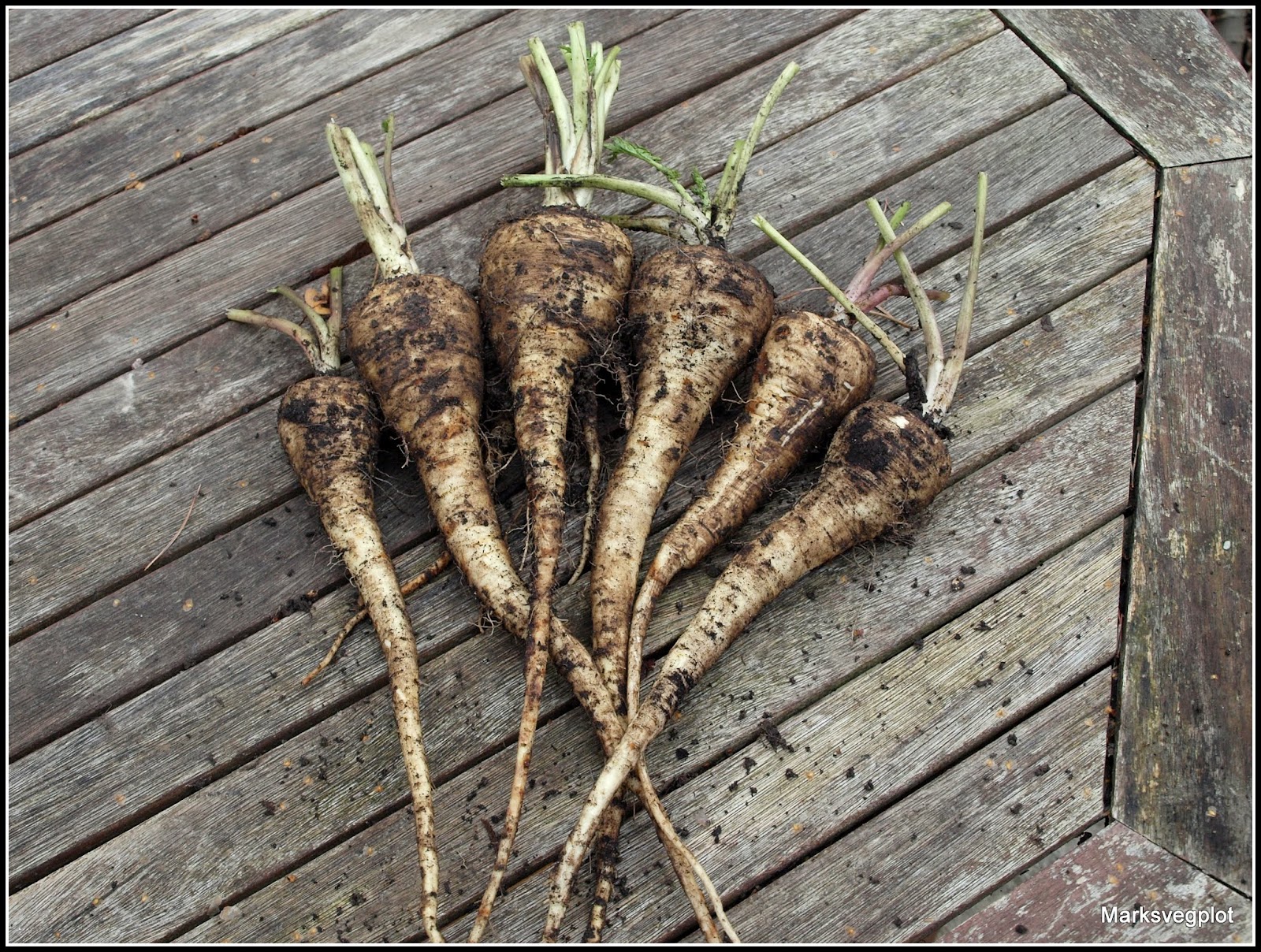
I expect some of you read my post about the parsnips with canker. Fortunately not all of them were afflicted and I was able to harvest a decent bunch. These ones are of the variety "Duchess" - a variety that has done well for me over the last three years.


My current favourite way of cooking parsnips is to do them as chips (fries to you folks in the US), in our Actifry machine. They come out crisp on the outside, but soft (and sweet) on the inside.


The carrots are still going. I pulled another small batch this week (about 500g). They were mostly small ones, but with one or two decent-sized ones amongst them.


The big ones at the Right are "Autumn King", others mostly "Darina"


As well as these root crops, this week I also harvested another endive and two more little lettuces, but I didn't think them significant enough to photograph.


That's all I could muster for this week, so if you want to see more harvests you'll have to head over to Our Happy Acres and see what other people have contributed to Harvest Monday.

Friday, 25 November 2016

Parsnips - some very mixed results

Yesterday I went to dig up some more Parsnips, and what I found was not what I expected. Loosening the soil around one of the roots, I gave a tug and this is what came up:


Yes, just the hollow top of a parsnip, with nothing down below! I pulled another. A very similar result. I pulled a third. Slightly better, but still horrible:


In desperation I pulled three more. They were all really bad. Only one (seen at the right of the line-up below) had anything useable on it.


Unfortunately, these parsnips have a severe case of the disease Parsnip canker, which makes the flesh of the vegetable go brown and squashy, allowing in all the pests. In my next photo you can see one of the parsnips riddled with tiny white millipedes. Yuck!


Recovering from the shock of harvesting these pretty disgusting parsnips, I realised that they were all from one of my 3 rows. They are the variety "Tender and True". Ironically, on the seed packet for this variety it says that it has good resistance to canker! Luckily, my other two rows are of a different variety - "Duchess" , a variety noted for its long slender roots.

So, with some trepidation, I lifted a few of the Duchess ones. Phew! I was relieved to see that they were clean and mostly unaffected by canker.


They are not huge (the batch of 6 weighed a total of 600g), and to be honest if the Tender and True ones had been OK I would not have pulled these ones at all, but in the circumstances I'm happy with them.


Here they are again, washed and ready for use.


In theory, the best thing for me to do now is to dig the whole bed of parsnips and store them in boxes of damp sand to prevent the further spread of the disease - but I haven't got any sand, or suitable boxes, so I will just have to leave them where they are and hope for the best. I will however use them rather more quickly than I had previously intended.

My experience provides ample evidence that parsnips are susceptible to canker in differing degrees. The strange thing is that the sellers of almost all varieties of parsnip seeds claim high resistance to the disease - which is just not true. I have grown Duchess before, but this was the first time I had grown Tender and True. It will also probably be the last!

Thursday, 24 November 2016

End-of-season Chillis

With the Autumn having been unusually mild, many of my chilli plants have survived longer than normal this year. Some of the luckier ones were brought inside in early October, and have continued to grow and produce fruit. Others, having finished fruiting, have been heavily pruned to try and keep them dormant for the Winter.

It seems odd to be picking ripe chillis in late November, but that's exactly what I'm doing. Here are photos of some of these late-developers:

The first 3 photos are of "Devil's Tongue, Chocolate", a very hot Habanero type (Capsicum Chinense). Most of the big fruits have been picked now, and I'm down to the last few small ones.

Devil's Tongue, Chocolate

Devil's Tongue, Chocolate

Devil's Tongue, Chocolate - just turning brown

This is "Cheiro Roxa", with its Flying Saucer-shaped fruits, now mostly a sort of pinkish-purple colour.

Cheiro Roxa

This plant was one of the last to set fruit this year, and while I had it outside it really didn't look like being able to ripen any, but when it came indoors that soon changed.

Cheiro Roxa

This next one is probably the most significant one for me. My first-ever ripe "Jay's Peach", grown from seeds kindly sent to me by fellow chilli enthusiast Enrico, from Italy.

Jay's Peach

That ripe chilli is very tiny, but I'm pleased to see it nonetheless. I grew its parent plant from seed last year, and although it produced some flowers it did not set any fruit. I kept it over Winter, and this year it grew outside most of the time, along with all my other chilli plants. By the beginning of October there were flowers again, but still no fruit. Bringing it indoors did the trick though - almost immediately some fruits set, and they ripened very rapidly. There are now 4 ripe fruits, though 3 of them look far too small to have seeds inside them. This one might be the exception...

Jay's Peach

Two of the plants I brought indoors are "Turkey, Small, Red" ones. One of these is still lush and green and producing more fruits. The other died naturally. It produced a final flush of red fruits before withering away. All the leaves fell off, and the stems gradually went yellow, then brown and dry. The last fruits had very thin flesh, and lots of seeds - a typical last effort to reproduce. This is the plant in question:

Turkey, Small, Red

Pods like that are not so nice for eating, and I have lots of juicier ones already, so this last batch is currently being dried to give me a good stock of seeds so that I can give them to any friends who ask for them. If you live in the UK, I'm happy to give you some of these seeds. You can contact me via my Profile, which appears in the sidebar of my blog page.

Monday, 21 November 2016

Harvest Monday - 21 November 2016

I don't have a lot of cultivated harvests to report this week, but I do have a foraged one - more Hedgehog Mushrooms:


Now that I have identified a place where these delicious fungi grow, I shall return there frequently, I think! This time I "harvested" 794g of them - and there were loads more if I had wanted them.

This is about half of what I picked

The Hedgehog Mushroom is so easy to identify, on account of its "spines", that there is little danger of confusing it with anything else. The spines fall off very readily, which is OK because they are said to be of little culinary value.


After a good clean-up, about half of these mushrooms were cooked with some bacon, garlic and parsley and served on toast as a lunch-time meal. Jane made the other half into what we call "Doubled Mushrooms" (called after a product of that name which we used to buy years ago on the Farmer's Market). Basically it entails cooking them in butter for a long time, so that they reduce to a very small volume, packed with flavour. They can then be stored in fridge or freezer for later use.

From the garden this week I did get more salad - three very small lettuces, and this Endive.


As most of you are probably aware, I have been blanching Endives by tying them up with string, to exclude the light. Once the string is removed, the lovely pale sweet inner leaves are revealed. Since we're not short of Endives, I generally discard all the outer leaves, which probably amount to 50% of the plant.


Well, that's the extent of my harvest this week. I think you will understand now why I'm going into hibernation. Although, to be fair, if we were not going away for a few days I would probably be harvesting more carrots and parsnips. Those will have to wait now until we return.

As usual, I'm linking to Dave's Harvest Monday post, over on Our Happy Acres.

Friday, 18 November 2016

Excuses, excuses...

I am not going to be posting much for a while. Now that's hard to say for someone who normally posts every day!

There are several reasons:

  • My garden is not exactly "Shut down for the Winter", but there is precious little in it that is new, or interesting enough for me to write about.

  • Jane and I will be away for a few days soon, visiting her Mum - helping her with Christmas shopping etc. There is little opportunity for blogging while we are there because she doesn't have any internet access and even the mobile phone signal in her area is atrocious.

  • I am heavily engaged with Social Media work on behalf of the charity with which Jane and I are volunteering - the Hart Foodbank.

Whenever I find the time, and suitably blog-worthy content, you can be sure that I will be posting, but for the time being I will be adopting a fairly low profile.

Wednesday, 16 November 2016

The slowest Sprouts on earth

For the last few years I have managed to grow a small number of "competent" Brussels Sprouts, but this year I'm really struggling.


When you look at the tops of the plants they don't look too bad. In my photos the leaves are glossy and glistening because I had just sprayed them with very dilute washing-up liquid, to reduce the Whitefly infestation. I don't think you can see any Whitefly in this photo:


But look down below and you'll see the results of their presence - many of the leaves (particularly the stems) are covered in black sooty mould, which grows on the euphemistically-named "Honeydew" excreted by these pests. Not a pretty sight.


But more to the point, the sprouts themselves are tiny! They are currently about the size of a pea.


This year, the Brussels Sprout plants have grown ever so slowly, and I'm not really sure why. I have done all the usual things I do with brassicas - fed them, watered them, protected them from Cabbage Root Fly and butterflies - but still they have proved reluctant to develop. All I can think of is that maybe the weather conditions didn't suit them. There is one other possibility: all 3 of my plants were grown from seeds left over from the previous year. Could it be that they had lost some of their vigour?


The reason why I think that maybe the weather is the reason why the Sprouts have been slow to develop is that the Leeks have done the same. I put 5 Leeks along each side of the bed where my PSB is growing, but they have done just about nothing. Just sat there sulking!


This one is (ironically) a "Winter Giant"!

The best Leeks are in one of my containers, though even these are hardly prize-winning specimens:


At least a couple of them appear vaguely Leek-shaped!


So, small Sprouts, small Leeks; what do you think the PSB will be like? Hopefully a lot better!


The PSB in the photo above is a "Red Spear", which is looking pretty good so far, and has lots of shoots appearing now. Next to the chilli, Purple Sprouting Broccoli is the vegetable I see as being most representative of me and my veg-plot, so there is always a bit of added pressure to get some good stuff to show off. I'll be nurturing these plants, that's for sure!