Monday, 25 August 2014

Harvest Monday - 25th August 2014

The harvest this week has been "bountiful" - lots of different good things have come into the kitchen...


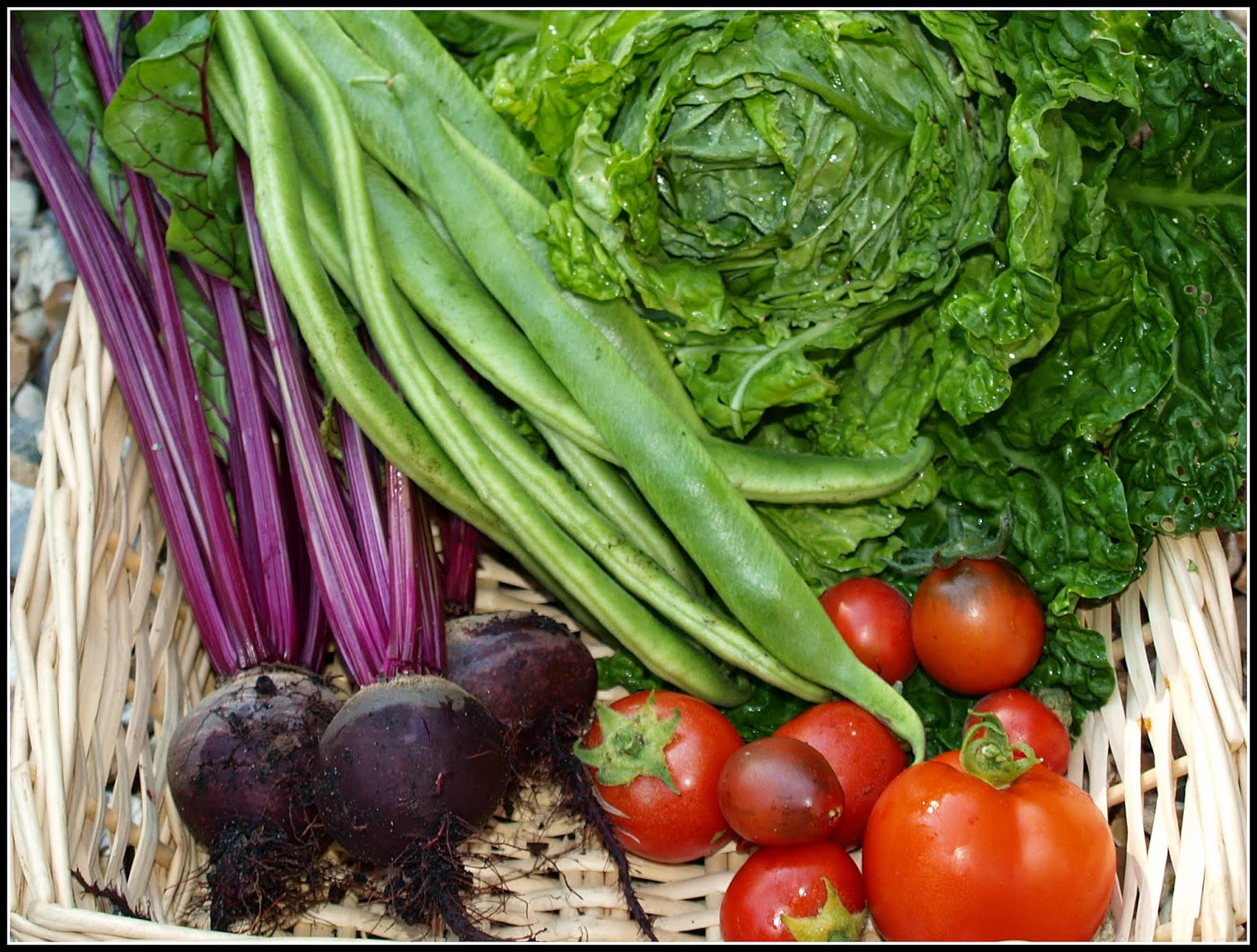
In that basket there are a "Predzvest" cabbage, some Runner Beans, three "Boltardy" beetroot, some Scarlet Empire" Runner Beans, and small selection of various tomatoes.


And of course I got some more potatoes. These are "Nicola" again (800g from one pot).


Here they are after washing. They are just as smooth and unblemished as ever.


I'm very proud of these carrots too. No Carrot Fly damage at all. The solitary "Iznik" cucumber is less impressive though.


The tomatoes are "Ferline", and there are two types of chilli - mostly "Nosferatu", but the big one is "Ohnivec". Here is the same selection in scrubbed-up form:


I can't say which varieties the Carrots are, but there are evidently at least two different ones here:


later in the week I pulled another batch of "Boltardy" Beetroot. These were roasted along with some shallots and Thyme, as an accompaniment to roast beef.


These are the "Nosferatu" chillis. I am going to dry these ones and save the seeds for next year.


I managed to assemble about 180g of Raspberries too. Not as many as I would like, but when combined with some Blueberries from the batch I had picked the previous weekend, it was sufficient for a nice dessert for us both.


Looking back at all this, I feel very smug! It feels so satisfying to bring in such a varied harvest. It makes all the hard work at other times of the year seem so much more worthwhile.

Sunday, 24 August 2014

Foraging

At this time of year the hedgerows are, as the saying goes, "groaning with free food". You just have to go out and help yourself to it! This is exactly what I did on Friday.

Last weekend we went out for lunch to a country pub, and on the way home through the lanes I noticed a plum tree laden with fruit. This Friday I went back to that place and picked some of the plums:


It turned out to be not just one plum tree, but a whole line of them, absolutely laden with ripe fruit, and easily accessible too. I could hardly believe my luck. In the space of half an hour I picked 12.5kgs!


The plums were mostly of two types - some red and some yellow.


If I had wanted to, I could easily have picked 50kgs. It was hard to know when to stop!


As I was loading the trug-tub full of plums into the car, I noticed these:


They are Sloes, a close relative of the plum. You wouldn't want to eat them raw because they are incredibly tart and astringent, but they are great in a Hedgerow Jelly, as well as being the vital ingredient of Sloe Gin. Fortunately I was well prepared, and had in the car a container in which to collect a few, along with a handful of Blackberries.


Most of the Blackberries were under-ripe, but there were enough to be worthwhile if you looked carefully.


While I was gathering the Sloes and Blackberries, my eye lit upon these:


They are Elderberries, of course. I just HAD to collect some!


If I had been into brewing I would probably have gathered a few of these too. They are Hops:


With plans for making jams, jellies and chutneys chasing each other round my brain, I drove home and more or less straight away phoned my friend Rosemary, who has a big Bramley apple tree in her garden. A short while later, a couple of kilos of Plums were traded for a couple of kilos of cooking-apples.


Apples are an important ingredient in many jams and jellies, because they contain high levels of pectin (which helps the jelly to set), and hedgerow fruit usually has only low levels of pectin.

I'll show you what I made with all this fruit in a post in a couple of days' time...

Saturday, 23 August 2014

Salad showcase

We eat salad a lot, and it probably doesn't figure on my blog as prominently as it should. I often pick just a few leaves here and there, and this doesn't seem as significant as harvesting, say, a cabbage. To me this is part of the attraction of home-grown salads, and I try to make sure there is always something leafy available for us.


The heart of most salads in the lettuce, and this year the lettuces have been very good. I have grown some very good-looking ones too...

"Cervanek"

"Marvel of Four Seasons"

"Rossa Romana"

These next couple are not Lettuces, but Radicchio (red chicory), but can serve the same purpose in a salad, especially in Winter. Their leaves start off being green, but as the weather turns cooler in the Autumn, they turn progressively redder.


No salad with those in it is going to be boring!

Around the edge of my PSB bed I have been growing some Lambs Lettuce (aka Mache, Corn Salad), which is now ready for cropping.

Mache

With both the Lambs Lettuce and the Landcress, I will pick individual leaves rather than complete plants, and they will re-sprout, making them last longer.

Landcress (aka American Cress)

Elsewhere I have some more tiny seedlings of Landcress coming along. They will be ready for planting out in a couple of weeks' time.


Landcress is much easier to grow than Watercress. It doesn't need running water, though it does prefer moist soil. It has a nice peppery flavour, very similar to Watercress, and you won't need much of it. We often have a few leaves of it in a mixed salad, or use some as a garnish, but you probably wouldn't want a salad composed solely of Landcress because it could be a bit overpowering.

These are some Endive seedlings, which I hope to find space for soon. During the Summer months of this year my Endives have not done well. They have mostly bolted before maturing, so they have been wasted. With a bit of luck they will do better in the cooler weather of Autumn.


The Radishes I sowed in pots are looking promising too - despite having had some of their leaves nibbled. They are just beginning to bulb-up.


Of course most salads include Cucumbers and Tomatoes too; I nearly forgot to mention them. We have had lots of Cucumbers available for salads this year, but far fewer Tomatoes than usual, for the reason that you all know about. One other salad ingredient that features regularly in our household is the Beetroot.


We normally serve this separately because it would stain all the other ingredients, but the odd beetroot leaf does occasionally find it way into the mix. If you look closely at the photo below you will see a tiny one right in the centre (green with red ribs).


My Mesclun recovered from its Flea Beetle attack, and I am cropping it now. You can see a few Sorrel leaves from it in that photo above - oh, and some of the Leaf Celery.

Friday, 22 August 2014

An attempt to revitalize some herbs

At this time of year, many of my herbs have a very tired appearance, and their leaves no longer have the freshness and zing needed to make them appealing for use in the kitchen, like this Oregano plant:


I could just call it a day and leave them till next year, but I think it is worth trying to revitalize them and get a bit more from them before the cold weather comes. The way I do this is to give the plants a very severe cut, taking them down to just an inch or two above soil level. Here is the same Oregano plant after the treatment:


In similar fashion, here is a trimmed pot of Chives:


and one of Mint:


Then I give the plants a good watering, with a dose of general-purpose liquid plant-food. A week or 10 days later, they will hopefully have re-sprouted. Here are the Chives:


and here is the Mint:


The Oregano has not yet responded to the treatment, (I only did it last weekend) so I can't show you that, but I'm confident that some new growth will appear before Autumn arrives.

This one is a longer-term investment - a Bay tree in the making:


I currently have two potted Bay trees which must be about 15 years old (or possibly more - I really can't remember) and they may not last forever, so I am rearing two more to replace them in due course (I have another one not pictured here). My technique is to cut off at or below ground level one of the suckers that my big Bay tree produces from time to time, dip it in hormone rooting powder and then push it into some moist compost. A few week later the cutting will produce some new leaves, and you know then that it has "taken" - meaning that it is now growing. When the cutting is well established you can start to train it. As you can see, this one of mine is a bit crooked, so I will shortly be tying it quite tightly to a short stake in order to persuade it to grow straight. Bay grows very slowly, so it will be a couple of years before I can consider this cutting to be a tree.

Thursday, 21 August 2014

A rant about poor compost

As lots of fellow bloggers have been doing recently, I feel I have to draw attention to how poor much of the commercial compost on sale these days is. Even leaving aside the issue of the weedkiller-contaminated compost with which I had to contend, very frequently the compost seems to be completely lacking in nutrients. Plants sown or planted in it can barely survive, let alone thrive. Look at these little cabbage seedlings, which are now a month old:


By this time, they should be at least twice the size, and they should be a healthy green colour, not yellow and sickly like these.


The trouble is that a high proportion of the content of commercial compost is material that has been discarded specifically because it is no good! Local Councils encourage us all to compost plant matter at home (some councils provide free or heavily-subsidised compost bins), and only to take to the Household Waste Recycling Facility (aka Tip) the material that is too big/tough to compost without being shredded, or is diseased. Is it any wonder therefore that commercial compost is poor? Where are the nutrients supposed come from?


This one mentions NPK and trace elements, but significantly gives no indication of how much of each is present. The patented wetting agent is evidently considered the most important feature. I would have thought that good compost wouldn't need an artificial wetting agent.


The blurb on this one has all the right words - "peat-free", "organic", "recycled".
 

But what are "composted timber residues"? Presumably wood!

How long would you expect your compost to provide plants with the nutrients they need? Suppliers of commercial compost evidently expect it to be a short time, probably because they hope you will then go and buy some of their expensive plant-food to replenish the poor compost, as evidenced by this next photo:


 I have seen some multi-purpose composts say that they provide nutrients for only 3 - 4 weeks. Surely this means that the nutrients are added artificially during manufacture and are easily leached out when your plant-containers are watered?

Until recently, most commercial composts used to contain a fair proportion of peat, but it has become politically incorrect to use peat, because this depletes the ancient peat-bogs, a resource that is renewable only in the very long term. But the fact is, peat is an excellent growing medium for young plants. Look at these words "...contains higher levels of peat for a better, more consistent growing medium..."


This puts gardeners in a difficult position. You have to see it in context though: we extract huge quantities of oil and gas from the earth and people seem to consider this to be OK - even "essential" - so how does this differ from extracting peat? What proportion of the population even know what a peat-bog is, let alone considers it essential to preserve? Using peat for growing plants doesn't pollute the atmosphere like burning oil does either.

August 2014: seedlings in 3" pots of multi-purpose compost

There is definitely an opportunity here for an enterprising company to develop compost that does have a good level of nutrients, does not contain peat, and does not consist mainly of discarded household rubbish. What happens, for instance, to all the fruit and vegetables that are rejected by the big supermarkets as being sub-standard or surplus to requirements? We are told they are "ploughed into landfill". Could they not form the basis of organic compost? What about the husks from maize and sweet corn, consumed in vast quantities by people all round the world? Could they not be used for making compost? There must be lots of things like this that could be used, if only someone thought about it. Anyone know an entrepreneur...?