Friday, 19 May 2017

The start of the Salad season

With increasing temperatures and (at last) some welcome rain, the vegetables in my garden have started to grow in earnest, rather than just struggling to survive.

Over the last couple of weeks I have been harvesting Radishes, which are normally the first salad veggies to become available each year. This year mine have not been such fine specimens as I usually produce. I think the dry conditions have not suited them at all well, and the slugs seem to have attacked them more than usual too.

The so-called "Daddy Salad" I sowed in a seed-tray has been brilliant though. I have already had four cuts from it, though I do cut the leaves carefully and only take the biggest ones each time.


The pea-shoots have been tasty, if rather scarcer than I had hoped. Not all of the peas germinated; I used old seed, so I suppose that's hardly surprising. However, I notice that they have started to produce a second crop of shoots now.


I have another tray of little lettuce seedlings coming along (mixed varieties). These ones will not be picked as Baby Leaves, but will in due course be planted-out in a raised bed for growing as "proper" lettuces.


In the relevant raised bed I already have a number of lettuces that are rapidly approaching pickable size:


I have one or two specimens of several different types:

The 2 at the top left are "Dubacek", and top right is "Tom Thumb".

I'm not sure what this one is, because it came from a mixed pack.


This is "Redin", a red 'un!


And this is the unmistakeable "Little Gem", a compact Cos / Romaine type.


And this frilly little number is "Lollo Rossa".


In the Right foreground of this next photo you can see my two half-rows of Beetroot.

Behind the Beetroot are Radishes

Here they are in close-up. They're obviously a long way from ready, but they are looking good so far.


Finally, there's the little square mini-bed of Baby Leaf Salad:


There's a bit of everything in there - lettuces, endives, rocket, cress, even a few stray bits of the self-seeded Celery Leaf (which is coming up everywhere!).

Thursday, 18 May 2017

Culinary herbs

Culinary herbs are easy to grow, don't require much space and are expensive to buy as ingredients, so it makes a lot of sense to grow your own if you like using them in your cooking. We use a lot of herbs, and my garden contains many of the more common varieties. Spring and early Summer are the best times for herbs too - lots of lovely fresh new growth.

Most of my herbs are in pots, which I find easier to manage and less prone to pest and animal damage, like this Greek Oregano:


Similarly, this Winter Savory (my favourite for serving with Broad Beans).


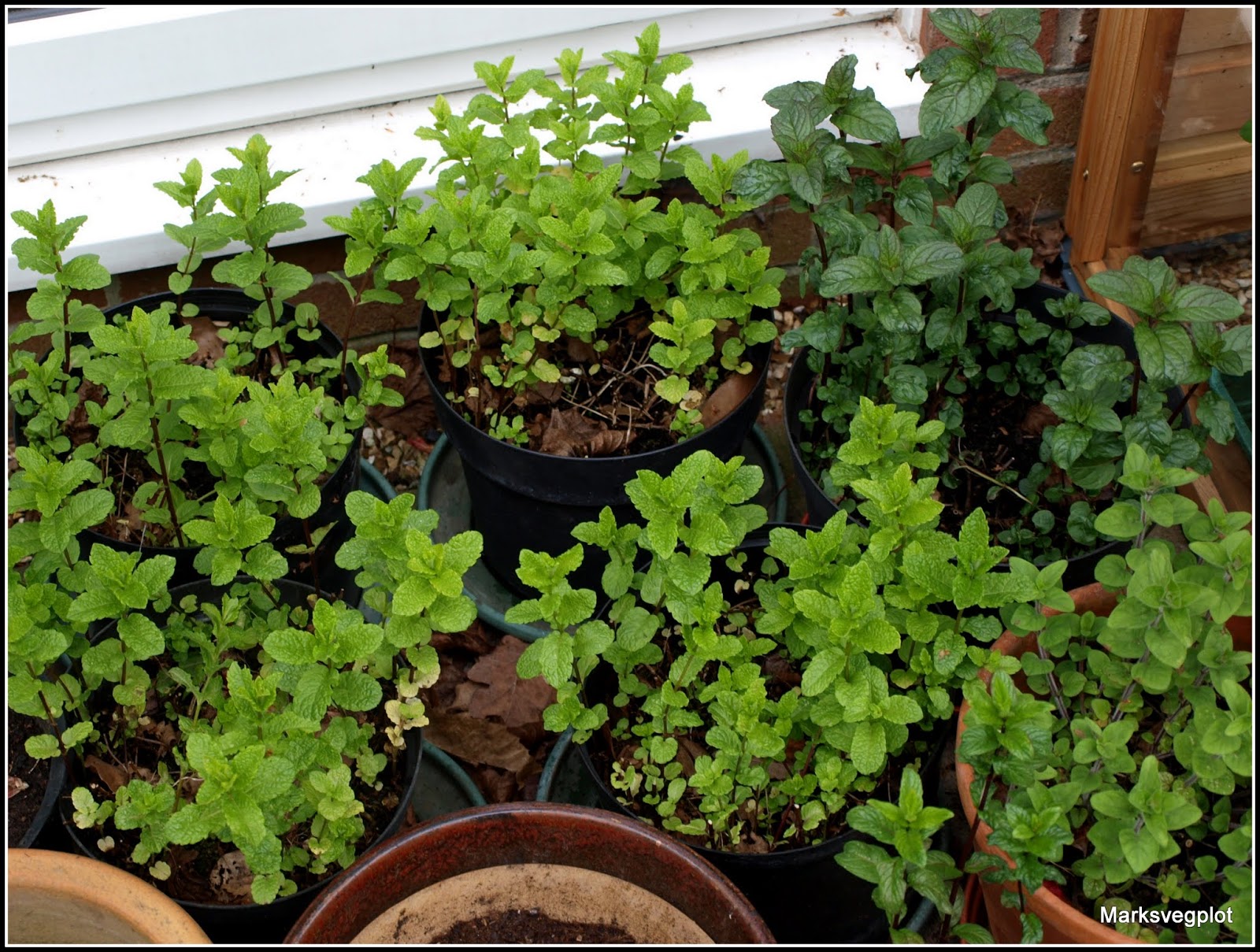
And I have lots of pots of Mint, along with Parsley probably our most commonly-used herb...


Most of it is Moroccan Mint, like this:


But I also have this Black Pepper Mint


And this Pineapple Mint:


Dotted around the garden wherever I have been able to find space are loads more herbs. This is Thyme:


Sage...


Chives...


Parsley (This is the Curly type, but I have the Flat-leaf type too)...


This is Rosemary, looking a bit the worse for wear. It hates the Winter, but now that the weather is warming up I suspect it will improve.


When growing herbs, it's important to know what type of site and soil conditions they like, because in the wrong conditions they won't thrive. For instance, Mint and Parsley both like moist soil and tolerate shade, whereas the Mediterranean herbs like Rosemary, Thyme, Oregano and Sage like full sun and well-drained soil. In fact many of them do best in really dry stony soil.

Basil is the only herb I grow indoors, because I find it very susceptible to slug- and weather-damage if it's planted outside. The soft fleshy leaves of Basil are easily damaged by hail or heavy rain. Besides, it's often too cold to grow Basil successfully in the UK's notoriously cool, gloomy Summers, so I keep mine in pots indoors on a windowsill. Having said that of course, if you have a greenhouse or coldframe available, then that may well be the best place to site your Basil.


By the way, there are loads of photos of herbs on the HERBS page of this blog - have a look at the tabs at the top of the page.

Wednesday, 17 May 2017

Tomatoes - squeezing in a few more!

You know what I'm like with tomatoes (and chillis) - I find it hard to part with any of them, even when I have "too many"...  Well, I have given away a load of my spares, but I still have more than I had originally planned to keep. The thing is, my big coldframe was just about empty, so I have re-configured it to accommodate three more tomato plants!


I have re-positioned the narrow top shelf, so that it is in the middle position now


On this shelf are two plants of "Maskotka", a bush / trailing variety, and the plan is for them to trail down from their lofty position. The height of those sticks is such that I can just close the lid of the coldframe if necessary.


Down below, positioned centrally, is one plant of "Losetto", another bush variety, but one which is supposed to benefit from staking. I'll not let it grow taller than the height of the shelf. "Losetto" has the added benefit of being very blight-resistant.


The fact that these plants will be effectively under cover even with the lid and doors of the coldframe open, will give some protection from the airborne spores of blight anyway.

Tuesday, 16 May 2017

Bean-poles are up

Another significant milestone has been reached in my gardening year: the bean-poles have been erected. In my normal rotation plan, Purple Sprouting Broccoli is followed by Runner Beans, so the PSB plants had to finally come out. The bees will be disappointed!


When "disassembled", the four PSB plants produced a huge amount of material for the compost bin. Only the roots and a few inches of the stems have been set aside for going to the tip. After removing the PSB I refreshed the raised bed with a few handfuls of pelleted chicken manure and a generous layer of home-made compost, worked thoroughly into the soil. Runner Beans like soil that contains a lot of organic matter.

My Runner Bean plants are still quite small.


They will definitely be OK in their pots for a few more days. This will give the soil a chance to settle, and for the Blackbirds to carry out their inevitable assault on the fresh compost. Judging by the weather forecast, the soil may also get a good soaking of rain. This would be welcome, because it's currently very dry after weeks of almost no rainfall.

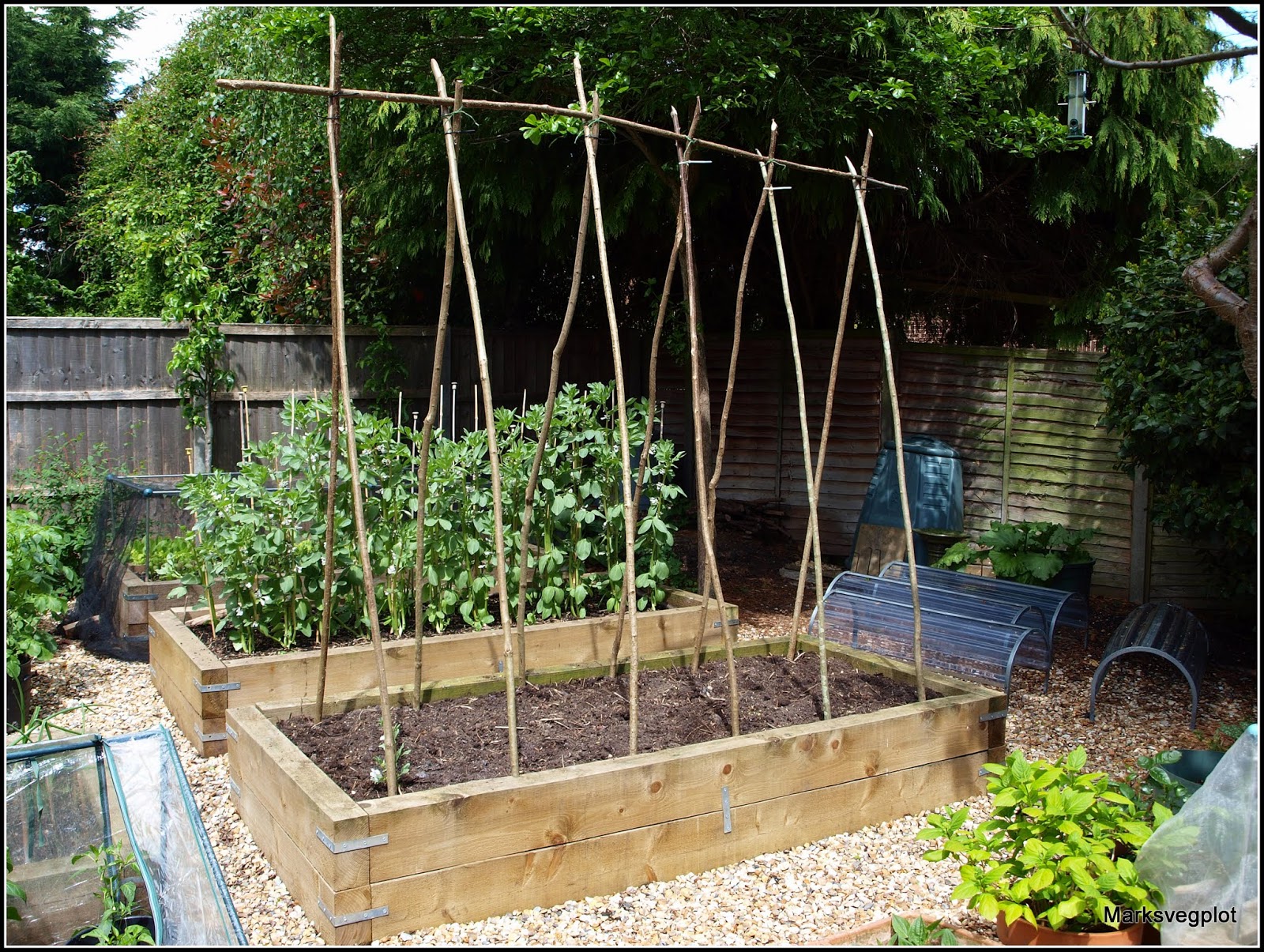
Then the big task - putting up the poles. This year I am using Hazel poles kindly given to me by the Countryside Services department of my local council.  For me the main attraction of the Hazel is that it is locally produced and sustainable. These poles come from a place close to West Green House, about which I have written a few times. It's about 5 miles away. Also the poles are rough-textured, unlike the smooth bamboo, and this will hopefully make it easier for the beans to grip them as they climb.


The theme in my garden this year is "Quality before Quantity", so I have put up only 6 pairs of poles, with another pole along the top to aid stability. In the past I have always had 7 pairs of poles, but I think the beans will be better if they have just a little more space.

The Hazel poles are a few inches longer than my usual 8-foot bamboos, so tying them into place was a bit more difficult, even though I was able to stand on the wooden sleepers of the raised bed. I cheated a bit by using some plastic cable-ties, which are quicker and easier to use than string, cutting down on the reaching up at full stretch - something that my Fibromyalgia doesn't like at all!


So there we are then - one set of retro, rustic bean-poles all ready and waiting.


I expect to be planting out the beans in a few days, hopefully after that long-awaited rain.


Monday, 15 May 2017

Promotion

My chilli plants have been "promoted". By this I mean moved to bigger pots.

Until yesterday they had been in 5-inch / 12.5cm pots like this:


Now they have gone into 10-inch / 25cm pots:


The doubling in diameter of the pot makes a big difference to the volume of soil to which the plant has access. If I were a mathematician I would work it out, but I'm not. Even I can see that it's not just twice as much!


Although the weather is much improved compared with say a month ago, I'm still keeping the chillis under cover when the sun is not shining. The plastic "Seedling Greenhouses" have been put to good use once again:


My biggest chilli plant (an unknown variety) has its first flowers already.


In a way, growing unknown varieties is more fun than growing identifiable ones. In this case all I had to go on was one dull red shrivelled-up pod, full of seeds. The pod was pretty big, so actually this might turn out to be a sweet pepper, like Long Red Marconi or something!

I think I have mentioned previously that my chillis this year are a very mixed bunch. The ones pictured above are good, and of a size that I would consider normal for this stage of their lives. Some others though are still resolutely tiny, like these:


I don't know what has made the difference, because they have all been grown in exactly the same way, using the same compost etc. It must just be "one of those things".

Sunday, 14 May 2017

Runner Beans started off

Now that my tomatoes are safely potted-up, my thoughts have turned to beans. The Broad Beans are looking very promising. They are covered in flowers.


I have been dutifully tying-in the plants to their canes as they grow, to stop them flopping over. Most of them have been tied in three places now.


I have been watching for bees visiting those flowers, and I have deliberately left the flowering PSB plants in place to attract them. I have seen lots of honey bees on the PSB, but the Broad Beans don't seem to tempt them so much. It seems to be mostly Bumble Bees that pollinate the Broad Beans.


Flowering PSB. The one on the right is "Red Spear".


The PSB is going to have to come up soon though, because it needs to make space for the Runner Beans that are to follow it.


This year I plan to grow 12 Runner Bean plants, but in my usual fashion I sowed twice that number. They have all germinated too.


I have used tall pots because Runner Beans quickly put down long roots


I start my Runners off in pots rather than direct-sowing them. There are two reasons for this: first, because this way I can get the beans started early - before I have to clear away the PSB - and second because when the beans are in pots it is easier to protect them from the weather and from pests. When they are about 6 inches tall and have their first set of true leaves I will plant them out, but before that I will need to remove the PSB, prepare the soil for the beans (adding home-made compost, and pelleted chicken manure), and erect the bean-poles. This year I will be using Hazel bean-poles instead of my usual bamboo. I'm expecting it to be a bit trickier to erect the poles, because I will have to tie them together with string rather than using plastic clips like I normally do.


I have decided that this year I will not grow any French beans. Normally I grow some along with the Runners, but they often get overshadowed by the vigorous growth of the Runners and don't do as well as I would like. Besides, French beans are readily available in the shops all year round, but Runners are less common, so my plan is to grow as many as possible of the latter and to freeze any surplus.


This is nothing to do with beans, but I just want to slip in a photo showing how my potatoes are coming on. They are looking very lush after the rain we had a couple of days ago. You can tell that this is a recent photo because of the potted-up tomato plants seen in the background!


Saturday, 13 May 2017

Potting-up Tomatoes

I think (I hope) the risk of frost has passed now, so I have potted up my tomato plants. Tomato plants are very "tender" and are easily damaged by frost. I expect a few people lost theirs when we had that severe frost 10 days ago. I always grow my tomatoes in pots, so theoretically it is possible to bring them under cover if frost is expected - I did once put all mine in the garage for a couple of nights, but it was a big pfaff! It wasn't easy either, because each pot has a tall bamboo cane in it. It's definitely better to wait until night-time temperatures are in double figures, if you have the patience.

I don't have that amount of patience, but the weather forecast for the next 10 days shows nothing below 8C, so I'm taking a chance on it. In an emergency, I could always drape them in fleece...

The 2 with short green-topped canes are Bush varieties "Grushkova" and "Losetto"

I have potted-up 12 plants of 11 different varieties, in my big Stewart self-watering pots (officially called "balconnieres"). The variety of which I have 2 is "Ferline", one of my favourites, a reliable cropper with an above-average blight resistance.

This year I am using (with some trepidation, given my experiences with contaminated compost in the past) Levington's Original Multi-Purpose compost, with some added Growmore and pelleted chicken manure. My reasoning is that it is probably as good as any - it's really a matter of luck. Even the well-known brands are not immune from weedkiller contamination, although they are most reluctant to admit it. The texture of the Levington's stuff seems pretty good, and it doesn't have any big lumps of wood, plastic or whatever in it.


One of my plants is a lot smaller than the others. This is "Vintage Wine", a potato-leaved variety. It has big pink fruits with golden-yellow stripes. I imagine it to be rather like a bigger version of the well-known "Tigerella". I'm hoping that nothing is amiss, and that it will eventually catch up with the others.


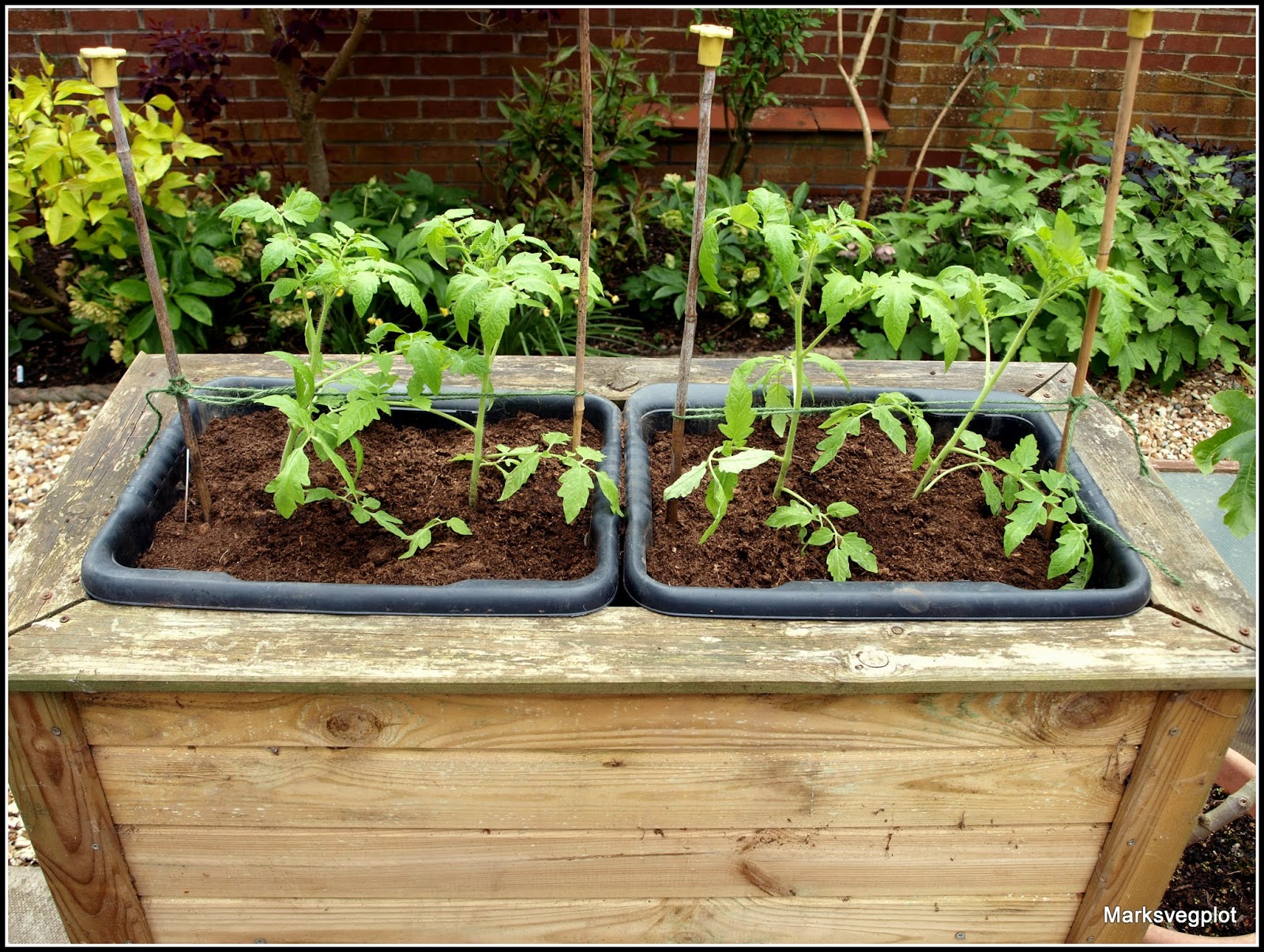
As well as the plants in the big containers, which are mostly indeterminate (cordon -grown) ones, I have put four "Maskotka" plants into the tall wooden planter in which I normally grow baby carrots. This planter normally lives under the kitchen window, at the front of our house, but I have moved it onto the patio, round at the back.


The idea is that the plants will trail downwards, but still remain mostly off the ground so less easily accessed by slugs. "Maskotka" is one of my all-time favourite tomato varieties, which I grow every year. It produces masses of small red fruits, larger than the traditional cherry types, but smaller than the so-called Salad tomatoes. It's the one most favoured by our grandchildren too.

Following my usual practice, I have a complete set of spare plants, just in case of casualties or "frost-induced disasters".


I will keep these in their current 5-inch pots for another couple of weeks, and if I don't need them I will give them away. Kept in the small pots they will be easier to protect if necessary.