Sunday, 8 November 2015

Garage gardening

There is not much in the garden for me to write about at present, so I thought I might just give a mention to my garage, which is currently doing duty as a chilli greenhouse. "Greenhouse" is hardly the right word though, because the garage is pretty gloomy. But it does have a side window, and I have arranged next to this a big wooden potting-bench, on which there are now four chilli plants and a few other bits and bobs - such as some herb and Geranium cuttings.

Conditions in the garage are therefore not ideal for the chillis, but they are certainly a lot better than being outside. At least the plants are relatively warm and definitely shielded from the wind.

Here you can see my "Alberto's Locoto" Rocoto chilli:

"Alberto's Locoto" Rocoto

It is big and straggly (and losing many of its leaves), but its fruits are finally ripening.

Rocoto

I have picked some of the ones that are beginning to go red, and I have taken them indoors to ripen fully in the warmth. Once they start showing some red I know it will only be a few days before they are fully ripe.

Rocoto


Next door to the Rocoto is one of my "Aji Limon" plants (I have 3). It's fruits too are ripening at last. There are a fair few of them, and yet again the garage has meant that I have been able to keep this plant going long enough to ripen fruit that would otherwise probably not have made it to maturity. I have found that Aji Limon is usually one of the last to ripen.

Aji Limon


Aji Limon

The top shelf of the potting-bench is hard to photograph in the low light:


Up there are two more chilli plants. I lifted them down to photograph them for you. The short one is "Calico", with its variegated foliage and purple (eventually red) fruits.

Calico


Calico

The tall one is the Nosferatu / Cayenne hybrid we nicknamed "Nosferatu Green Leaf", on account of the fact that its foliage is much greener than that of a normal Nosferatu. The fruits are Nosferatu colour, but Cayenne shape. None of them have turned red yet, but I expect they will eventually.

Nosferatu Green Leaf

So there you have it - my "greenhouse substitute". My ambition is to one day have a polytunnel, so you just wait...!

Saturday, 7 November 2015

Leaves with everything

Today the weather is much more like "normal" November weather, with strong winds and torrents of rain - although it is still very mild. Between rain-showers I took a little trip round my garden with the camera in hand. What I saw was mostly leaves. Wet leaves.

Libertia (with Maple leaves)

Hellebores (with Dogwood leaves)

Scraping away some of the leaves on top of those Hellebores, I find that many of the plants are putting up flower-stems now. I think it will soon be time to trim off most of their foliage to make room for the new growth. I'm not doing today though!

New shoots coming up on a Hellebore plant

There are still a few little splashes of colour, but it's mostly a definite case of "faded glory":

Geranium - a very "past it" bloom

My dead-heading regime hasn't kept pace with this one!

Soggy Coreopsis!

There is a little colour on some of the Hydrangea flowers still.

Still a little colour on some of the Hydrangea flowers

But most of them have faded from bright pink to a muted grey-green colour.

Add caption

Whereas the Blueberries have gone the opposite way. Leaves that were plain green during the Summer are now an eye-catching scarlet.

Blueberry

This tiny Calendula is probably the last of its kind for this year, but it certainly stands out in the gloom!


At one point this morning I had to go out and rescue my Olive tree, which had been blown over by the wind, despite being in a big (and heavy) pot. I also weighted-down my mini-greenhouses with some spare bricks to stop them blowing away. I'm mighty glad I staked all my Brassica plants the other day, otherwise they would probably have been flattened by now!

Back to the armchair gardening now...

Friday, 6 November 2015

A bad (business) trip

This past week I was away from home for 3 days on a business trip. I stayed in a hotel which was very poor in many ways (It was booked for me by my employer, I hasten to add). Shortly after getting home on Wednesday evening I began to feel very unwell, and by the next morning it was all too obvious that I had a bad dose of food-poisoning. I cannot prove this, but it seems likely that I have been a victim of poor food hygiene in the hotel. For 24 hours I had the full-works D-and-V and felt really awful. Unsurprisingly, I have been unenthusiastic about everything, even blogging! However, I am more-or-less recovered again now.

One of my first jobs has been to go round and check how my chillis are faring. Since most of them are indoors or in the garage now, many of their fruits are continuing to ripen, despite the lateness of the season - like this rather impressive Rocoto:


It is an "Alberto's Locoto". (A type of Rocoto chilli), grown from seeds given to me by Terry Wells, a fellow member of the UK Veg Gardeners forum. (Thanks, Terry!). To give you a better impression of the size of this fruit, here it is next to a hen's egg:


My Rocoto plant is currently residing in the garage (which fortunately has a window, so is not totally dark), and many of its other fruits are showing signs of ripening too, which is great because earlier in the year I thought I was unlikely to get any fruit at all from it, let alone any ripe ones. It was very late setting fruit.

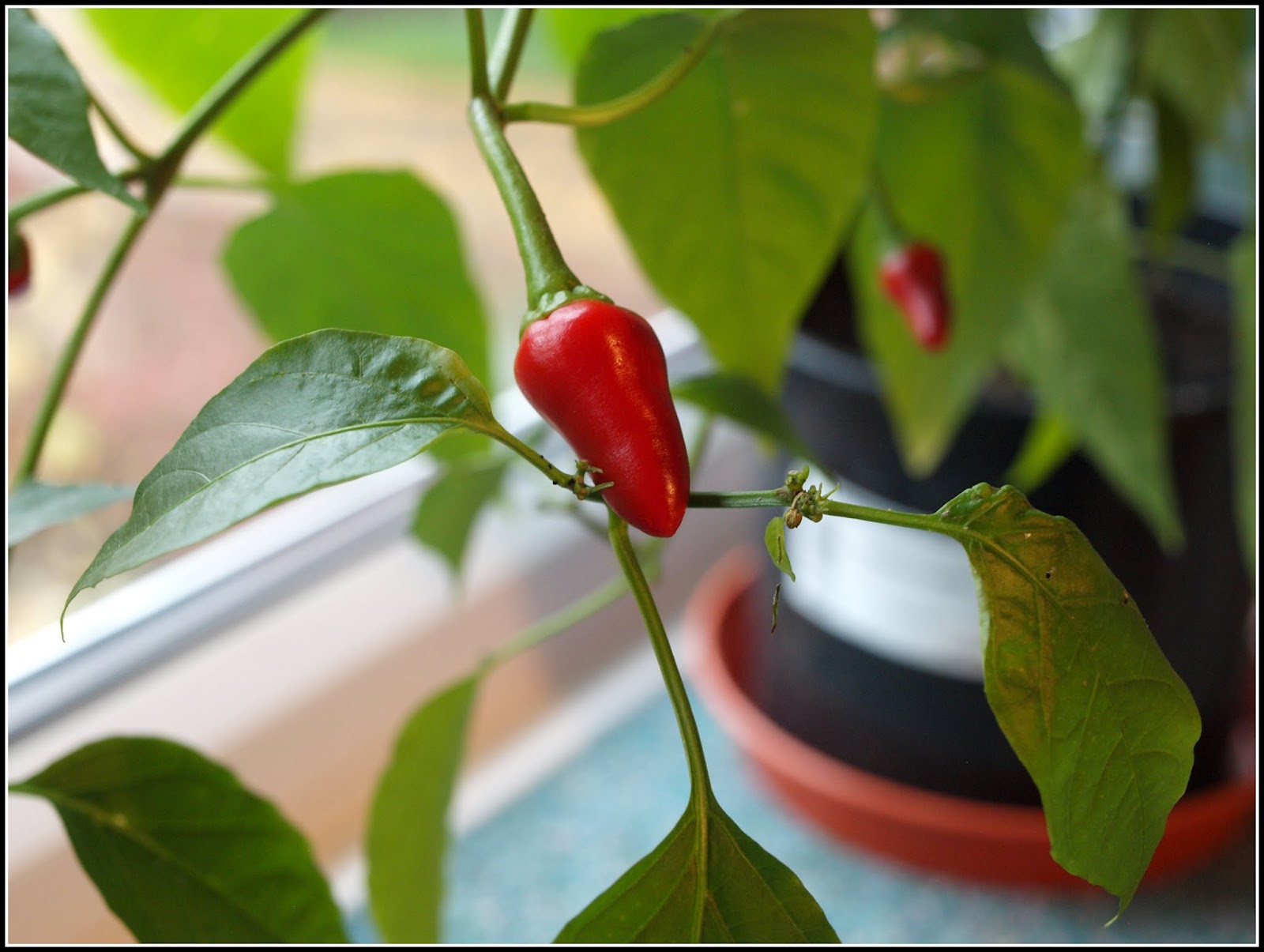
This smaller chilli plant is also doing well, occupying part of the windowsill in our Guest bedroom:


It is a plant which popped up in my Asparagus bed, presumably growing from a seed which got deposited there in my home-made compost. I have no idea what variety it is, and in fact I think it may be unique - a chance hybrid from some of the other varieties I have grown. Some people have said the fruit looks like "Apache", but that the flower definitely doesn't. (And I have never grown Apache).


The flowers are very pretty- mostly white, but with a purple edge to the petals, and purple anthers.


I shall be saving seeds from this one to see if I can grow it again (deliberately this time) next year.

This is one of my unidentified Turkish varieties. I just call it "Turkey, small, red":


This plant was also grown from a volunteer, potted-up very late in the season as a desperate measure, at the time when my indoor-sown plants were under such severe aphid attack that I thought most of them would succumb. This type of chilli is very useful for us in the kitchen, so I will be saving seeds from this one too!

I have stripped all the fruits off the Brazilian Starfish, which is too tall to bring indoors, even though most of them are still green. The weather has turned wet and windy (though still not very cold), so I reckoned it was best to ripen these fruits indoors. Here you see them with the odd one or two of several other different types.


There is not much going on in my garden at present - apart from a deepening layer of soggy fallen leaves - so I probably won't be writing much about growing stuff for a while. Maybe at the weekend I'll feel well enough to cook something and write about that...?

Wednesday, 4 November 2015

A welcome volunteer

Whilst raking leaves off the shingle the other day, a little flash of green amongst the yellows and browns caught my eye. Closer inspection revealed that it was a Cyclamen leaf:


Never one to miss an opportunity, I decided I would adopt it. After all, Cyclamens are beautiful plants... I carefully scraped aside the shingle until the plant's corm (like a bulb) was visible.


Using a dibber I gently removed the plant. In fact I also found another one nearby, so I had two. One of the tiny plants had a second leaf forming.


For such tiny plants they had very well-developed root systems.


I potted-up both corms in one 4-inch pot - "for company"! I'll put them into separate pots later on, if they survive and grow bigger. I used a potting medium that was 50% general-purpose compost and 50% gravel, mimicking the conditions in which I had found the plants.


Right, now I have to go and do a bit of research about Cyclamens. A good place to start will be the blog of my friend Sue - "Our Plot at Green Lane Allotments", because I know she is expert on such things...

Tuesday, 3 November 2015

Purple Sprouting Broccoli

Regular readers know that I am a big fan of Purple Sprouting Broccoli (PSB), and that I grow some every year. This year I have just 3 plants - one each of "Early Purple", "Rudolph" and "Red Spear". I made a conscious decision to go for fewer plants this time. Last year I had six, and it was too many: we were bored of broccoli before the crop was finished. Having fewer plants also means that in all likelihood they will be individually a lot bigger. Look at the size of this:


I think it is about 5 feet tall. Hopefully it won't get much taller. I say "it" but I really mean "they". All three plants are a very similar size. Mine are firmly tied to sturdy wooden stakes because they could easily be blown over if we get any severe gales. Despite their size, PSB plants have surprisingly shallow roots.


The embryonic flower-shoots which will eventually turn into the "spears" that we eat are now visible in the leaf axils.


When I took the netting off these plants at the weekend I gave their bed a general tidy-up, removing a few small weeds and a few dead leaves that had fallen off the PSB. This is good practice because decaying leaves can harbour slugs and moulds. I also dug in a few handfuls of Growmore granulated plant food to give the plants the nutrients they will need to produce a good crop for me. Everything is on track at present, so let's hope it stays that way!

Anyone else out there growing PSB this year? And if so, what varieties have you got? I'm always on the lookout for good varieties to try.

Monday, 2 November 2015

Harvest Monday - 02 November 2015

Well, I think this is my first proper Winter veg harvest:


It's a "Mila" Savoy Cabbage. It's not big, but it looked bigger when it was still growing! The rather ratty outer leaves were discarded of course.


Actually that Cabbage was just the right size for the two of us. The Savoy type provides a good mix of light and dark green leaves - just what we like!


Meanwhile, we're still eating salad. This is "Amaze", another one of the trial varieties kindly supplied by Marshalls.


Yesterday I picked another batch of Carrots, and there are still plenty more to come. This has been probably my most successful crop of the year. They wouldn't win any prizes for good looks or uniformity, but the main things is they are fly-free. I have had to throw away one or two split ones, but the vast majority are fine.


Now what about this: I know they say "If you pick it, you can count it", but this is ridiculous!


That one solitary Radish was the only harvest from the batch I sowed on August 23rd. I re-used the compost in which I had earlier grown some Carrots, and it was a mistake. The Carrots also had failed completely. Their foliage was weak and twisted, whilst the roots were tough and insignificantly tiny. I feel sure this was once more attributable to contaminated compost, because Carrots grown this way (in plastic crates) have done quite well for me in recent years.

This week I'm also counting this:


They are Celeriac leaves. I keep pulling off the outer leaves of the Celeriac, in order to promote "bulb" growth and it seems a shame to just compost them. I have kept the best bits for adding flavour to soups, stews or stock. They impart a lovely savouriness, verging on the umami.


Well, that's my harvests for this week, but please take a look at Harvest Monday over on Our Happy Acres, and see what other gardeners have produced.

Sunday, 1 November 2015

Removing the nets

For the last several months all my brassica crops have been covered with anti-butterfly netting, but I think the nets have done their job now, so I have taken them off.


I think this will have several advantages. For a start it will improve airflow, which is important at a time when fungal diseases are common. By the way, the Clove spray I applied to my Brussels Sprouts the other day has had no discernible effect. In fact the fungus is even worse now!


Another benefit of removing the nets is that since access is easier, removing the nets has allowed / persuaded me to stake the smaller plants ready for the Winter gales. I had already staked the big PSB and Brussels Sprouts plants, but not the smaller Brokali.


I have now attached each plant to a sturdy bamboo cane, using a few turns of soft string:


This is the Brussels Sprout bed, also now uncovered:


I deliberately removed the nets on a dry day, so that they are not put away for the Winter in a wet condition. I have also been good and washed the aluminium poles before putting them away for the next few months.

I think it won't be long before I'm harvesting some sprouts:


After such a dismal rainy day on Friday, Saturday was dry, bright and for several hours sunny too, so the Brassicas have been enjoying their new-found freedom. You can almost hear them saying "Aaaahhh".