Friday, 6 June 2014

Shredded Lettuce, anyone?

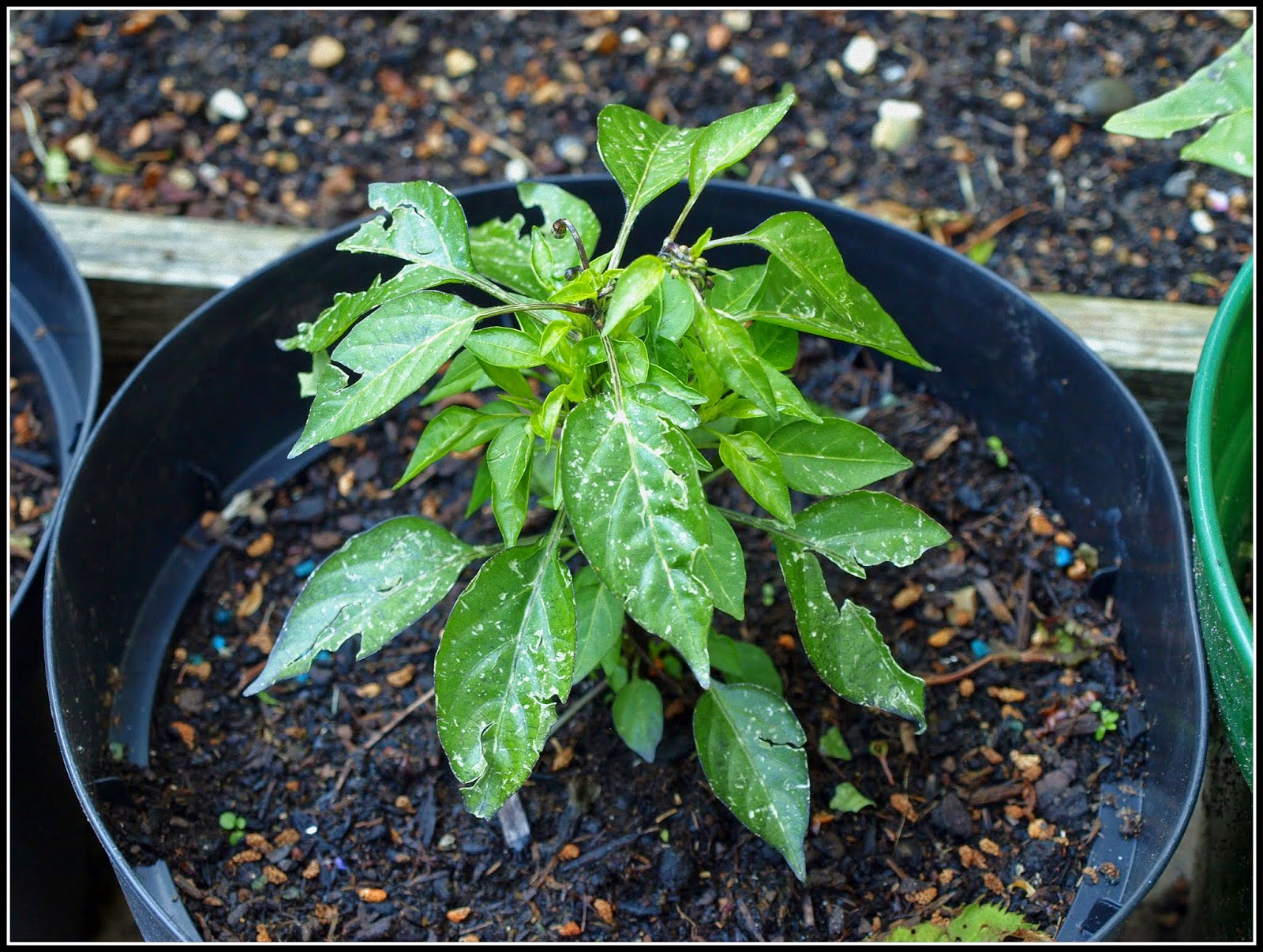
On Wednesday evening we had a terrific storm. Thunder and lightning, strong winds, deluges of rain and an amazing barrage of hail. Hail like I have seldom seen before - lashing down in violent flurries, almost like a sand-blaster, and settling in drifts like snow. And in the process shredding my plants! The only ones that escaped significant damage are the ones beneath nets and mesh. The others are all scarred, scuffed and riddled with holes.

Potato plant

One of my precious "Nosferatu" chillies

Hydrangea

Lettuce - full of "bullet-holes"

Unfortunately the plants most severely damaged are the chillies. :(
Chilli

But even slender targets like the pea-pods have not escaped damage.
Pea-pod

Every single leaf in the garden seems to be scuffed and scratched.
Broad Bean leaf

I hope that in most cases the damage will prove to have been superficial, and that the plants will survive, but I'm sure they are currently far from happy. We NEED a week of fine, calm, sunny weather to restore their health and morale!

******************************************************************************
On a lighter note... This week Jane won a whole load of Black Puddings, from Chadwicks!


Actually, they are not all black. Some of them are white. And then there is this V-pud!


Vegetarian Black Pudding?! Whatever next?

Thursday, 5 June 2014

My garden in the first week of June

Here we are nearly halfway through the year already! Today I am going to write generally about how things are progressing in my garden.

Firstly, the Runner Beans are beginning to climb. I often have to tie them to their canes with string to get them started, but this year it looks as if I won't need to do that:


Nearby, the "Winter Veg" bed is rapidly filling up. The Leeks went in last week, and the two "Predzvest" cabbages have been joined by 5 more of different types.


The last element will be the "Ruby" Swede Turnips, which will go in after the little patch of Radishes has finished.

The Lettuces have been fantastic. Some really nice specimens, and the successional sowing is working a treat.


In the bed with the Lettuces are some Beetroot (a row down the right-hand side) and a few Turnips (foreground) - and of course the Parsley (the row down the left-hand side).

The Cucumber plants are gradually recovering, though still far from strong.


The first flowers on the Tomatoes are showing colour now too - this one is "Maskotka":


The tomatoes are all looking pretty good, and I am doing all the right things to them - pinching out the sideshoots of the cordon varieties; tying the plants to the canes as they get taller etc, and I have started applying "Tomorite" liquid feed as well.


The Asparagus is continuing to provide a steady trickle of spears to augment the shop-bought ones that are everywhere now. I'll have to stop cutting them soon. 21st June is the official end of the Asparagus season here. After that time you are supposed to let the spears develop into fern, so that the plants can build up their energy for next year.


Even the Rhubarb has decided to put up some more leaves - prompted no doubt by the copious amount of rain that has fallen in the last couple of weeks.


I have not picked any Rhubarb this year. My three plants are not very big, and I decided to let them develop undisturbed this year. I think I will move them at the end of the season too, since they are not doing as well as I would like in their present site.

The Broad Beans are still a long way from ready. A fair few pods are setting, but I think the plants need more sunshine!


They got blown about a bit in the gales we had a few weeks back, but they soon righted themselves. I have supported them with three lines of string so far, and they may eventually need four.


The potatoes actually like wet weather. They have made a lot of foliage. Hopefully not at the expense of tubers though.


I expect to be harvesting the first potatoes very soon - a much-anticipated treat!

The Parsnips and Carrots in the big Woodblocx raised bed are putting on weight too. Here you can see Parsnips on the left and Carrots on the right, and if you look very carefully you might just make out a line of tiny Turnips down the middle:


I don't know whether the Turnips will manage to get enough light to grow properly. I sowed them after harvesting the Radishes that preceded them in that space, which did very well, but that was when the Parsnips and Carrots were only an inch or so tall. Still, Turnips do grow pretty rapidly, so maybe they'll do OK.

Finally for today, a token flower. The white rose-bush is covered in blooms now, and very few aphids, so I reckon that's a good result!


Wednesday, 4 June 2014

Some garden wildlife

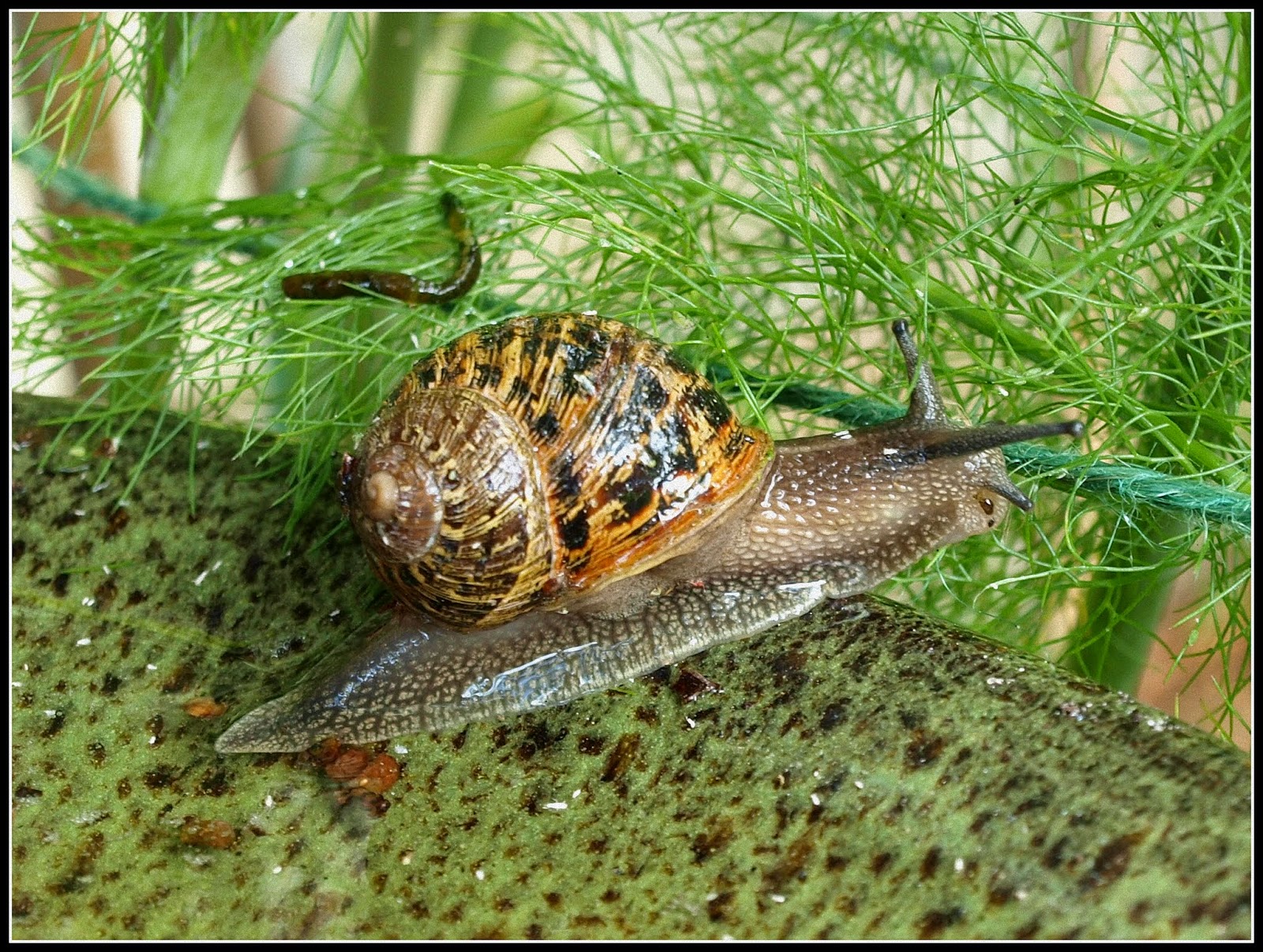
This is probably the gardener's worst enemy - the common garden snail Helix Aspersa:


This post has been inspired by one written the other day by my friend David Ford on his blog Wellcome Allotments. In a post illustrated with his characteristically awesome style of photography, David told us about how he deals with slugs and snails on his allotment. I can't hope to match the quality of David's photos, but I think my snails are at least as good as his!


This one was taking a dip in my birdbath when I spotted it - using it as a route to the succulent young leaves of my Bronze Fennel.


I let it get up to the Fennel leaves and have just a little munch before I removed it... it died happy!


Here is a different type of snail, but still attracted by the same plant:


I photographed the same subject with the flash too - it produces a very different effect.


As subjects for wildlife photography go, I think the snail is probably one of the easier ones - it may be a moving target, but never a fast-moving one!

A more welcome and very different sort of creature (and usually a very fast-moving one) is the bee:-


I'll be honest and admit that this particular bee was very lethargic - perhaps tired; perhaps injured (is one of its back legs broken?) - and thus much easier to photograph than you would expect.


This next one is a Hoverfly of some sort; I don't know which. Here it is not hovering, but sitting still, sipping nectar from a cucumber flower.


The fact that bees are in danger and in decline is well-known. The reasons are less uniformly ageed. In the circumstances, the Hoverfly may become more important than hitherto, perhaps eventually replacing the bee as the primary pollinator of our food plants.

Tuesday, 3 June 2014

Cabbages

If you want to be a successful vegetable-gardener, you have to think ahead a long way. A lot of people are just too impatient. They expect to sow one day, plant the next and harvest on the third (well, almost). The Brassica family of vegetables is one which demands a lot of patience and forward planning, since many of them take many months to mature - Brussels Sprouts, Purple Sprouting Broccoli, and some types of Cabbage, to name but a few.

I don't normally go in for Cabbage much, because I consider it to have a fairly low Value for Space Rating (VSR). One Cabbage that takes months to grow, and probably costs less than £1 to buy in a shop is often consumed in one meal. However, this year I am aiming to grow a wider range of veg for Autumn / Winter harvesting, so I thought I had better try a few Cabbages. My earliest ones sown were these "Predzvest" ones, from seed sent to me by Dominika in the Czech Republic:


I have been struggling to decipher the rather odd English on the website of SEMO, the company that markets the seeds for this cabbage. It is described as a Savoy Cabbage but it doesn't look like one, either in their picture or "in the flesh". I think it is going to be a big one though, so I have allowed it plenty of room.


One of the pair is very well-behaved, but the other is determined it is not going to sit up straight. I keep supporting it with soil around the stem, but it still flops. I don't suppose it is a major issue, but I just feel that it is not good for it to be lying on the soil surface.


Waiting in the wings I have these:-


I have two more "Predzvest" (an insurance policy, so to speak, just in case the first two failed), and I have also two of "Caramba" and one of "Tundra" (originally there were two of the latter as well, but one died).

"Caramba" is a pointed "Sweetheart" type, which matures in the late Summer / early Autumn, and "Tundra" is one a bit like the well-known "January King", and is described as "extremely Winter hardy". In view of the latter description I was surprised to see on the pack that is supposed to be harvested between June and October. The picture on the pack even shows the cabbages half covered in snow!

Besides the Cabbages, I have also got next year's Purple Sprouting Broccoli under way now:


There is one pot each of four different varieties - "Red Arrow", "Red Spear", "Rudolph" and "Early Purple Sprouting". I will probably only grow a total of four (maybe six...) plants, but I always sow a lot more than I think I will need, and then thin them progressively, removing the weakest seedlings. In a few days' time I will transplant the seedlings into separate pots and grow them on for a while longer, before planting them in the raised bed currently occupied by the Broad Beans. Then it will just be a case of waiting a further 9 months before they are ready for harvesting!

By the way, just to set the record straight, not all the members of the Brassica family are slow growers. The Radish is a brassica, and those mature in four to six weeks at the right time of year. These are "French Breakfast".


The Turnip is also a brassica and they mature in about three months (dependent on variety). These are "Milan Purple Top".


The common parentage of all the above is probably most obviously seen in their kidney-shaped cotyledons ("seed leaves"). Once you know what to look for, it is hard to mistake a brassica seedling for a member of a different family. The trouble is, they all look very similar until they begin to grow up!

Monday, 2 June 2014

Harvest Monday - 2nd June 2014

This is my entry for this week's Harvest Monday, hosted as usual by Daphne's Dandelions.

For me it's the same old story: this past week I harvested salads!


In this bowl I have lettuce ("Marvel of Four Seasons"), Rocket and Celery Leaf. The latter has to be picked when very young, and used sparingly because it is very strongly flavoured - but thoroughly delicious as well!


We have had two more small pickings of Radishes. Here's one - a mix of "French Breakfast" and "Cherry Belle".


We did also test a couple of peas (yes, literally two pods) to see if they were ready. The answer was "nearly". Next week I may show you some pictures of peas...

In the meantime, let me show you our latest acquisition in terms of crockery:


These are items from the "Steelite" range. They are all unique in terms of patterning, because they are hand-decorated. They come in many different shapes, sizes and colours. The items we bought are not marketed as a set; we just thought they go well together. And of course they are ideal for serving "Nibbles", such as Radishes!

Since my offering this week is a bit thin, I also want to show you some overhead views of my plot, as evidence that there really are some crops coming along, even if they are mostly not yet harvestable:-

The six 2.4 x 1 metre raised beds are the mainstay of the plot

Anyone who is new to my blog will be able to see very easily from this photo what sort of person I am! I like things to be neat and tidy - especially my garden. I'm not apologising for this; I'm proud of it. Long-term readers will verify that by dint of carefully planned and meticulous work I manage to get a lot of produce from a small space. The whole garden is roughly 10 metres x 10 metres.

The paved area serves as both outdoor dining-room & seedling nursery!
  
Oooh, now I'm wishing I had moved the hosepipe before taking the photos! :-)

Sunday, 1 June 2014

Blueberries netted

I have been building fruit-cages again. This time for the Blueberries.


 William Heath Robinson would be proud of me! I have cobbled together another masterpiece of improvisation using bits from my "Build-a-Ball" set and the (nearly defunct) "Seedling Greenhouse"...


In this case the balls (I only had 4 left after making the Strawberry cage) are used to extend the height of the verticals by joining two aluminium rods. The bricks across the corners of the base are for stability. I just hope we don't get any gales! And of course the net is longer than it is wide, so I had to fold the corners round and close up the gaps with some clothes-pegs. At least I chose the tasteful green ones, not the bright pink ones.


It may not look pretty, but I'm reasonably sure it will keep out the pesky Blackbirds. It only has to last a few weeks too, which is just as well in the circumstances, since it doesn't exactly exude an air of permanence!
  

Before this time next year I aim to acquire another Build-a-Ball set and some more aluminium rods, so that I can put together something a tad more professional next time.