Thursday, 6 March 2014

What's in the veggie garden in March?

"Not much" is the honest answer! Most of my Winter crops have gone now, though there are still a few of the Endives and Chicories left. They are very hardy and will survive some serious frost, but they got off lightly this Winter.

Chicory "Rossa di Treviso"

Chicory "Rossa di Treviso"

The Sugarloaf chicory has not done particularly well, producing only some very small hearts. I think I sowed it too late in the year for it to get well established before the Autumn came.

Chicory "Sugarloaf"

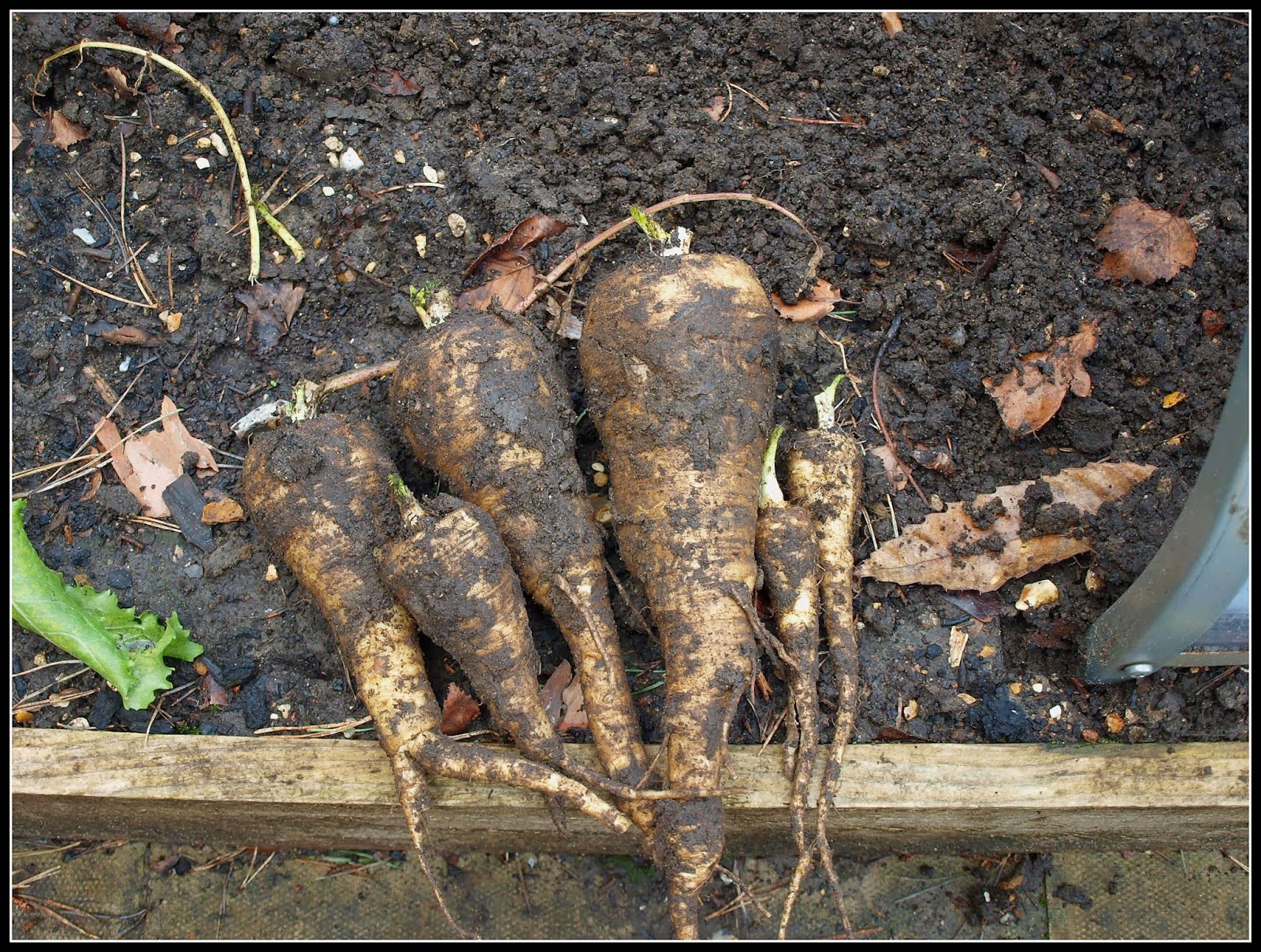
At the weekend I was preparing one of the raised beds for sowing, and I had a pleasant surprise:-


I thought I had cleared all the Parsnips a couple of weeks ago but evidently not!  The leaves of Parsnips die down in the Autumn, but as you can see in my photo, new ones appear in the following Spring. The Parsnip is a biennial, using the first year to store up energy in its swollen root. If you leave it, it will produce new leaves and eventually a flower stem, in its second year. This one has missed its chance. It will soon be ending its days in a stew or something!

I now have two rows of Broad Beans:


Well, I say I have two rows of Broad Beans, but I actually mean one real row and one potential row. Under the left-hand cloches is a row of small seedlings, (they are "Stereo"), whereas under the right-hand cloches there is simply a row of seeds, which I put in about 10 days ago. Hopefully they will soon germinate too. I have closed off the ends of my "Longrow" cloches with end-pieces improvised from rectangles of clear acrylic which I had in my shed, because the ones that came with the cloches were far too flimsy and they keep falling out. I have lost patience with them, so they have gone in the dustbin now. While I was planting out the Broad Bean seedlings I sowed a row of Radishes alongside them, so that when they germinate they too will be protected by the cloche.

In the garage my seed potato tubers are putting out some nice shoots (aka "chits"):

  
I expect to be planting the first of the potatoes some time towards the end of March. I'll soon be setting up my plastic "Seedling Greenhouse" to protect them from frosts. We have had very little frost this Winter, but I'm not being complacent because we could certainly still get a cold spell.

My two pots of peas are looking good, growing slowly but strongly. I have now provided them with some sticks for support.


The pea-sticks are small Beech branches, "foraged" from the side of the road about 50 metres from our house. In our road there are several big Beech trees and during the Winter storms they have lost a lot of branches. Seems a shame to waste them...!


At the weekend I sowed some Leek seeds ("Toledo") in a number of small pots so that I can keep them under cover in their early days. I have little experience with growing Leeks (I have only tried them once before, a long time ago, and wasn't very successful), but I'm determined to do better this time.

I have also sowed a variety of Lettuces. Some of them are the Best Winter Lettuce mix that I was sent by Sarah Raven, and the others are ones sent by Dominika, a blogging friend from the Czech Republic. They are a green butterhead called "Devin" and a red-tinged one called "Cervaneck", which looks a bit like "Marvel of Four Seasons". Lettuce is the heart of most good salads, so I'm planning to ensure that I have plenty of it available for as much of the growing season as possible.

March is not the busiest month for seed-sowing - for me that is April - but it's certainly nice to feel I've made a good start. I'm now anxiously scanning the surface of the Asparagus bed every day to see if the first few spears are coming up. I suspect it won't be long now, in view of the contiinued wet but mild weather.

Wednesday, 5 March 2014

Out with the old, in with the new

On Saturday the weather was really nice, so I had a good clear-out of the garden. I finally knuckled-down and took to the tip all the (many) bags of green (brown) waste that had been accumulating round the side of the house where I do my potting, seed-sowing etc.There must have been about 20 bags - plus a fair few other bits and pieces that were no longer useful and just needed chucking away. Even with the back seats of the car folded down I had to make two trips. I feel all self-righteous now, and ready to start again! So ready in fact that I have just ordered 12 bags of special compost made from composted stable manure, which I plan to use for tomatoes etc in due course.

One of the things I discarded was the remains of my old bird-bath, which I had had for about 25 years. The upright part of it got broken ages ago, but since the "business" part of the thing was still OK I never replaced it. This is what it looked like the Winter before last, when it froze completely:


So that was the "Old" going out, so now for the "New" coming in... My birthday is coming up soon, and my MIL has as usual sent me money to spend on gardening stuff. For the past couple of years I have spent my birthday money on pots for growing tomatoes, but this year I chose a new bird-bath and an ornamental glazed pot. The birdbath is made of glazed terracotta. It was available in blue, red and green. The red and blue ones seemed a bit brash, so I went for the green. It's a nice "understated" shade of green, which will blend in well with its surroundings:


The new item has been duly installed down at the bottom of the garden, near the rhubarb patch. I wonder what the local cats and foxes will make of it, because this is very close to where they come under the fence from Next Door's garden.
                   

I haven't yet seen any birds using the bath, but within five minutes of installing it I saw a male Blackbird inspecting it very closely, so it probably won't be long.

The other item I bought with the money from MIL was this 12" glazed pot:


It has already been filled. I chose the colour specially because I think it will look good with the flowers of Echinacea "Little Magnus", an example of which I bought at the end of last Summer.


This is what "Little Magnus" looked like last September. Do you think the colour goes with the grey-green of my new pot?


The Echinacea plant is already beginning to show signs of life - there are lots of new shoots coming up amongst the dried-up stems from last year. They are very attractive to slugs, so I have librerally sprinkled the pot with slug-pellets.

The trouble is that with one plant housed in its smart new home, the other rather worn plastic ones which currently hold my other two Echinaceas are in contrast looking decidedly shabby. I sense that it won't be very long before I make another trip to the Garden Centre...

Tuesday, 4 March 2014

Crocuses in the rain

Mild weather is all very well, but sometimes I would rather have cold and DRY! I'm sure we are all fed up with the never-ending rain. I suppose we have to consider ourselves lucky that we haven't had a storm for some while now - it must be at least a week...

Crocuses don't like rain. They remain closed up and let the raindrops slide down their slim, pointed flowers:

"Ruby Giant"
It's hard for me to get my camera to do justice to this one's true colour. It's not blue. It's not purple. In some light conditions it looks almost red:

"Ruby Giant"
This one, spattered with tiny pearldrops of rain, was described simply as "Yellow", but it has dark mauve stripes on the outside of its flowers, just like "Gypsy Girl".

"Yellow"

There's no doubt about this one's credentials. This is "Prins Claus":

"Prins Claus"
The flowers in the photos above are in some small pots. Seen from a distance today, they look distinctly unimpressive, but yesterday afternoon when the sun was out the blooms were fully open and much more colourful.


I think the pot at left rear (without any flowers open at present) contains "Cream Beauty", but I'm not certain of that. Should have labelled them, I suppose!

The Crocuses around the bases of the trees have taken a battering from the rain, and today they are a really sorry sight. Most of the "Tommasinianus" (light mauve) ones have finished now, but this patch of "Ruby Giant" would have been good for a few more days if the weather had been better:

"Ruby Giant"

Out at the front of the house, the circular bed round the Crab Apple tree looks good now. The Irises are past their best, but the Daffodils (mostly Tete a Tete) are in fine form:


And of course, you already know that the "Soleils d'Or" are at their best...

Monday, 3 March 2014

Harvest Monday - 3 March 2014

Today I am posting twice, so if you haven't already seen my post about Yorkshire Pudding Trenchers, why not have a look at it once you've read this one...?

My harvest this week is a good example of the "quantity isn't everything" principle. It consists simply of this plate of Mesclun:


Yes, well, before you laugh can I just mention QUALITY?

I don't normally weigh a harvest so blatantly small, so I shall gloss quickly over that aspect in order to mention that this little harvest is actually the 5th (and final) cut I have taken from that tray of Mesclun that I originally sowed just before Christmas!


How about this view? Does that look appetising, or what?


Notice that I have homed-in on my favourite element of the mix - the celery leaf!

Considering that this was only half of a pack of seeds that came free on the cover of Grow your Own magazine, I think I have done very well!


To see what everybody else has been harvesting, visit Harvest Monday over on Daphne's Dandelions.

Yorkshire Pudding "Trenchers"

Do you know what a "trencher" is? The word was originally used to mean a sort of plate made of bread, on which food was placed. When the food was finished, the trencher / plate could then be eaten too. I like that idea - it saves on the washing-up! You may have heard people say of someone "He is a good trencherman" - meaning that he eats a lot (and finishes his plate...?).


In parts of the UK this technique is still used, but instead of bread, Yorkshire Pudding is used. I'm sure most of you know what Yorkshire Pudding is, but for the benefit of the uninitiated, it is a roasted savoury pudding using a batter made from flour, eggs and milk. It is often served alongside roast beef as an accompaniment to the archetypical British Sunday Roast.

Here is my version of Yorkshire Pudding used as a trencher:


I have only ever cooked Yorkshire Pudding twice before this, and both times it had been highly successful, so there was an element of "reputation needing to be maintained" in this meal. I didn't see fit to change a winning formula, so I used as before the recipe from Hugh Fearnley-Whittingstall's book "Meat" (p517). I did however add a refinement of my own. I know that Yorkshire Pudding has a propensity to stick in the pan, so I lined the base of my pans with silicon paper, well greased with lard. Hugh suggests using oil for cooking the puddings, but I used the more traditional lard. I made really sure that the pans were thoroughly greased, especially at the edges where the batter bubbles up most.

The key to getting good Yorkshire Pudding seems to me to be to get the lard / oil as hot as possible before putting in the batter. When pouring the batter into the pans you should not take the pans out of the oven but instead take the batter to the oven and pour it into the pans from a jug, and then close the oven door as quickly as possible so that little heat is lost. I also think it is good to allow the batter to stand after mixing it. I made mine about 6 hours in advance and left it to stand in the fridge until about half an hour before cooking time.

Hugh's recipe suggests a cooking time of 20 - 25 minutes at 220C, which turned out to be exactly right, though I would recommend keeping a close eye on your puddings as they cook (it is fascinating to watch them rise anyway!). You want them to be crispy, but not burnt. It's probably not a good idea to open the oven door either, until the puddings are done.

Sometimes a Yorkshire Pudding can be soggy in the middle even when the edges are cooked, but since I cooked my puddings in large pans (they are cake-tins really), they had a big surface area and therefore the batter was distributed fairly thinly. This, combined with my trick of lining the pans with paper, meant that each pudding was cooked evenly and there was not a hint of sticking. When they were done, the puddings slipped out of the pans very easily.


The filling I used was very simple - minced beef cooked long and slow with some onions and mushrooms, along with some boiled carrtots, green beans and new potatoes. I deliberately made the beef quite "runny" so that there was plenty of gravy. If you are a non-meat-eater I imagine this dish would be just as good served with no beef but a larger quantity of mushrooms.

So there you are: three in a row. Reputation maintained!


Sunday, 2 March 2014

"Soleil d'Or"

I make no apologies for posting again about Spring flowers, folks. They are only with us for a short time each year, so we need to make the most of them.


This post is about Daffodil "Soleil d'Or" (Golden Sun). I grew mine from a bag of bulbs I bought in St.Mary's last year, when visiting the Isles of Scilly. If anyone from Isles of Scilly Flowers is reading this, I just want to say "Thank you" for including in my bag not just 20 bulbs, but 34! A reader asked me the other day whether this variety had a scent. I think this photo provides the answer:


To my mind, these flowers (I mean this particular variety) are the archetypical Cornish Daffodil. Their two-tone multi-flowered blooms are tall, slender, elegant, and radiantly beautiful. My Granny was particularly fond of Soleils d'Ors. She would have loved these.


 As you can see in my photos, the colour of the central trumpets varies considerably. Some are yellow, but most of them are orange. I'm wondering now whether the colour of each individual flower changes as it matures... Must observe more closely!


Last Autumn I bought a blue glazed flower-pot, specially to house these bulbs. Of course, when I found that I had a lot more than 20 bulbs, I had to split them over three pots! the other two stand proudly either side of our front door.


Saturday, 1 March 2014

Garden Share Collective - Feb 2014

I am doing this post as my first entry to an exciting new blog-hop - The Garden Share Collective , run by Lizzie over there in Australia, so I want to begin by introducing myself to the community:

Hi! My name is Mark, and I have a small garden in a domestic setting in Fleet, Hampshire, UK, about 35 miles South of London. I have lived here since 1991, so my garden is well-established, though still constantly evolving. Until recently I concentrated mainly on growing veg (hence the title of my blog), but more and more ornamental plants are somehow creeping in. My plot is not big - approximately 10m x 10m - but I manage to produce a fair bit of stuff. Both I and my wife Jane are keen cooks, and we love to cook things grown in the garden.

Raised beds covered with cloches - February 2014

In February there is not a lot to see in my garden, since we are emerging from a long and exceptionally wet Winter, but if you look closely there are still items of interest. for instance, I have some Purple Sprouting Broccoli plants that have been growing since last Summer and are just about to produce their crop (one of my favourite vegetables):

Purple Sprouting Broccoli

I am also continuing to harvest some Endives and Chicories that have developed slowly over the Winter. I have had most of them under the cover of cloches which have protected them from the seemingly-incessant wind and rain. It is nice to have something like this in the garden that crops over a long period of time rather than all at once. It's lovely to be able to just nip out and harvest what you need for a salad at a few minutes' notice.

Chicory

The last of my Parsnips were lifted at the beginning of the month, and it is already nearly time to sow some more! Again, this is a crop that will stand well in the ground for ages without deteriorating, so we tend to spin them out. Home-grown Parsnips have so much more flavour than shop-bought ones.


As regular readers will know, I often struggle to keep a sufficient supply of Parsley, so I have been particularly pleased to see mine do so well this Winter. Covering the plants with individual bell-cloches seems to be the key to success:

Parsley growing under cloches

As for sowing and planting in February, well not much of it gets done here in the UK! I sowed some Chilli seeds the other day, and most of them have germinated.

Chillis and Peppers under the lights

Even more successfully I sowed a couple of pots of Parsley and kept them indoors under the lights, and now they have been transplanted to the corners of one of the raised beds - under cloches to help them get started, you'll note.

Parsley at the corners, Chicory down the middle

I have also planted a row of Broad Beans ("Stereo"). I sowed them in little pots and kept them in my garage until they germinated and then moved them outside into one of my plastic mini-greenhouses (a constant and now indispendable feature of my plot), where they have grown into strong little seedlings. They too are now covered in long cloches to protect them in their early days. 


In the next month I expect to be planting my potatoes, which are currently sitting in some egg-boxes in the garage, chitting. I always grow my potatoes in pots and containers of various sorts, which means I can keep them under cover and thus get them off to an early start. If you want to read more about what types I will be growing, follow this link: Hampshire Potato Day.

Potatoes chitting in egg-boxes

I will also be sowing my tomato seeds. I haven't 100% decided which ones I will sow, because I have loads of them and I can't reasonably grow them all! There may well be a bit of last-minute impulsiveness involved... In any case, I am going to start them off the same way, regardless of which ones they are. They will be sown in little pots and placed in my "Growlight House" so that they have plenty of light right from the start and do not go leggy. Later in the year I will be experimenting with these cane-supports which I recently bought. They will be used with bamboo canes to support the tomato plants when I pot them up.


As I mentioned earlier, I am beginning to plant more flowers in my garden these days, and of course it is just about Spring-time now, so I'm going to end my post with a couple of pics of flowers that are at their best at the end of February:

Narcissus "Soleil d'Or"


Crocus "Tommasinianus"