Thursday, 5 December 2013

Autumn gales - not completely bad...

The UK, especially the Northern and Eastern parts, is currently experiencing another severe storm. Fortunately we here in Hampshire are not too badly affected. Yes, the wind is pretty strong, but not (yet at least) strong enough to inflict structural damage. The worst we have had so far is that some barriers and signs associated with excavations being carried out by Southern Gas Networks were blown out into the road, causing a hazard to traffic. Once I reported this they sent someone to sort it out, but I think they might have to do it again!

In my garden the wind has actually done me a favour by sweeping up all the fallen leaves into a nice neat pile.


I have been watching this happen. The wind seems to blow round the inside of my garden perimeter in a circular movement, like a miniature tornado. The coldframe has almost disappeared.


When the wind dies down I'll nip outside quickly and scoop as many as possible of those leaves into my leafmould bin, and put the rest in plastic sacks. They are dry at present and should be easy enough to handle.

I hope everyone else is safe, and hasn't suffered any damage or casualties.

Wednesday, 4 December 2013

Cloches

On the assumption that Winter will eventually arrive, I have deployed most of my cloches, and much of the garden is now clothed in plastic:


The tall plants in the distance to the left of the compost bins are PSB and Cavolo Nero - too tall for cloches, and they don't need them anyway. In the foreground of the bed nearest the camera are Parsnips. No need for cloches there either. Elsewhere however there are lots of Chicory, Endive and Radicchio plants, and it is them that I have protected.

To be honest, the Chicory family is generally pretty hardy and will survive several degrees of frost, but I think that protecting them (particularly from wind) will make them nicer. Their leaves will be softer because they don't have to toughen-up in the face of icy blasts. Cloches like mine don't really provide much extra warmth (except perhaps on the rare sunny days), but they will protect to a certain extent from wind, hail, snow and frost.

I use two different types of cloche. The first is this long type - aptly named "Longrow" - made by Parasene, but widely available.


These cloches are 1.2 metres long, and are thus suitable for protecting a row of small plants. Conveniently, my raised beds are 2.4 metres long, so will accommodate two of these cloches placed end-to-end. They do come with end-pieces fitted with an adustable vent, but these have proved to be far too flimsy and not fit for purpose. They do not fit in very securely and keep popping out and blowing away. I must say that I find this very disappointing in a product that sells for about £35. I had expected better!

My other type of cloche is the bell-cloche, suitable for protecting a single plant, or possibly a couple of small ones.


I have three of these, which were sold as a set. I think they are really good, and excellent value at £10 a set (two years ago). They have an adjustable ventilation aperture at the top, which I find useful for giving the plants a quick drink without having to remove the whole thing, which is kept in place by two U-shaped metal staples. At present I have each one protecting two Chicory / Endive plants. I wish I had some more of them. Recently I saw some in my local Garden Centre which I initially thought were the same, but they turned out to be made of much thicker plastic and were being sold at £12.99 each, so I didn't buy any!

I forgot to mention that one of the other things that cloches provide protection against is animals. Foxes / badgers / cats / whatever, have dug up several of my Chicories this Autumn, and I am fed up with having to re-plant them!

Tuesday, 3 December 2013

Sausage casserole - the ultimate comfort food

Pork sausage  and beans. What better combination can there be? On this occasion not just any old sausages, but some lovely garlicky Toulouse sausages. The sort of thing you need for making a proper Cassoulet. Yes, Cassoulet was definitely my inspiration for this dish.


I'm not going to give you a recipe for this one, because everyone knows how to make a sausage casserole, surely? I'll just describe it...

Fry some smoked bacon and sliced onions in a casserole dish, along with a few whole tiny onions and some garlic. Set aside while you brown the sausages. Return the bacon and onions to the pan and add the remaining ingredients: stock; homemade tomato sauce; herbs (thyme and rosemary) and a tin of cannellini beans. Cook gently for a long time. Then you have this:

 
Since my sausage casserole was to be fairly straightforward, I wanted to do something a bit more upmarket with its vegetable accompaniments. I chose to do Parsnip chips (with homegrown Parsnips) and Sweet Potato mash - both easy to do but dramatic to look at.

I stuck some whole, unpeeled, Sweet Potatoes in the oven while the casserole was cooking. When they were cooked (about 90 minutes) I halved them and removed the flesh from the skins:


I put the potato flesh in a non-stick pan, added some butter and black pepper and beat it firmly with a wooden spoon until it was smooth and creamy. At this point I left it to cool and warmed it up later, just before serving time. If I had been able to judge how long the Sweet Potatoes would take to cook I could have co-ordinated my timings to serve them straight away, but...


Now the Parsnip chips. Easy when you have an Actifry machine! Just peel the Parsnips and cut into chip-sized pieces; put them in the Actifry; add a tablespoonful of oil; switch on. Forty minutes later the machine goes "Beep" and you have lovely golden Parsnip chips!


Of course you could make Parsnips chips the old-fashioned way, deep-fried in a pan of oil, but we are great fans of the Actifry - it cooks things very evenly because they are constantly being turned by the cunning rotating blade thingy, and they are much healthier because you only use a very small quantity of oil.

You will have noticed that my meal had a very brown / yellow / orange colour theme. Well, I had an answer to that. You want some green? I can give you green...


A sprinkling of finely-chopped (homegrown) Parsley adds the necessary colour contrast, but also adds a pleasantly fresh taste.

So there you go: Toulouse sausage and bean casserole, with Sweet Potato mash and Parsnip chips:


Monday, 2 December 2013

Harvest Monday - 02 December 2013

Thin pickings this week!  My nicest harvest was this batch of Lettuces:


This lot had originally been intended to produce Baby Leaf Salad, but since only a very small number of seeds germinated, I left them to grow big - well, less small really! I also hadn't expected them to survive until now. I thought that frost would have seen them off well before now. Anyway, Lasagne was on the menu on Friday night, and salad was definitely required, so I picked the lot. It sounds extravagant, doesn't it? "We ate seven lettuces between the two of us, all in one meal!" Of course they were very tiny, and we only ate the best bits. And oh how nice it was to have such summery salad on a cold November evening!

I also picked the very last of the "Aji Limon" chillis. Their parent plant is now chopped up and in the compost bin.


I did make one more picking of about 300g of Brussels Sprouts. There are very few sprouts left on the plants now - probably only one more picking like this one - but I have been well pleased with the crop in terms of both quantity and quality.


The only other harvest I had this week was a bunch of herbs that went into a sausage casserole.

Thyme, Rosemary and Parsley

Actually, come to think of it, herbs were used in some other dishes too - for instance Jane made some chicken stock and that had a Bay leaf in it, and more Parsley - so I feel justified in including this photo of my patch of Rosemary, which is getting so big that it is in danger of swamping the nearby raised bed:


I didn't harvest any Parsnips this week, because we got a huge bag of them in our weekly veg box. Much as I like Parsnips, there are relatively few ways you can use them. They are not as versatile as Carrots, for instance.

For further Harvest Monday inspiration, head over to Daphne's Dandelions 

Sunday, 1 December 2013

Tomatoes in December??

When I picked this batch of "Sungold" tomatoes on 2nd November I thought I had done well to get ripe tomato fruit so late in the year:


After picking those supposedly final fruits, I should have cut down the parent plant and composted it, but somehow I never got round to it. It's hardly picturesque, is it?


But look closely at the part I have highlighted in this next photo:


Yep, there are ripe tomatoes!


I took that photo yesterday, 30th November, but I left the fruits in place until today so that I could honestly say that I have been picking ripe outdoor-grown tomatoes in December!

So here we are - December-harvested tomatoes:-


Given a few days indoors in the warmth they will probably ripen fully. I expect them to be horrible, with tough skins, tasteless flesh, etc, but these ones were "for honours only" and the quality doesn't really matter.

Now, it's just about time to sit down and decide which tomato varieties to grow next year. Could be a long job... 

Saturday, 30 November 2013

Ciabatta

Yesterday I had a go at making Ciabatta. This is something I have not done before.


Having mastered the art of baking a simple white Bloomer, thanks to Paul Hollywood's book "Bread", I have been feeling the need to move on to something a bit more ambitious. Jane was cooking a Lasagne for dinner, so I thought Ciabatta would be the perfect accompaniment. The challenge was on!

So, out with Hollywood's book again... I read the instructions through, several times over. They sounded reasonably straightforward, though Jane (who has done these things before) did warn me that Ciabatta is "quite tricky"...

Paul Hollywood's recipe calls for half of the flour, yeast and water to be mixed up into a batter and left to stand for 6 hours before the remaining ingredients are used, and then there is an additional 135 minutes' rising time later on, so this is not a bread to make when you are in a hurry! The reason that some of the ingredients are made into a batter (Hollywood calls it a "sponge") and left to ferment is to add flavour, and I can say with the benefit of hindsight that this was indeed a really tasty bread.

The fermenting batter or "sponge". Blup, blup, blup...

After the batter has had its 6 hours you then put it and the rest of the ingredients into a food-mixer and mix then all up until you have a nice stringy elastic dough. Hollywood says to give it 10-15 minutes in the mixer, but our food-processor doesn't have a really slow "kneading" setting, so I gave it about 6-7 minutes. When the dough reaches the right point (it should be able to stretch 30cm without breaking), it is put in an oiled, lidded plastic container and allowed to rise for another two hours. Then the tricky bit... (No photos of this, because my hands were well and truly full. And sticky).

The risen dough (about 10cm thick) is tipped out onto a floured surface (50% flour, 50% polenta) and divided into two long thin pieces, which are stretched even further to make the characteristic Ciabatta-shaped loaf. Well, that's the theory anyway. The dough is very wet and sticky, and I found it very hard to shape. In the end I managed to get an approximation of two Ciabatta loaves onto a floured baking tray and put them inside a big plastic bag to preserve humidity during their final rising (15 minutes). During this time the oven is heated to 220C.

The loaves getting their final 15 minutes' rising

Then into the oven to bake...


The recipe says 30 minutes, but mine were ready in not much over 20. I think this is because they were flatter than desirable. I'm sure this is due to the dough being a bit wetter (and hence more mobile) than it should have been. I turned mine over for the last 5 minutes, to brown the undersides too - we like bread "Well Done". This is the end result:


The nearest one doesn't look too bad, though the furthest one is a bit wonky. Still, as they say "the proof of the pudding is in the eating", so as soon as the bread was cool enough to do so, we had a little taste:


The taste was very good - full of flavour - and the texture was better than I had dared to hope. The classic Ciabatta has lots of big holes in it, caused by the air-bubbles in the dough, so I reckon mine probably scored about 7 out of 10 in this respect. I was also proud of the crust. Despite the deep golden colour it was crispy but not hard. This is something that is improved by putting a roasting-dish full of boiling water in the bottom of the oven (as I did ) to create steam during the cooking.

I expect Paul Hollywood would find plenty to criticise in my results, but all in all, I am well satisfied. The main thing is we enjoyed eating the bread. I am also happy that my bread-baking repertoire has now officially expanded by 100%!

Thursday, 28 November 2013

Shades of Autumn

It is very much the end of the year in my garden. There is hardly any veg left. Parsnips and Cavolo Nero are currently being harvested "on demand"; there are a few more Brussels Sprouts to come; the last few chillies; plenty of Parsley still; a couple of Lettuces... Otherwise, that's about it. The Chicories are not ready yet, and the PSB will not mature for another couple of months. This doesn't mean to say that there is nothing of interest in the garden, though. You just have to look more carefully for it.

The "Christmas Bell" chillis are incredibly slow to ripen. All the leaves on the plant have shrivelled up - most have fallen - but the fruits are stubbornly green. Well, OK, maybe a little bit reddish now, but certainly not red.

Chilli "Christmas Bell"

The Callicarpa is putting on a good show though. It has loads of berries this year.

Callicarpa, aka "Beauty Bush"

The white rose (variety unknown) is still producing one or two blooms. Where I have missed the odd one when dead-heading, some quite big rose-hips have formed, which are beautiful in their own right.

Rose-hip

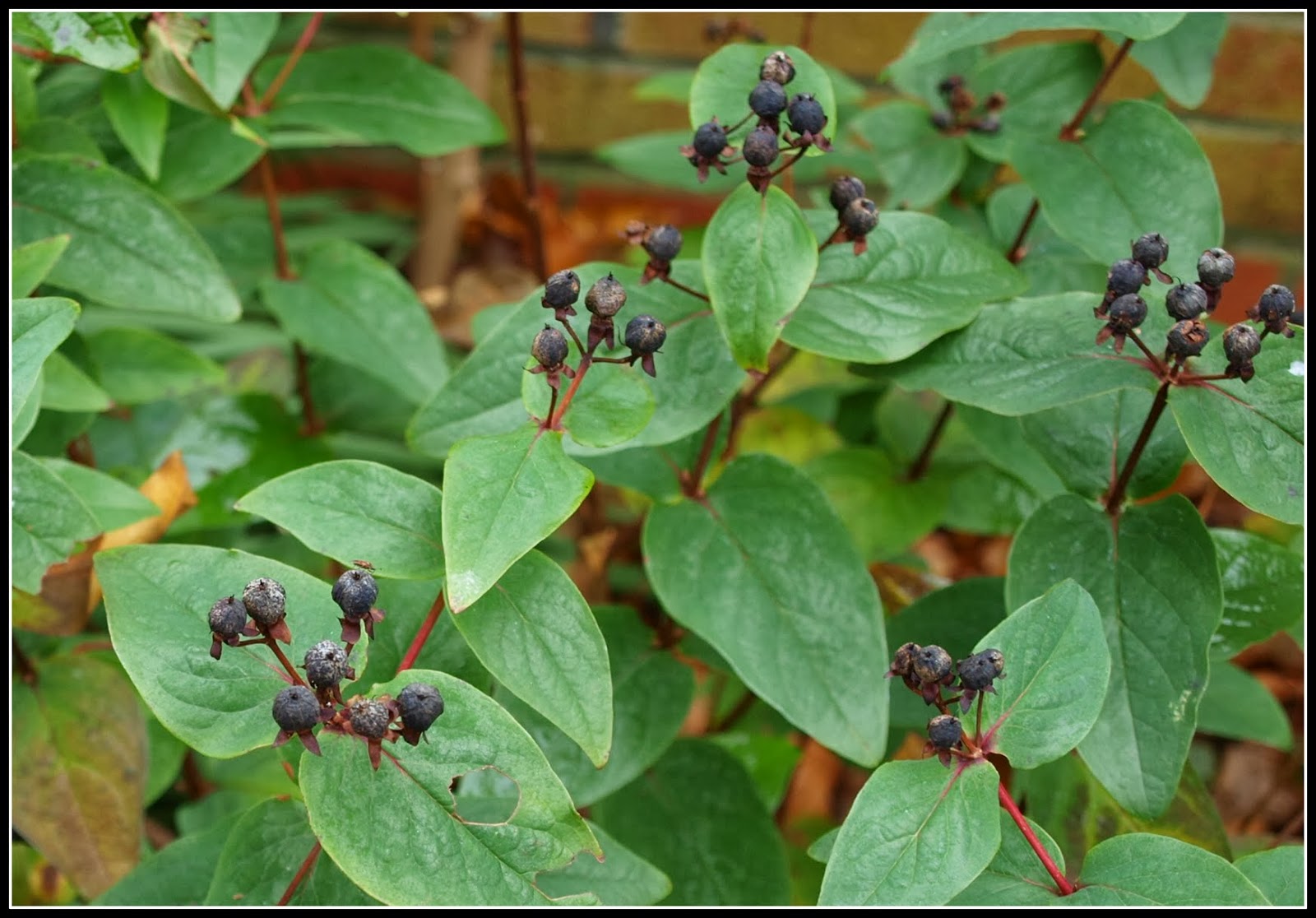
The shrivelled black berries of the Hypericum are also quite striking in a macabre sort of way. I wonder whether the birds will eat them?

Hypericum berries

I'm definitely leaving these Marjoram seedheads for the birds. I have seen Goldfinches tucking in to them in the past.

Marjoram seed-heads

Marjoram seed-head

The Dogwood shrubs have lost almost all their leaves now, and the colour of their stems is beginning to be more apparent:

Dogwood

I think this last photo epitomises the time of year quite nicely:

Maple leaf suspended on Dogwood stems