Saturday, 29 February 2020

Waking up

My blog has been "resting" since October, but I feel ready to start it up again, so Hello everyone!


From a gardening point of view, 2020 has got off to a really bad start, with a succession of severe storms, each bringing violent winds and floods of rain. To be honest, here in NE Hampshire we have fared quite well compared with most parts of the country, but the weather has still been foul, and certainly not conducive to sowing or planting anything outdoors.

I've been really glad to have my big upright coldframe, which is heavy enough to resist being blown away. It has helped me to get a few things started without having to subject them to the rigours of the weather.

Onions (front) and Broad Beans (rear)

I'm growing my onions in clumps again, like I did last year. This year I have three types - "Ailsa Craig", "Bedfordshire Champion" and a mixture of "Elista and Karminka". These latter ones are long-shaped ones, which should be ideal for salad onions.

I have also started off two batches of Broad Beans. My technique is to sow the beans in individual modules and germinate them indoors. When they germinate they are moved out to the coldframe to grow on a bit before being planted out in one of the raised beds when the weather abates. Aiming for a successional crop my first batch is of the variety "Express" which is supposedly very quick-maturing. The others are an old favourite called "Imperial Green Longpod". As the name suggests, it produces long pods filled with green (as opposed to grey) beans.

Broad Beans "Express"

Over the Winter I was cropping Brussels Sprouts ("Evesham Special"), and I'm happy report that we were able to eat home-grown sprouts with our Christmas Dinner. Unfortunately many of the sprouts "blew" - in other words went to leaf without producing tight buds. However, my four plants still produced a viable crop, and I'll persevere with this vegetable because I'm doing better each year. One day I'll have a crop I'm really proud of, I'm sure! The Brussels Sprouts have been sharing a bed with my Purple Sprouting Broccoli plants, which are just about to deliver their first spears, so today I removed the spent sprout plants to give the PSB a clear run.

Old Brussels Sprout plant just prior to removal.

Last year I had four PSB plants and they produced a huge crop, but my wife Jane is not really all that keen on this vegetable and it's normally me that eats most of it, so this time round I have only grown two plants. One of them (a "Red Arrow" one) is nice and big, but the other (an "Early Purple Sprouting" one) is pathetically small. I don't think I'll grow the latter variety again. Here you see them side-by-side...


I can see that the "Red Arrow" is going to give me a nice crop:

PSB "Red Arrow"

But the "Early Purple Sprouting" will probably only produce about half a dozen spears.

PSB "Early Purple Sprouting"

I also have some chillis on the go (of course!). As usual, I sowed them on 14th February (Valentine's Day). I germinated them in the airing-cupboard and then transferred them to my Growlight House.


Again, last year I grew far too many chillis and there are only so many that we can use (we mostly made them into Sweet Chilli Sauce), so this year I'm going easy on them. In fact, I sowed 3 or 4 seeds in each of 16 little pots (covering 10 different varieties) and I plan to keep only a maximum of 2 plants of each type. As it happens, some of them didn't germinate (or haven't yet done so), so I'll probably end up with a manageable quantity. When choosing which ones to grow I had a big clear-out, disposing of the majority of my collection of chilli seeds, most of which were pretty old. The ones that I sowed but haven't come up were really Last Chance ones, so I'm not surprised that some of them haven't germinated.

We are still eating Endives, which have again done well over the Winter, growing slowly but steadily under their cloche protection. Until 2018 I had always treated my Endives as an Autumn crop, but in that season I accidentally sowed my Endives later than usual which meant that they were not ready for cutting at the normal time. I covered them with cloches and hoped for the best. They produced some of the best Endives I've ever had, so this is what I did again in 2019. This is one that I cut this week:

Curly Endive - variety not known (it's from a mix)

In January I bought myself another Pear tree (a "Williams Bon Chretien" one), so I now have two potted Apple trees and two Pear trees. I have shuffled the pots around so that the two Apples are close to each other and the two Pears likewise, which I'm hoping will help with mutual pollination.

Apple trees in 60L pots

On the ornamental side of things, I have a good collection of Hellebores now (many of them have self-seeded), and they flowering at present, which brightens up the otherwise pretty dull garden.


So there we are, Mark's Veg Plot is back in business, but please be aware that I'm planning to post a bit less frequently this year, because I'm heavily involved with fungi-spotting as well these days, so my gardening-time is somewhat reduced!

Saturday, 12 October 2019

Shutting up shop for Winter

I haven't posted anything here for ages, so you probably guessed this: I'm shutting up my blog for the Winter.

My garden looks bedraggled and messy at present, and there is very little for me to write about. Who wants to see photos of my last few tomatoes, still holding out against the encroaching Blight?


My remaining cucumber plants are still producing a few fruits, but they are not very appealing!


We've already made a few jars of Sweet Chilli Sauce, so even the incentive to pick more of the chilli crop is much reduced now.


Fortunately, just as the gardening season tails off, the best time of year for my other hobby - fungi-hunting - begins. This is what I'll be doing for the next few months. Thanks for following, and see you next Spring!

Amanita muscaria - Fly Agaric


Boletus edulis - Penny Bun


Lactarius deliciosus - Saffron Milkcap


Mycena haematopus - Burgundydrop Bonnet


Calocera viscosa - Yellow Stagshorn


Laccaria amethystina - Amethyst Deceiver


Helvella crispa - White Saddle

Thursday, 3 October 2019

Radicchio

About this time every year I do my best to sing the praises of a vegetable that is unfortunately very under-appreciated in the UK, even though it is much more popular in most of the rest of Europe (and maybe further afield too?) - it's the chicory, and more specifically the variant known as radicchio.


Although you can usually find this vegetable in the shops these days, as far as I'm aware few British amateur gardeners grow it, which is a shame in my opinion because I reckon that even if I didn't like the taste of it I would probably want to grow this vegetable in my garden just because of its spectacular good looks.


Radicchio is often grown as an Autumn-maturing crop, because it tolerates cool temperatures. In fact some varieties (e.g. Grumolo rosso) will survive several degrees of frost. Sown in Mid-Summer and planted out in say early August, it can be harvested in late Autumn. It is grown very much like lettuce, and forms a tight inner heart like Iceberg lettuce. The outer leaves generally remain green and tough, but their purpose is just to protect the more tender heart, and they get discarded at harvest. The heart is usually quite firm - crisp vibrantly-coloured red leaves with crunchy white ribs.


My radicchio are not ready for harvest yet. Many of the leaves are still quite green - they get redder as the temperatures fall.


Actually, before we assume that all chicories are red radicchios, let's acknowledge the existence of varieties that remain green, probably with yellowish inside leaves, like this one:


This year my chicories are a "mixed bag", grown from seeds out of several packs left over from previous years. I seem to have ended up with about 60% red ones and 40% green ones.


Some of them will be speckly ones, possibly the variety "Variegato di Castelfranco". I know there were some seeds of that one in the mix.


You can see that the chicory is interplanted with some curly endives, another of my favourite late-season salad vegetables. Last year I was late sowing my endives and I had to over-winter them under cloches (they did very well eventually). This year I remembered to sow at the right time - the first week of July - and they are much further forward than they were this time last year, although clearly not ready to harvest just yet.


If you haven't tried these vegetables - either eating them or growing them - I urge you to give them a try. Both endives and radicchio are sometimes accused of being unduly bitter, but I assure you this is not the case. Modern varieties are a lot sweeter than you would think, catering for modern tastes. I suppose I shouldn't say this, but I think these days many people in the UK don't like strong tastes, and most frequently prefer what I'd call bland flavours.

Monday, 30 September 2019

Maincrop carrots

I've had a good year for carrots. I have grown three types - a rainbow mix called "Harlequin", some "Chantenay Red-Cored" (which turned out not to have red cores!), and a well-known maincrop variety called "Autumn King". The latter is an "old-fashioned" variety, but one which definitely deserves its popularity. It produces huge deep-orange roots which somehow manage to remain tender despite their size.


My other two types of carrot are finished now, so today I lifted my first batch of "Autumn King". Some of them are huge.


The biggest one I pulled up today weighed 376g. It's the fat barrel-shaped one seen in this next photo.


I only have one 2.4m row of these, but because of their robust stature they will produce a pretty decent yield, and keep us supplied for several weeks to come.


After my other carrots were lifted I planted the vacant space with some endives and chicories, which you can see here on the right:


They are still small, but I'm hoping they will mature in their own good time, hopefully before Christmas. Actually I think the Enviromesh which is primarily for the benefit of the carrots will give them a welcome bit of protection too!

By the way, not all the carrots were good-looking...


They may not be pretty, but there's plenty of useable material there. I often use the irregularly-shaped ones when I make stock, for which they are perfectly fine.

In the meantime I'll leave you with this. I'm keeping an eye on my carrots, but they are evidently keeping an eye on me too!


Thursday, 26 September 2019

Fading

My garden is looking very much "End of Year" now. This old Sunflower head sums it up. Everything has a faded and droopy look.


It's a similar story here. This Hydrangea flower was once bright pink, but it's now pale and washed-out. It will soon be brown, I suppose...


I'm not going to be in too much of a hurry to tidy things up though, because these days I am more aware than ever of the role that the seeds contained in old flower-heads play in sustaining wildlife during the lean Winter months. I expect the birds will enjoy the Sunflower seeds, as well as the ones from these Rudbeckia:


The seeds of Rudbeckia are tiny, but the Goldfinches spend ages picking them out, so they must consider it worth the effort.


I think that the seeds from this fern might be too small even for the Goldfinches. Actually I'm not sure they are even seeds. Maybe they are spores? Anyone know?


I've been doing a bit of seed-saving myself recently, picking the dry brown pods of the various types of bean that I've grown. Despite my best efforts to pick them at their best, I inevitably miss a few and they only become visible once the leaves start dropping off the plants.


I'll dry those pods completely and when they are ready I'll take the beans out and keep them for use in soups and stews for the Winter. They will be joined by a lot more in a couple of weeks' time because I can see that there are a lot of big pods right up at the tops of the plants, where I have been unable to reach them (I use 9-foot poles). I'll only be able to get them by ripping down the whole plants, but I'm not ready for that just yet since there are still a few useable pods lower down.

Despite what I've said above, not everything is on its last legs. For instance, some of my herbs are really revelling in the cooler, wet conditions we are experiencing now, and have put on some lush new growth. Just look at this Sage:


I chopped off the old growth of this Greek Oregano about two weeks ago, and it has responded by producing a whole new set of foliage.


I keep thinking the tomatoes must be just about finished, but they are still going. When the fruit start showing a bit of colour I pick them and bring them indoors to finish ripening. These ones are "Ferline F1"


The Dwarf tomato plants I have grown from the seeds kindly sent to me by Craig LeHoullier in the USA have been very late to set fruit this year, and most of them are still green, like this "Dwarf Beauty King":


I'm hoping they will make it to maturity before the first frosts, but it's going to be a close-run thing. I expect we'll get frost before the middle of October, if not before.

Monday, 23 September 2019

Chillis - a contrast in styles

Regular readers will be well aware that I'm a keen grower of chillis. However, they may not know that we (my wife Jane and me) do not actually eat huge quantities of chillis. We do enjoy a bit of Sweet Chilli Sauce on our Chinese fried rice, and we do occasionally put homegrown chillis in curries, soups and salsa, but we're not fanatical about it (unlike some I could mention...!). Furthermore, neither of us likes the blisteringly hot types of chilli, the so-called Super-hots.

The only chilli I'm growing this year that could conceivably be considered a Super-hot is this "Paper Lantern", and even this would be considered pretty tame by the standards of many chilli fanatics.


"Paper Lantern" is one of the Habanero types of chilli (botanically a Capsicum chinense) and its fruits are generally rated in the region of 300,000 SHU. [Scoville Heat Units]. Compare that with about 1,500,000 for a "Carolina Reaper" or about 5,000 for a "Jalapeno".

I wouldn't normally enjoy eating  "Paper Lantern" or indeed any other Habanero chillis - though I do admit that one is a nice ingredient for a Caribbean curry - but I just like the look of them. The teardrop shape of this particular variety is very attractive, and I also like the way the colour gradually spreads through the fruit as it ripens, often creating a sort of Red-Amber-Green traffic-light effect.


Towards the other end of the heat scale is this one, the "Hungarian Hot Wax".


Even though it looks more like a Sweet Pepper, it's a mild chilli, rated anywhere between 1,500 and 15,000 SHU. (It's surprising how much sources vary in this respect). The ones seen here are immature, and they will eventually turn orange and finally red and they get hotter as they ripen. We like to eat them as they are just going from yellow to orange, because at this stage they have only a little heat but plenty of flavour. I particularly like them cut into segments and then stir-fried until slightly black at the edges.


I have two plants of "Hungarian Hot Wax" this year. They were both very badly hit by the contaminated compost affair and at one point I thought they were doomed, but they have bounced back very nicely and each one has several fruits.

The type of chilli that we enjoy most is represented by the ever-reliable "Cayenne", which is not only a prolific fruiter, but is also conveniently positioned in the "comfortable heat" bracket of the Scoville scale, coming in at about 30,000 to 50,000 SHU.


These photos show the unusual pair of fused-together twin fruits that developed on one of my plants. I find it very interesting that the twins have fully ripened before their nearby sibling has developed any colour at all.


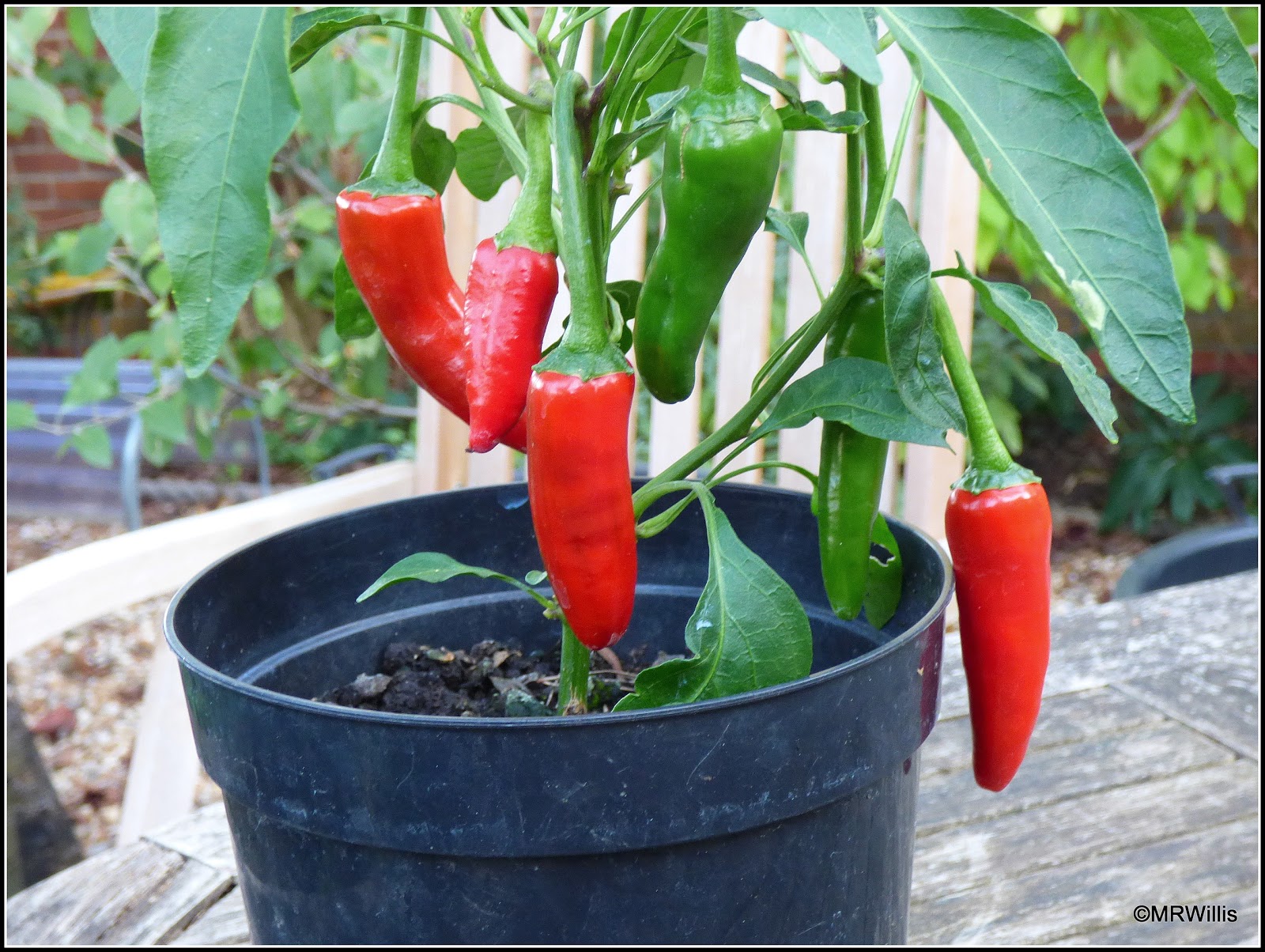
I have three plants of a variety called "Cayenne Long Slim" and one other plant simply called "Cayenne", which has produced some much fatter fruits, more on the lines of "Jalapeno":


As well as the red ones, I have this "Golden Cayenne". It also has very chunky fruits, which are similar in flavour and heat level.


So, expect to see lots of chilli photos on my blog during the next few weeks!