Friday, 12 May 2017

A cheesy tale

As I mentioned a couple of days ago, Jane and I recently went over to France to spend some time with one of our daughters and her family. While we were there we went on a trip to the historic little Swiss town of Gruyeres, home of the eponymous cheese. [In English, the cheese is normally called Gruyere, without the "s" at the end.]


Gruyeres is a very small but very picturesque town, perched on top of a steep hill about 25kms from Montreux, on the North side of Lac Leman (aka Lake Geneva).


Rue du Bourg - Main street, with chateau in the distance

The fortified chateau, dating from the 13th century, is the dominant feature. We walked round it, but didn't go inside.


The main (practically only!) street is comprised almost entirely of restaurants and gift shops.
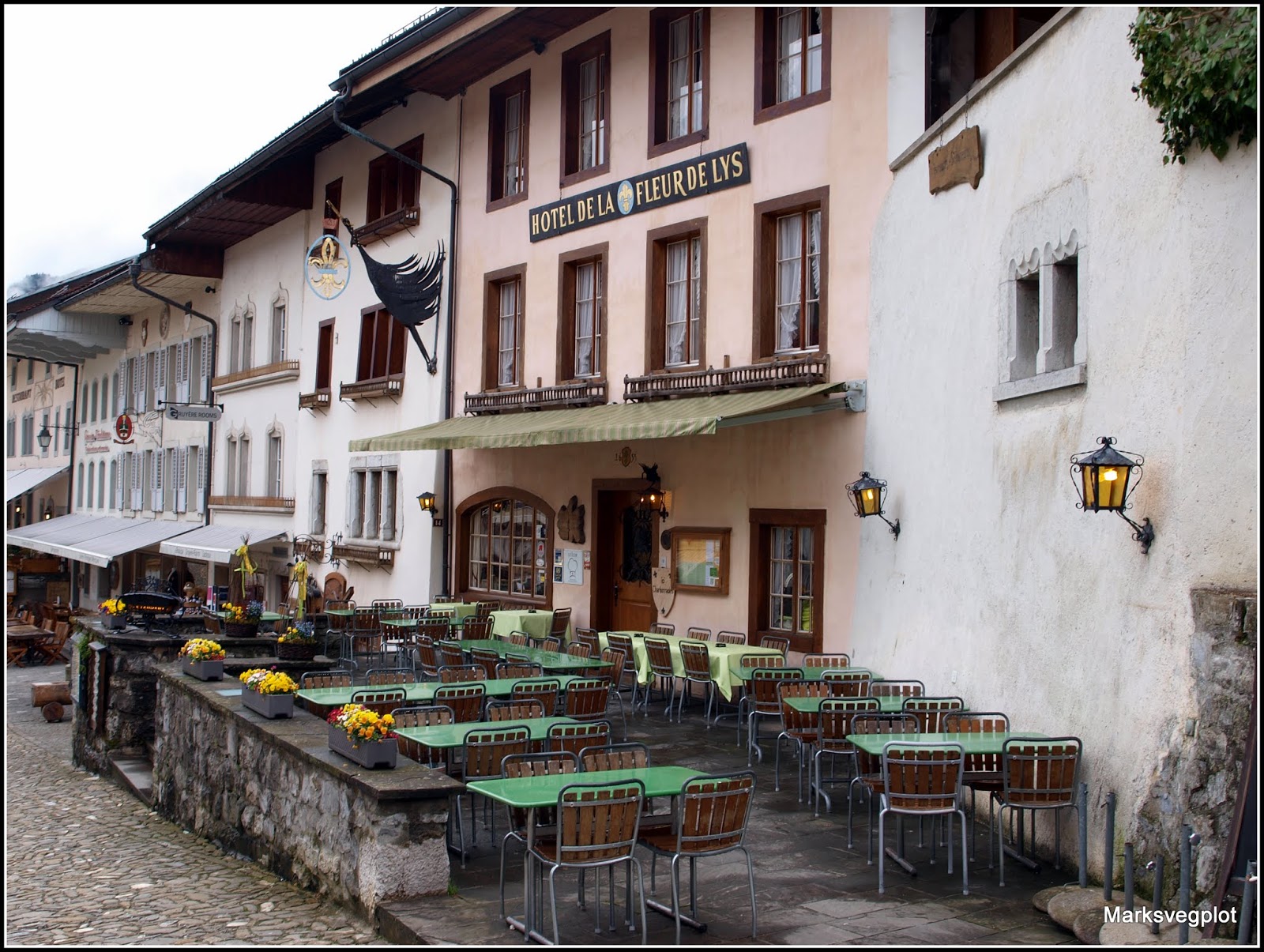


We had a delicious lunch in the Café-Restaurant des Remparts. Naturally enough our food contained a fair amount of cheese. I had the "Tartiflette Gruerienne", which is a dish of potatoes, bacon lardons and Gruyere cheese, baked until the cheese goes runny and slightly golden on top. Very nice! It's traditionally made with Reblochon cheese, but "when in Rome, do as the Romans do"...


Actually, as well as the restaurants, the town has several museums. One is a Tibetan Buddhist museum, and one is dedicated to the works of H.R.Giger of "Aliens" fame.


Sculpture outside the Giger museum


Here are some photos of other miscellaneous objects I saw in the town:


St.George and the Dragon


Spout on a water fountain


Doorway to the shop of a woodworker and turner.


Ornamental cats


I think this is the town's "coat of arms"


Vaulted cloister under the ramparts.


After our lunch we went down the hill again, and paid a visit to the cheese factory in the village of Pringy. I don't have any of my own photos of this visit, so I am resorting to showing you the leaflet I picked up in the factory / visitor centre:


Normally they make cheese 4 times a day here, in full view of the visitors, but at the time we went (Monday 8th May) the only thing happening was the mechanised stirring of a vast vat of milk. The leaflet tells me that each of their four vats holds 4800 litres. Still, we got to see all the various bits of the setup, and at the end of the tour we were able to look through glass windows into the huge "cave d'affinage" in which the finished cheeses are matured.


One of the most endearing aspects of this attraction is that your entry ticket is actually in the form of a packet of cheese! It contains small samples of the cheese at different ages (6, 8 and 10 months), so that you can find out for yourself how the taste changes as the cheese matures.


Le cheese-ticket!


I can vouch for the fact that this is tasty cheese - and of course the more mature ones are the best! In the gift shop we bought some cheese to bring home, including a piece of the "Alpage" type. This rich, nutty cheese is made exclusively from the milk produced by cows feeding on the extra-lush vegetation of the high pastures to which the herds are moved during the Summer months.

Wednesday, 10 May 2017

Getting away from the grey

The weather here during the latter part of April was grim. Cold and grey every day with strong breezes and no compensating rain to help the gardens. It was therefore a blessed relief for Jane and me to get away from it for a few days by visiting our daughter and her family in France.


Although they work in Geneva, Switzerland, they live in France, commuting daily over the border. I can definitely see the attractions in this arrangement. I'm not very fond of big cities; I much prefer the countryside. This is the view from the bottom of their road. The snow-topped mountains are the Jura.


A couple of hundred yards further on you leave the village and get out into the real countryside:


It seems incredible that this place is just 20 minutes' drive from the centre of a major city!


When I'm out walking I always like to inspect the "flora and fauna" as closely as possible. These are trees full of clumps of mistletoe, which seems to be very common there.


Turning round 180 degrees you see this:


That view is of the Alps, with Mont Blanc dominating the skyline.


The contrast between the beauty of Nature and the utilitarian ugliness of man-made structures was very striking:


Like most places, the village in which my daughter lives is slowly expanding as new houses and apartments go up to provide accommodation for Geneva commuters. However it was encouraging to see that the increasing population has enabled a very nice food-shop to open in the village (something previously lacking) - thus cutting down on the need to make trips to town and to the supermarkets.


I just hope that those lovely fields and open spaces don't all get swallowed up in some vast concrete-and-brick conurbation!

Monday, 8 May 2017

Salads and herbs

Late Spring and Early Summer are the best times for salads and herbs, when everything is fresh and new, rather than later on in the year when plants have potentially had to cope with fierce sunshine, high temperatures and drought (not likely in the UK, I know!)


My first "saladings" of the year were radishes and Baby Leaf lettuces:


"Cherry Belle" (round) and "French Breakfast" (long)

Baby Leaf lettuce being grown in a seed-tray, under cover

Now, I'm just about to pick the first few springs of Watercress form that miniature bed I started a couple of weeks ago.


I also have a few peas in a pot, which I intend to use as pea-shoots. I sowed 24 seeds in that pot, but some of them have gone AWOL. I suspect mice may have pinched them. Or perhaps they just didn't germinate...


There are few occasions when there are NO herbs available for use in my garden, but this is one of the best times for them. Recently I made a lovely Tabbouleh with bulgur wheat and loads of fresh Mint, Parsley and Onion leaves.


Various potted Mints


I am particularly pleased to see that the Thyme plants which I thought had died last Autumn have recovered nicely. Here you can see them in the foreground, with Chives, Parsley and Celery Leaf in the background.


It will be a while before my salads include any cucumbers though - they are only just germinating!


Cucumber "Passandra"

Saturday, 6 May 2017

It's a waiting game

Mindful of the potential gardening difficulties of a string of trips away from home (visiting relatives, holiday...), I have been more careful than ever to plan my gardening activities this year. Right now, the flurry of sowing and planting has subsided for a while, and I just have to be patient, sit back and watch things grow. This is hard for me: I always want to be doing something!

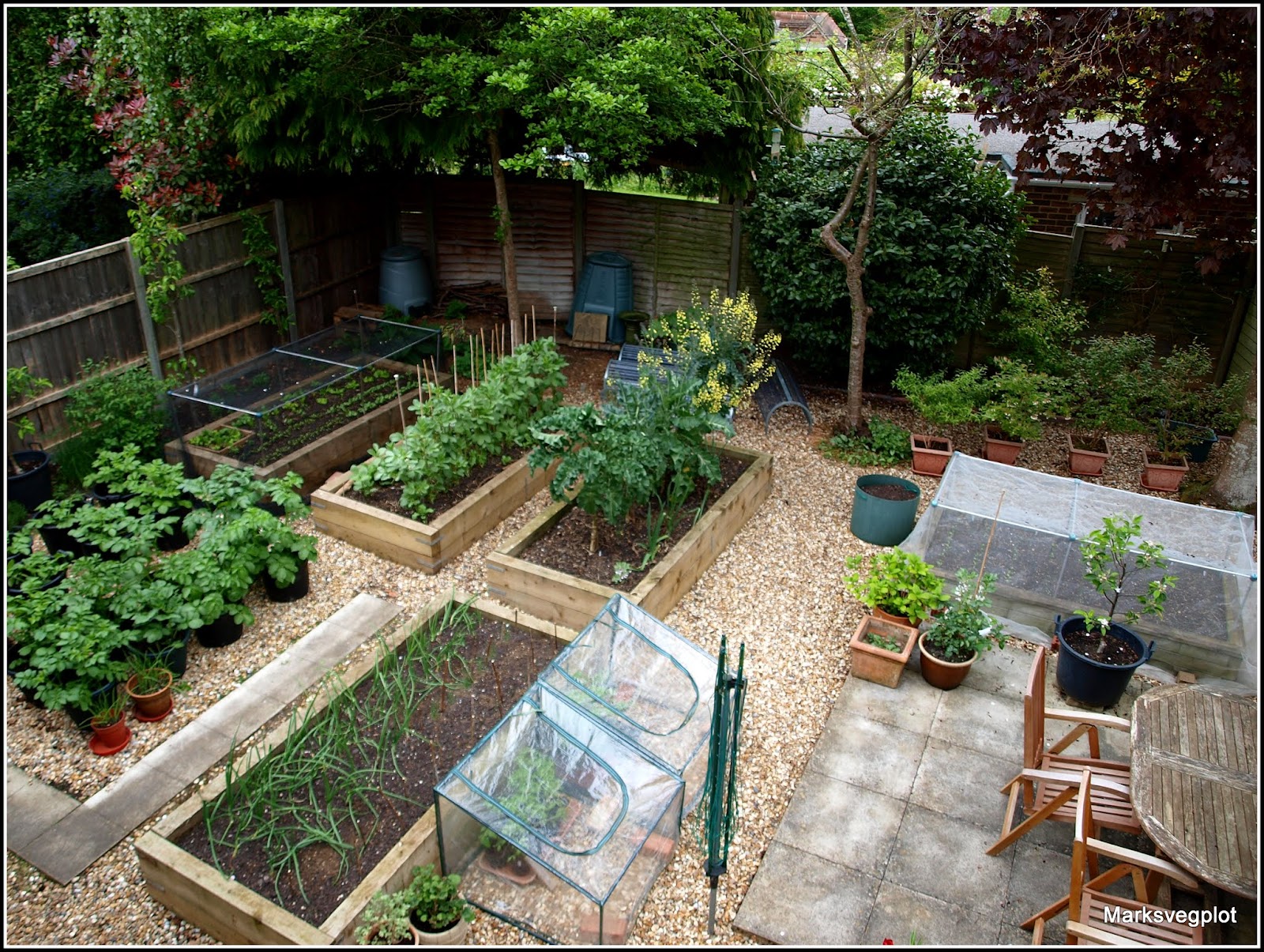
This is Mark's Veg Plot, seen earlier this week:

4 terracotta-coloured pots Top Right hold Blueberry bushes

I'll give you a tour...

Here are the potatoes, (seen Top Left in the photo above), putting on lots of luxuriant foliage now.


The first of the raised beds hosts onions and leeks. The leeks are at the right here, and so tiny still that you probably can't see them. The sticks are there to deter "diggers".


Behind the onions is the bed with the PSB, flowering now but shortly to be removed to make room for Runner Beans.


There's not too much of a hurry yet, because the Runner Beans are only just germinating.


In the third raised bed are my Broad Beans - two rows planted at different times, so that one lot will mature well before the other.


The first row has a good number of flowers on already, so hopefully it won't be very long before they yield their crop.


On the outer edges of the BB bed are rows of radishes, protected to some extent from the ravages of the Blackbirds by sticks and bits of wood.


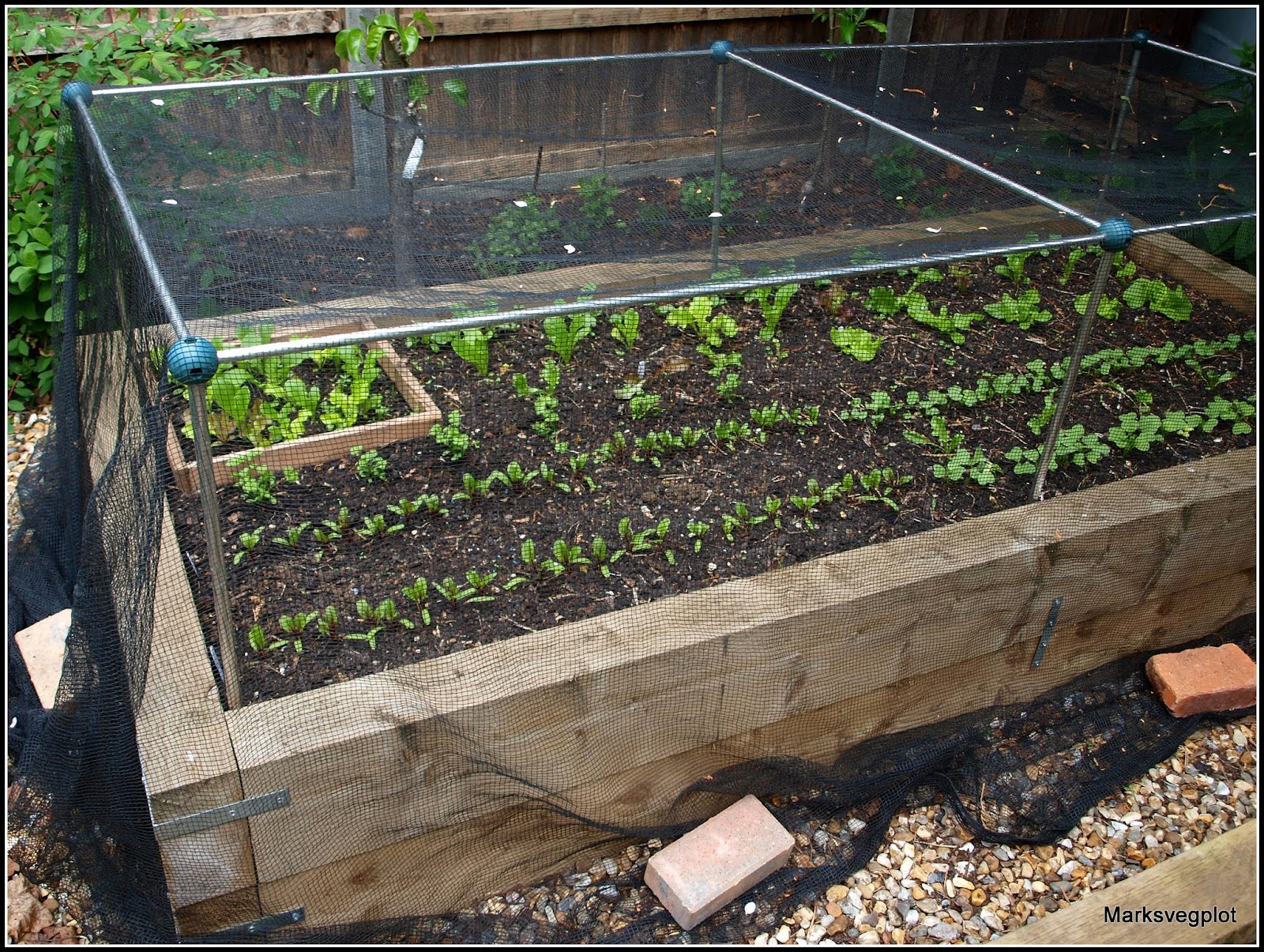
Number four bed contains salads - lettuces, beetroot, more radishes and some parsley. The bed is netted to keep birds and animals off.


Seen through the netting, here is my little patch of "Daddy Salad", nearly ready for picking. It's a bit more sparsely-populated than I would have wished, because relatively few of the seeds germinated. Still, I can't really complain since most of the seeds were from old part-used packs.


My fifth raised bed is the one with carrots and parsnips in. I wrote about it / them only a few days ago, so here's a token photo of the parsnips (taken through their protective Enviromesh):


Whether the asparagus I have is worth growing is a moot point. I have only 3 crowns of it, ones transplanted out of a raised bed I renewed last year, and they are only producing a very meagre crop. I think I may give them one more year and if they don't improve a lot, ditch them in favour of something else.


The ultimate waiting game is being played here of course:-


My plastic mini-greenhouses are doing just what they are intended for - protecting seedlings, rooted cuttings, over-wintered tender perennials etc, until such time as I feel they will be OK in the fresh air, hopefully in just ten days or a fortnight from now.

Thursday, 4 May 2017

Signs of Summer?

OK, it's May now, so can the weather please warm up? I'm tired of the cold grey days. It wouldn't be so bad if those grey days had brought a bit of rain, but it's been unusually dry here for weeks.

My tomato plants were getting thin and leggy due to the low light-levels on the windowsills, so I have moved them outside. Well, not completely outside - into the big wooden coldframe.


In order to accommodate the tomato plants I have had to re-arrange the coldframe setup completely. The middle shelf has come out, because with it in place the tomatoes would not get enough light, and many of them are already too tall to fit on the shelf anyway. They now have plenty of headroom to grow, but I'm a bit uncomfortable about the temperature (notice the thermometer prominently displayed!). Day-time temperatures outside at present are only about 12 - 14C. The coldframe boosts those by a few degrees, but most of the time the tomatoes will be wishing they were warmer. At this time of year it is always a trade-off between light and warmth. Right now I think light is the more important of the two factors.


The plants that were previously on the floor and on the middle shelf have been moved to the trusty plastic mini-greenhouses. In my mind there is no doubt that they take second place in the list of priorities!

Elsewhere there are a few signs of movement. I have been anxiously scanning the pot in which my Dahlia "Bishop of Llandaff" was overwintered, looking for signs of life. A couple of days ago I was rewarded with this:


The Dogwood shrubs are beginning to fill out too. I removed several of them earlier in the year, but not this one, which is my favourite. It's Cornus Alba "Aureum":


Last year at about this time something attacked this and other Dogwood plants, nibbling through the fresh young stems right at the tips, which caused a lot of damage, so I'm keeping a close eye on things this time.

Next door to that Dogwood bush is the Libertia with its mass of sharp pointy leaves. Sometimes it does well, others not. It looks as if is going to do well this year, because I have counted 26 flower spikes on it. No colour yet, but plenty of potential.


The Aquilegias are not looking so special this year. I re-potted some of the plants last year because they had become overcrowded, and they mostly look quite weak still. Best of the bunch so far though is this one, which is a self-seeded one, growing down at the bottom of the garden near my Comfrey patch.


This is another sign of approaching Summer - Radishes being harvested:


My first row of Radishes is nearly finished now. It was heavily depleted by the blessed Blackbirds. Still, I have got more coming along, and most of those are under nets now.

Tuesday, 2 May 2017

Thinning Carrots and Parsnips

Carrot seeds are tiny, and it is very difficult to sow them at the correct density, so most people (me included) sow them fairly thickly and then thin them out later on. Carrots that are too closely spaced will compete for light, air, water, and nutrients from the soil, and will probably produce fairly thin roots. It's usually better to have fewer but better carrots. On Saturday I thinned mine.


How much space you leave between the seedlings depends on several factors, for instance the variety of carrot. Some of mine are "Autumn King", which can get very big, but others are "Nantes", which usually remain quite small. If you want carrots to develop big roots it is usually better to err on the generous side when it comes to spacing. I have left about an inch or two between mine, but as they develop I may decide to thin them even further by removing every other plant at the "Baby veg" stage.


A few tips on thinning carrots:
1. Do the job on a dull, cool day. If it's warm and sunny the scent of the carrot thinnings can be detected more easily by Carrot Root Flies.
2. Water the rows of carrots before thinning, to make it easier to remove the unwanted plants without disturbing the ones you wish to keep.
3. Put the thinnings in a receptacle of some sort as you go along (I use a plastic pot-saucer), so that you can more easily move them off-site when the job is done.
4. Put the removed seedlings into a covered compost-bin, or if you only have an open bin cover them with a layer of other material. This will mask their scent so that Carrot Root Flies are less likely to detect them.
5. Water the rows again after thinning, to settle the plants in firmly. They may have been disturbed a bit by the removal of some of their siblings.
6. If you can, cover the thinned rows with some Enviromesh or similar material as soon as possible after completing the task, in order to deny the Carrot Root Flies the opportunity to move in.


As well as thinning the carrots, I also did the parsnips. This was easier, since I had sowed fewer seeds. You may remember that I "station-sowed" them, with 2 seeds at each station. Germination of the "Hollow Crown" ones was excellent, but there were a couple of gaps in the "Student" ones. I have filled these gaps with thinnings from elsewhere, though I'm not optimistic about the results. I find that parsnips hate being moved, so the transplanted ones may not take. I think the ideal spacing between parsnips is about 6 inches, so again mine might get thinned a second time if they all develop well.


If you look very carefully, you might just be able to make out the rows of tiny seedlings in this photo. There are 4 rows of parsnips nearest the camera, and 5 rows of carrots in the distance.


The warm weather during early April helped with germination of my carrots and parsnips - it's the first year for quite a while that I have not had to re-sow at all - but just recently it has been very dry, so I have been making sure I water the little seedlings every few days, which I will continue to do until they are well established.


P.S. Just wanted to sneak in a photo of my watercress. It's definitely growing!