My harvest this week comprises solely another batch of Purple Sprouting Broccoli:
Six nice chunky spears, just the right amount for a 2-person serving.
The Broccoli has done well this time. We have had a nice steady supply over a period of about two months, and there is still more to come. Which reminds me, it's nearly time to sow the seeds for next year's crop! I think I will grow three plants again. That seems like the ideal quantity for us. It will be one each of three different varieties too, to spread the harvesting period.
Our broccoli this time was served as an accompaniment to some roast Belly Pork. We like lots of veg with our meals, and that one included not only PSB, but also potatoes, celeriac, carrots and French beans. The little home-grown celeriac I showed last week went in with a bigger shop-bought one, because it was too small to make a decent serving on its own!
I'm linking to Harvest Monday, hosted by Dave at Our Happy Acres.
Monday, 7 March 2016
Sunday, 6 March 2016
Chit chat
Back at the end of January, I bought my seed potatoes. Since then they have been quietly sitting in the garage, chitting. Let's chat about chitting...
Chitting means letting the potatoes develop shoots, which grow out of the seed-tuber's eyes, most of which appear at the rose end of the tuber. Sounds gruesome and complicated, doesn't it? Actually it's not. Nor is it strictly necessary. Potatoes will grow quite happily without being chitted, but some people contend that chitted potatoes produce stronger plants and higher yields. I'm not sure whether there is any evidence to support such views, but I chit my potatoes anyway. In fact, one of the most powerful arguments for it these days is that seed tubers are being sold earlier and earlier in the year, so if you leave it until March to buy them you may find that there is less choice, because all the more desirable ones have already been sold! Since it is unwise to plant potatoes in January, this means that you really have to chit your spuds.
Traditionally, amateur potato-growers chit their tubers in old egg-boxes, which is a convenient way of supporting the tubers with the rose end uppermost. The rose end is the end of the potato furthest from the place where it was originally attached to its parent plant. Most of the new shoots develop from here.
My potatoes are currently in the garage, which is cool but frost-free. It has a window, so the potatoes get a reasonable amount of light. If they are kept in the dark the chits will be long, pale and thin and too fragile to do well. You're looking for short, sturdy, dark-coloured chits - maybe an inch or so long. Some people advocate removing all but 2 or 3 shoots, aiming to produce a smaller number of bigger shoots.
My potatoes are not ready for planting yet - they will need another few weeks - but they are doing fine. All I need now is something good to plant them in. For the last couple of years I have used mostly composted stable manure, mixed with a small proportion of commercial general-purpose compost, but I have become disillusioned with commercial compost of all types (regular readers will know why!), and I really don't know what to use this time. I think maybe I'll use mostly soil from that bulk bag I bought the other day. At the time 1 tonne sounded like a lot, but I have used a lot of it already and if my new raised beds are to be filled properly I will probably have to get another bag.
At least I have some nice containers for the potatoes. These are the 35-litre ones I bought from LBS Horticultural Supplies.
I am going to plant two tubers in each of those, but I also have some other, slightly smaller, pots, which are only big enough for one tuber each. The bigger pots are better, because they dry out less quickly and therefore require less effort to keep properly watered. This makes a big difference, because potatoes do not do well in dry conditions.
Charlotte x 4
Nocola x 4
Pink Fir Apple x 4
Nadine x 2
Maxine x 2
Since I'm writing about potatoes today, I though some readers would probably be interested in this - a Calendar of Potato Days. The dates are for this year, and many of them have passed already, but at least the list may help you to identify a suitable event near you for next year.
*********************************************************************************
On a different subject: The other day I was writing about the need to ferry all the old paving-stones and rubble to the tip, and Margaret suggested that I advertise them for free collection. I joined the local Freecycle group, and more or less the first thing I saw was "Wanted, paving-slabs..." Suffice it to say, the slabs have gone now! Thank you Margaret for the idea.
Chitting means letting the potatoes develop shoots, which grow out of the seed-tuber's eyes, most of which appear at the rose end of the tuber. Sounds gruesome and complicated, doesn't it? Actually it's not. Nor is it strictly necessary. Potatoes will grow quite happily without being chitted, but some people contend that chitted potatoes produce stronger plants and higher yields. I'm not sure whether there is any evidence to support such views, but I chit my potatoes anyway. In fact, one of the most powerful arguments for it these days is that seed tubers are being sold earlier and earlier in the year, so if you leave it until March to buy them you may find that there is less choice, because all the more desirable ones have already been sold! Since it is unwise to plant potatoes in January, this means that you really have to chit your spuds.
| The rose end of a potato |
| That's a decent chit |
At least I have some nice containers for the potatoes. These are the 35-litre ones I bought from LBS Horticultural Supplies.
For the record, these are my potato selections for this year:
Lady Christl x 4Charlotte x 4
Nocola x 4
Pink Fir Apple x 4
Nadine x 2
Maxine x 2
Since I'm writing about potatoes today, I though some readers would probably be interested in this - a Calendar of Potato Days. The dates are for this year, and many of them have passed already, but at least the list may help you to identify a suitable event near you for next year.
*********************************************************************************
On a different subject: The other day I was writing about the need to ferry all the old paving-stones and rubble to the tip, and Margaret suggested that I advertise them for free collection. I joined the local Freecycle group, and more or less the first thing I saw was "Wanted, paving-slabs..." Suffice it to say, the slabs have gone now! Thank you Margaret for the idea.
Saturday, 5 March 2016
Herbwise Organic Solutions
I'm always on the lookout for products that can help me to keep my plants in good condition without having loads of artificial and potentially harmful chemicals in them. I am as keen as the next gardener to stop the "beasties" destroying my precious plants, but I know that what kills the bugs can often do us humans some harm as well. For this reason I was very pleased to be contacted by Herbwise Organic Solutions, suggesting that I might like to try some free samples of their products, which are all made from natural beneficial ingredients.
When they first approached me it was Autumn, at a time when I was not much in need of these things, but in early February this year I started using the product called "Cultivate", which is a plant food. I'm assured it is very suitable for chillis, and that is where I am using it. Lorna from H.O.S. says this: "In regards to chillies, from testing 'Cultivate' gives an increase in flavonoid content, the fruits seem more 'real' for want of a better phrase. Some species of plants react by an increase in yield while something like a typical Birds Eye chilli plant just has better developed seeds inside at harvest and a slightly more rounded taste. The size will remain in the normal range though you will tend to find there are more stems and therefore in the end more chillies."
In the past I have tried various other products on my chillis, like Chilli Focus, and even Tomorite, so it will be interesting to see how Cultivate compares. It's early days yet, but my over-Wintered chilli plants are looking nice and strong already, so maybe some of this is due to the Cultivate.
The main products supplied by H.O.S. are "Cultivate", a plant food; "Eradicate", an insecticide; and "Detonate" which allegedly promotes an "explosion" of flowers! I have been supplied with one of each. Each product comes in a plastic 500ml bottle with a screw top. At £12, Cultivate sounds expensive, but you have to consider that before use it is diluted at the rate of 25ml (one capful) per 500ml of water, so one bottle will go a long way. Furthermore, the price includes delivery, so I think that makes it very reasonable.
My only complaint - and it's hardly a complaint, more of an observation - is that the labels are not very clear, nor particularly attractive. The product names are quite hard to discern. I think a distinctive logo would be more appropriate, instead of the rather un-enterprising "H.O.S.". I also think a back-label with a description of the product and instructions for use would be a good addition.
It is too early for me to judge the effectiveness of these products, but I will certainly be making use of them throughout the season and will report my findings later. In the meantime, my thanks go to Lorna and Daniel at H.O.S. for providing such a generous sample.
When they first approached me it was Autumn, at a time when I was not much in need of these things, but in early February this year I started using the product called "Cultivate", which is a plant food. I'm assured it is very suitable for chillis, and that is where I am using it. Lorna from H.O.S. says this: "In regards to chillies, from testing 'Cultivate' gives an increase in flavonoid content, the fruits seem more 'real' for want of a better phrase. Some species of plants react by an increase in yield while something like a typical Birds Eye chilli plant just has better developed seeds inside at harvest and a slightly more rounded taste. The size will remain in the normal range though you will tend to find there are more stems and therefore in the end more chillies."
In the past I have tried various other products on my chillis, like Chilli Focus, and even Tomorite, so it will be interesting to see how Cultivate compares. It's early days yet, but my over-Wintered chilli plants are looking nice and strong already, so maybe some of this is due to the Cultivate.
The main products supplied by H.O.S. are "Cultivate", a plant food; "Eradicate", an insecticide; and "Detonate" which allegedly promotes an "explosion" of flowers! I have been supplied with one of each. Each product comes in a plastic 500ml bottle with a screw top. At £12, Cultivate sounds expensive, but you have to consider that before use it is diluted at the rate of 25ml (one capful) per 500ml of water, so one bottle will go a long way. Furthermore, the price includes delivery, so I think that makes it very reasonable.
My only complaint - and it's hardly a complaint, more of an observation - is that the labels are not very clear, nor particularly attractive. The product names are quite hard to discern. I think a distinctive logo would be more appropriate, instead of the rather un-enterprising "H.O.S.". I also think a back-label with a description of the product and instructions for use would be a good addition.
It is too early for me to judge the effectiveness of these products, but I will certainly be making use of them throughout the season and will report my findings later. In the meantime, my thanks go to Lorna and Daniel at H.O.S. for providing such a generous sample.
Friday, 4 March 2016
Early germinations
Today, although some parts of the UK are carpeted with snow, here in Fleet we have blue sky and sunshine. Sunshine makes everything look so much nicer! This pot of Mint in my coldframe is certainly enjoying it:
On sunny days like today I open up the lid of the coldframe for an hour or two to give the plants maximum light. The rest of the time they are tucked up inside, protected from frost and especially wind, which can be more damaging than cold temperatures. The benefit of the coldframe is very obvious when you compare that Mint plant which is bursting into new growth to an exactly similar one that has been outside all Winter - and is still showing almost no growth.
A month or so ago (Feb 7th, to be precise) I sowed a batch of Broad Bean seeds in some plastic containers and set them to germinate in one of my mini-greenhouses. After about three weeks there was no sign of germination, so I brought the containers indoors to hasten things along. After just a few days on a windowsill above a radiator, they began to appear:
I have now moved the little plants out into the mini-greenhouses again, because I don't want them to get soft. When they have at least two fully-opened leaves I will plant them out in one of the raised beds, initially under cloches.
I did the same thing with my Cabbages, sown on Feb 13th. Most of them germinated rapidly when brought indoors. I had sowed two seeds per pot, and almost every one germinated.
So now I have removed one of each pair of seedlings, leaving behind the strongest one, or if they both seemed the same, the one most centrally-placed.
These too are out in the mini-greenhouses now, so that they get maximum light. Keeping them indoors for any length of time risks having them go weak and spindly - sometimes called "leggy". Outside, they will develop more slowly but they will be stronger.
One type of plant that I will not banish outside is the Basil. I sowed about 15 seeds in a 6-inch pot which I have kept on the windowsill all the time, covered with a clear plastic bag, which increases humidity and thus helps germination. When the seeds germinated, I thinned them out by about 50%.
In due course, when they are big enough to handle easily, I will select the best ones and transplant them into more of these 6-inch pots. I normally keep four of them on my Dining-Room windowsill more or less all year round. These plants shown below are ones I sowed this time last year. I have cropped them three or four times and used their leaves to make Pesto.
I don't generally grow any Basil outside, because it doesn't do well - it can't get enough warmth or direct sunlight.
I'm still waiting for my pot of "Terrain" peas to germinate. They are in the black pot seen at the left of the photo above. They have been indoors for a week now, and still nothing... Patience is the most necessary virtue for a gardener!
On sunny days like today I open up the lid of the coldframe for an hour or two to give the plants maximum light. The rest of the time they are tucked up inside, protected from frost and especially wind, which can be more damaging than cold temperatures. The benefit of the coldframe is very obvious when you compare that Mint plant which is bursting into new growth to an exactly similar one that has been outside all Winter - and is still showing almost no growth.
A month or so ago (Feb 7th, to be precise) I sowed a batch of Broad Bean seeds in some plastic containers and set them to germinate in one of my mini-greenhouses. After about three weeks there was no sign of germination, so I brought the containers indoors to hasten things along. After just a few days on a windowsill above a radiator, they began to appear:
I have now moved the little plants out into the mini-greenhouses again, because I don't want them to get soft. When they have at least two fully-opened leaves I will plant them out in one of the raised beds, initially under cloches.
I did the same thing with my Cabbages, sown on Feb 13th. Most of them germinated rapidly when brought indoors. I had sowed two seeds per pot, and almost every one germinated.
So now I have removed one of each pair of seedlings, leaving behind the strongest one, or if they both seemed the same, the one most centrally-placed.
These too are out in the mini-greenhouses now, so that they get maximum light. Keeping them indoors for any length of time risks having them go weak and spindly - sometimes called "leggy". Outside, they will develop more slowly but they will be stronger.
One type of plant that I will not banish outside is the Basil. I sowed about 15 seeds in a 6-inch pot which I have kept on the windowsill all the time, covered with a clear plastic bag, which increases humidity and thus helps germination. When the seeds germinated, I thinned them out by about 50%.
In due course, when they are big enough to handle easily, I will select the best ones and transplant them into more of these 6-inch pots. I normally keep four of them on my Dining-Room windowsill more or less all year round. These plants shown below are ones I sowed this time last year. I have cropped them three or four times and used their leaves to make Pesto.
I don't generally grow any Basil outside, because it doesn't do well - it can't get enough warmth or direct sunlight.
I'm still waiting for my pot of "Terrain" peas to germinate. They are in the black pot seen at the left of the photo above. They have been indoors for a week now, and still nothing... Patience is the most necessary virtue for a gardener!
Thursday, 3 March 2016
Goat Curry
Although it is now yet widely available, goat meat is becoming trendy here in the UK. To the uninitiated, goat meat is perceived as being gristly and chewy, but that is far from the truth. Properly reared and butchered goat meat is like good strong-tasting lamb, and there is no reason at all why it should be tough. The other day, when we were shopping for that lovely piece of beef we had for our 40th Engagement Anniversary, we saw some goat meat on sale and decided to get some and freeze it for a later occasion. I subsequently made it into a Caribbean-inspired curry.
I cut the meat into cubes and marinated it for several hours in a dry mix of home-made curry powder, powdered Allspice (Jamaican Pepper), grated fresh ginger and crushed garlic. After browning the meat I cooked it long and slow (about 3 hours +). In the dish went onion, chilli (one Rocoto and one Cayenne - both home-grown), more curry powder, some fresh thyme, some fennel seeds, stock and lots of ginger cut into thin "Julienne" strips.
Continuing the Caribbean theme I decided to accompany my curry with this salsa made from mango, diced chilli and mint - reflecting the yellow, red and green combination so popular in that part of the world:
The chillis and mint came from my garden, but (regrettably) not the mango!
Next up, in the absence of plantains, I cooked some bananas. Prior to baking them I cut a long slit in them in order to avoid any explosions. After 20 minutes they were completely black on the outside, but gooey and sweet on the inside:
Normally I would have served Rice-and-Peas with this curry, but I decided that for the sake of variety I would do some Sweet Potato wedges. I cut the potatoes lengthways into quarters, leaving the skins on, rubbed them with a tablespoonful of vegetable oil and sprinkled them generously with paprika - a mix of the sweet and the spicy versions.
The last element of the meal was some "greens". In the Caribbean this would probably have been callaloo or an amaranth of some sort, but I used Brussels Tops from my garden:
Here is the meal, plated-up:
The curry was not HOT, hot, just mildly warming, leaving a pleasant tingle on the tongue. The curry powder I used was one that Jane makes from home-roasted whole spices. It is a fragrant mix rather than a very hot one. The other ingredients I used were in a similar vein, particularly the ginger, which went lovely and soft and mellow after its 3 hours of cooking. And the goat meat? Likewise, melt-in-the-mouth tender and delicious.
If you can get hold of goat meat, I strongly recommend that you get some and try it.
I cut the meat into cubes and marinated it for several hours in a dry mix of home-made curry powder, powdered Allspice (Jamaican Pepper), grated fresh ginger and crushed garlic. After browning the meat I cooked it long and slow (about 3 hours +). In the dish went onion, chilli (one Rocoto and one Cayenne - both home-grown), more curry powder, some fresh thyme, some fennel seeds, stock and lots of ginger cut into thin "Julienne" strips.
Continuing the Caribbean theme I decided to accompany my curry with this salsa made from mango, diced chilli and mint - reflecting the yellow, red and green combination so popular in that part of the world:
The chillis and mint came from my garden, but (regrettably) not the mango!
Next up, in the absence of plantains, I cooked some bananas. Prior to baking them I cut a long slit in them in order to avoid any explosions. After 20 minutes they were completely black on the outside, but gooey and sweet on the inside:
Normally I would have served Rice-and-Peas with this curry, but I decided that for the sake of variety I would do some Sweet Potato wedges. I cut the potatoes lengthways into quarters, leaving the skins on, rubbed them with a tablespoonful of vegetable oil and sprinkled them generously with paprika - a mix of the sweet and the spicy versions.
The last element of the meal was some "greens". In the Caribbean this would probably have been callaloo or an amaranth of some sort, but I used Brussels Tops from my garden:
Here is the meal, plated-up:
The curry was not HOT, hot, just mildly warming, leaving a pleasant tingle on the tongue. The curry powder I used was one that Jane makes from home-roasted whole spices. It is a fragrant mix rather than a very hot one. The other ingredients I used were in a similar vein, particularly the ginger, which went lovely and soft and mellow after its 3 hours of cooking. And the goat meat? Likewise, melt-in-the-mouth tender and delicious.
If you can get hold of goat meat, I strongly recommend that you get some and try it.
Wednesday, 2 March 2016
Plans for the borders
In my garden, the emphasis is firmly on the edibles - fruit, veg and herbs - but two sides of my plot are edged with an ornamental border about three feet wide. In the border I want easy-maintenance plants, so that means mostly shrubs. I am particularly fond of Dogwoods, which provide lots of interest (attractive leaves in Summer / Autumn and brightly-coloured stems in Winter / Spring), whilst needing minimal maintenance.
I am also currently very much enthused with Hellebores, so I am gradually establishing clumps of them underneath the Dogwoods. This is a good combination because the Hellebores flower at a time when the Dogwoods have no leaves.
I am raising several new Hellebore plants from seed, and my plan is to put them into the border down by the shed, in an area from which I have recently removed lots of the Euphorbia.
Euphorbia is nice enough, but (in my opinion) rather unexciting. Actually, over the last couple of years it seems to have lost its vigour and probably needed some drastic treatment anyway.
Also in the border is this Libertia, a plant which has a history. It was once on display at the Chelsea Flower Show. I mean this specific plant, not just one of this type.
Next to the Libertia, at the right of the photo above is an Hypericum. This one is a volunteer that just appeared one year, presumably growing from a seed imported by a bird. It has beautiful flowers and berries, so I am happy to have it in my garden.
At the other end of the border is this... a Japanese Anemone called "September Charm".
This type of Anemone spreads very easily, via underground roots, and little plants are popping up all over the place. I will have to be ruthless if I am to keep this one in check!
latest addition to the border is this Lysimachia Ciliata "Firecracker", purchased last Summer on a visit to RHS Wisley:
I grew it in a pot last year, when it was still small, but when it died down in the Autumn I transferred it to the border, near the Anemone. With a bit of luck it will grow a lot bigger this year.
I realise that I have strayed from the point a bit in this post. I started by writing of some plans to augment the planting in my borders, and I have ended up telling you what the borders contain! Oh well...
Actually, it has served to remind me that despite the preponderance of edibles in my garden, there are also plenty of ornamentals too these days. I think my garden has reached a state of balance.
I am also currently very much enthused with Hellebores, so I am gradually establishing clumps of them underneath the Dogwoods. This is a good combination because the Hellebores flower at a time when the Dogwoods have no leaves.
I am raising several new Hellebore plants from seed, and my plan is to put them into the border down by the shed, in an area from which I have recently removed lots of the Euphorbia.
Euphorbia is nice enough, but (in my opinion) rather unexciting. Actually, over the last couple of years it seems to have lost its vigour and probably needed some drastic treatment anyway.
| Euphorbia "Clarice Howard" |
Since the Hellebore seedlings are currently very small and will take a couple of years to bulk-up even when they are planted out, I am going to temporarily fill the space with Heuchera plants. I have five like this, which are offshoots from a mature plant that I have had for several years:
| Heuchera diversifolia "Palace Purple" |
Also in the border is this Libertia, a plant which has a history. It was once on display at the Chelsea Flower Show. I mean this specific plant, not just one of this type.
Next to the Libertia, at the right of the photo above is an Hypericum. This one is a volunteer that just appeared one year, presumably growing from a seed imported by a bird. It has beautiful flowers and berries, so I am happy to have it in my garden.
This type of Anemone spreads very easily, via underground roots, and little plants are popping up all over the place. I will have to be ruthless if I am to keep this one in check!
latest addition to the border is this Lysimachia Ciliata "Firecracker", purchased last Summer on a visit to RHS Wisley:
I grew it in a pot last year, when it was still small, but when it died down in the Autumn I transferred it to the border, near the Anemone. With a bit of luck it will grow a lot bigger this year.
I realise that I have strayed from the point a bit in this post. I started by writing of some plans to augment the planting in my borders, and I have ended up telling you what the borders contain! Oh well...
Actually, it has served to remind me that despite the preponderance of edibles in my garden, there are also plenty of ornamentals too these days. I think my garden has reached a state of balance.
Tuesday, 1 March 2016
Raised beds - why I like them
Anyone who has read my blog recently can hardly fail to have noticed that I am in the process of building some new raised beds. I thought this might be an opportune moment to write a bit more about Raised Beds in general...
Regular readers understand that my garden has to be "Just so". I have a strong OCD streak in me!
Over the years I have progressively upgraded my raised beds, and one day maybe they will be perfect. Yeah, maybe... In the early days, the edging of my beds was made from bits of scrap wood gleaned from old packing-cases and pallets. This was before I took up photography, so I don't have any pictures of that stage.
Then I forked out some money and made some proper beds with planks and nails. Those ones lasted a few years, but when the wood rotted I replaced them again in similar fashion but made them stronger, with steel angle-brackets at the corners.
Those early beds were quite good, but not good enough. For one thing, they were only 6 inches (15cm) tall.
Then I got the Woodblocx bed, which was a big improvement. Hard work to assemble, but definitely worth it. Nice and deep too.
Last year (2015) many of the beds needed replacing again and I decided on a pattern that has a depth similar to the Woodblocx one - 40cm. It also has the benefit of simplicity of construction, which the Woodblocx bed definitely did not have.
The timber is supplied as "sleepers", each 240cm x 20cm x 10cm. It is still softwood though, not like the iron-hard stuff that proper old railways sleepers used to be made of. I made two of these beds last year. They performed very well. The one in the photo above produced the best crop of carrots I have ever had. Of course part of the success was due to the Enviromesh cover which I put over the bed.
The regular shape of the beds and the tall sides make it easy to erect a suitable framework for the netting:
The framework is made from plastic "Build-a-Ball" balls, with lightweight aluminium rods purchased from a company called Gardening Naturally. This has proved to be a very efficient and versatile combination.
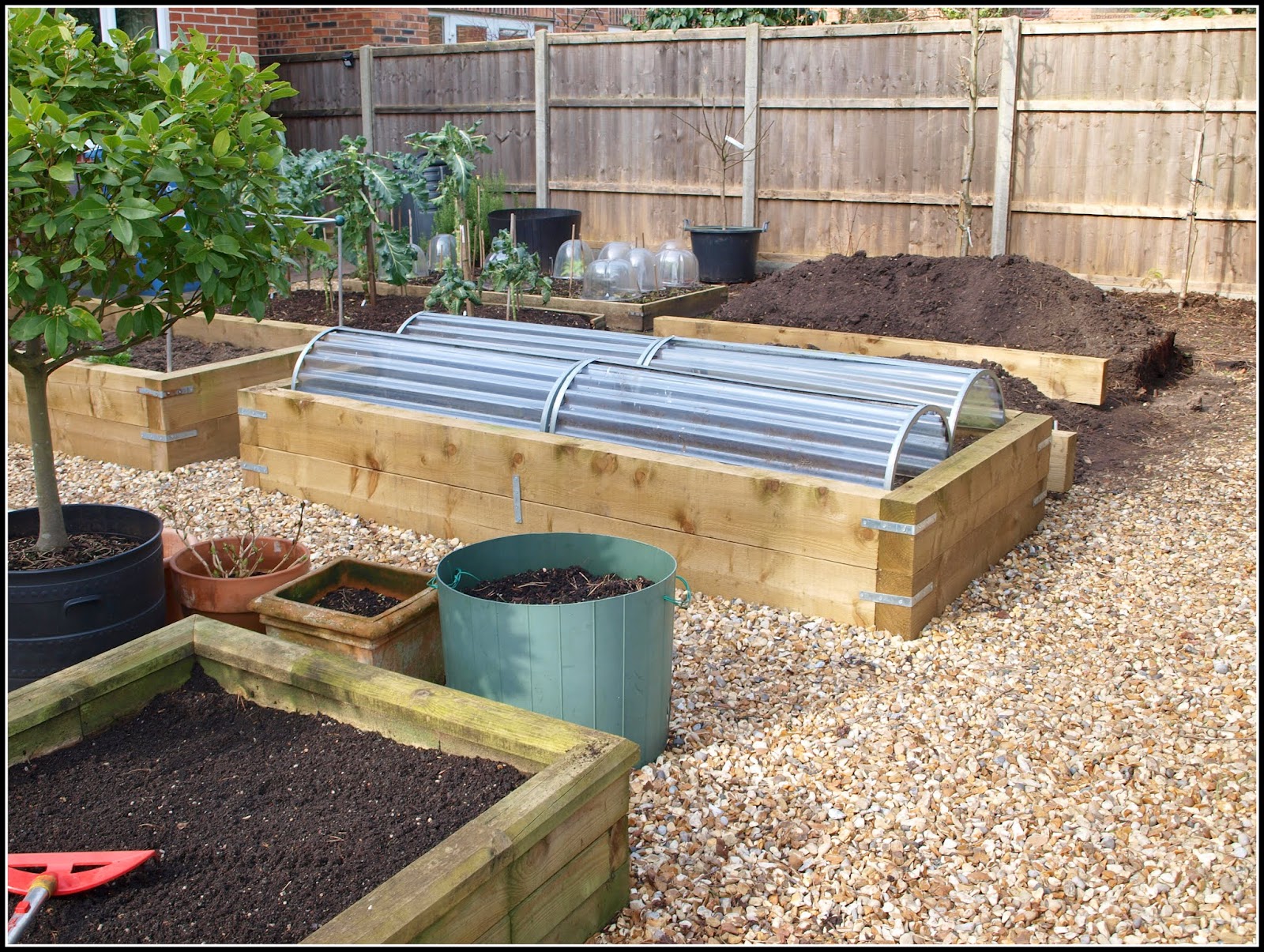
Coincidentally, the dimensions of the beds are perfect to accommodate my four "Longrow" tunnel cloches:
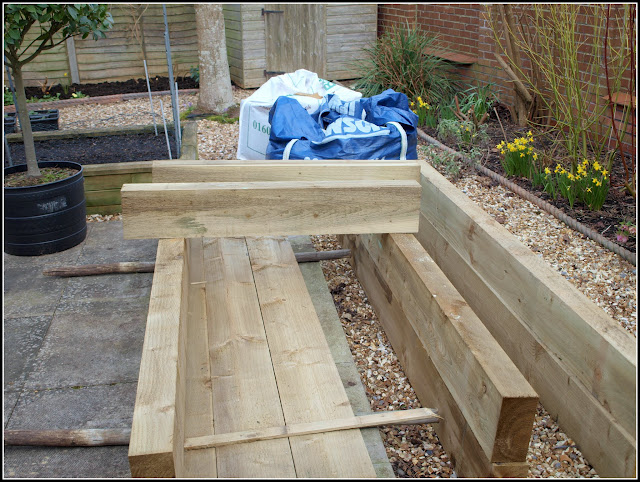
This year, as you know, I have committed to building another two of these big deep beds.
I'm not sure yet what is happening about the remaining two. Maybe I'll do them later this year (I'll have more time to spare after I retire), or maybe I'll leave them till next year. Finances are a consideration too: each of those beds comes in at about £157, and I may not be able to justify spending that sort of money when my income drops dramatically! [If you want to see the exact costings, I wrote about these last year, HERE.]
Anyway, I've just remembered that I was supposed to be saying why I like raised beds so much, so here goes:
1. They keep the garden neat and tidy (in particular, they stop the Blackbirds kicking compost all over the place!)
2. They allow me to concentrate all available compost / fertiliser / water etc on the productive parts of the garden, without wasting any on unproductive areas
3. The added depth gives the vegetables more room to put down big roots
4. The soil in the beds warms up quicker in the Spring
5. Being above ground level, the beds never get waterlogged
6. It is easier to protect plants in the beds, using nets, mesh, fleece etc supported on the sort of framework described above
Regular readers understand that my garden has to be "Just so". I have a strong OCD streak in me!
Over the years I have progressively upgraded my raised beds, and one day maybe they will be perfect. Yeah, maybe... In the early days, the edging of my beds was made from bits of scrap wood gleaned from old packing-cases and pallets. This was before I took up photography, so I don't have any pictures of that stage.
Those early beds were quite good, but not good enough. For one thing, they were only 6 inches (15cm) tall.
Then I got the Woodblocx bed, which was a big improvement. Hard work to assemble, but definitely worth it. Nice and deep too.
Last year (2015) many of the beds needed replacing again and I decided on a pattern that has a depth similar to the Woodblocx one - 40cm. It also has the benefit of simplicity of construction, which the Woodblocx bed definitely did not have.
The timber is supplied as "sleepers", each 240cm x 20cm x 10cm. It is still softwood though, not like the iron-hard stuff that proper old railways sleepers used to be made of. I made two of these beds last year. They performed very well. The one in the photo above produced the best crop of carrots I have ever had. Of course part of the success was due to the Enviromesh cover which I put over the bed.
The regular shape of the beds and the tall sides make it easy to erect a suitable framework for the netting:
The framework is made from plastic "Build-a-Ball" balls, with lightweight aluminium rods purchased from a company called Gardening Naturally. This has proved to be a very efficient and versatile combination.
Coincidentally, the dimensions of the beds are perfect to accommodate my four "Longrow" tunnel cloches:
This year, as you know, I have committed to building another two of these big deep beds.
| Some of the sleepers have to be cut in half to make the end pieces. |
I'm not sure yet what is happening about the remaining two. Maybe I'll do them later this year (I'll have more time to spare after I retire), or maybe I'll leave them till next year. Finances are a consideration too: each of those beds comes in at about £157, and I may not be able to justify spending that sort of money when my income drops dramatically! [If you want to see the exact costings, I wrote about these last year, HERE.]
Anyway, I've just remembered that I was supposed to be saying why I like raised beds so much, so here goes:
1. They keep the garden neat and tidy (in particular, they stop the Blackbirds kicking compost all over the place!)
2. They allow me to concentrate all available compost / fertiliser / water etc on the productive parts of the garden, without wasting any on unproductive areas
3. The added depth gives the vegetables more room to put down big roots
4. The soil in the beds warms up quicker in the Spring
5. Being above ground level, the beds never get waterlogged
6. It is easier to protect plants in the beds, using nets, mesh, fleece etc supported on the sort of framework described above
Subscribe to:
Posts (Atom)