Tuesday, 14 May 2013

Busy, busy, busy!

Dodging the April  May showers, I spent a large part of the weekend working in the garden. At this time of year it's necessary!

I have potted-up most of the rest of my tomato plants, just keeping a few in reserve in case of disasters. I now have 14 plants in big pots:


 My highest hopes for a good crop are vested in the ones I have put in those self-watering planters that my MIL gave me. Here you can see some of them with their water-tubes poking up:-


My first row of Broad Beans has grown to about 15 inches tall now, so I have put in place new support and protection arrangements - tall wooden stakes support a net to keep the wildlife off, and a pattern of soft string stretched between the stakes provides support. As the plants grow taller I'll add another couple of layers of string.


I picked the last of the PSB and removed the plants, so now I have two vacant raised beds, ready for my beans. One bed is going to have Runner Beans in it (14 plants), for which I have now erected this frame of 8-foot bamboo poles:


The other will have the climbing French Beans. Some of the Chicories that I cut without removing the roots have re-sprouted, so I have left them in place. I may be able to get a small crop of young leaves from them before I need to dig them up.


I have resisted the temptation to use these beds for growing salads, so the only place I could find in which to plant my Lettuce seedlings was this...!
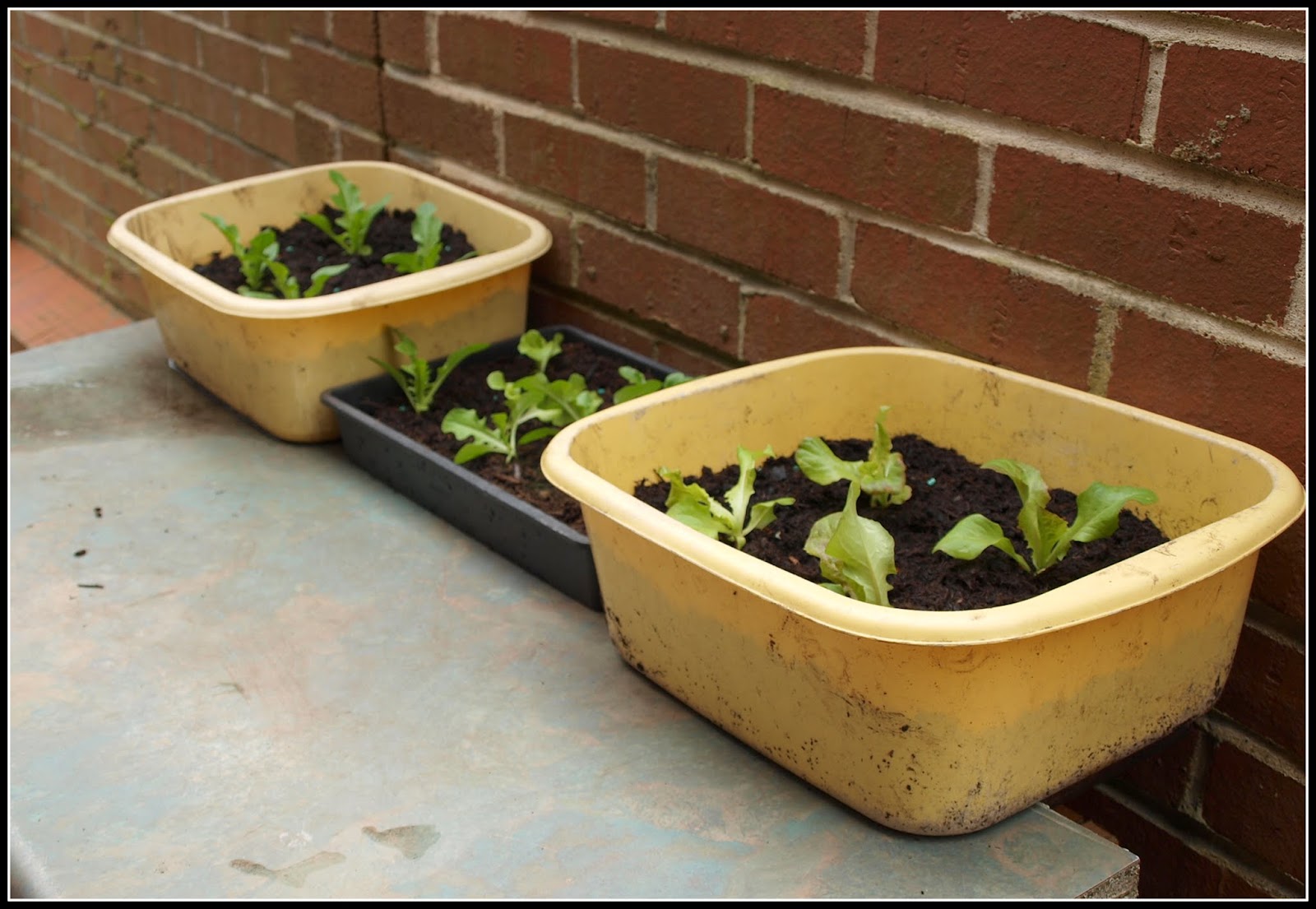

Those are old plastic washing-up bowls with drainage holes drilled in them (the black tray in the centre is just the seed-tray from which I have transferred the lettuces). I have put four seedlings in each bowl. One has Green Oak Leaf:


And the other has Marvel of Four Seasons:


Meanwhile the recent rain has given the Asparagus a real boost. I have picked a second lot of 5 spears, but there are about 20 more visible now.


The Asparagus needs little attention at this stage. It's simply a question of judging the right moment to cut the spears. Keeping the bed free of weeds is desirable too, since it makes the spears easy to see.

This coming weekend I had been hoping to plant out some cucumbers - under cloches - but unless the weather improves dramatically I think this is now unlikely.

Monday, 13 May 2013

The chilli plantation

This year I'm growing more varieties of chilli than ever before. If I had more space, I'd grow even more chillis! The plants are rapidly increasing in size and it will soon be time for me to decide which ones to keep, and which ones to give away. I know that a couple of my "Garden Helpers" who look after my garden when I'm away on holiday will gladly give the spares a good home.

A few days ago I moved the young plants into bigger pots. They were originally sowed in 3-inch pots, small enough to fit under the lights of the Grow Light House. For the past few days thay have been indoors at night and outside during the daytime.


They have now outgrown the 3-inch pots, and besides, the Grow Light House is full of cucumber seedlings, so the chillis have been moved into 5-inch pots, and are now living full-time in the plastic mini greenhouses:


I am a great fan of these little greenhouses, and have just acquired two more (making a total of four). With their big zip-up flaps they are ideal for this time of year, when the daytime temperatures are warm, but the nights are still cold. They are also good for protecting young plants from the strong winds and heavy rain which we so often get in April and May. Whilst it is nice that they are lightweight and easily portable, they are a bit flimsy though, and you will see that I have weighted mine down with a couple of house-bricks each.


 In a couple of weeks' time these plants will be big enough to fend for themselves without protection, and will be upgraded once again - this time to 10-inch pots, their final homes. When that time comes, I'll probably only keep 10 or 12 chillis, and say 'Bye 'Bye to the others.

I'll definitely be keeping this good -looker. This is "Black Prince".


Indoors, my Scotch Bonnet plant from last year now has several small fruits on it:


Just need some warmer weather now...

Sunday, 12 May 2013

Softening the outlines

The harsh outlines of Winter have been replaced by the softer look of Summer. My micro-pond is rapidly disappearing in a welter of Lily of The Valley:


Just out of shot to the right there are two Tulip flowers.


 These are ones left over from a previous year. I certainly haven't planted any Tulips for several years now. I had forgotten about these ones, and I didn't even remember what colour they were. It looks as if they will be pink:


The Philadelphus tree / shrub that I pruned so severely last Summer is also smothered in fresh green shoots.


It still looks ugly at present, but hopefully in a few weeks time it will look OK. It couldn't really be worse than it was before I pruned it!

The Euphorbia is at its best right now. Green can be such a cold colour, but this shade of green is anything but cold:


The Golden Hops are romping away now, clothing the dull wooden fence panels with a fresh coat of zingy colour.


Talking of fence panels, the ones on the other side of the garden will soon be hidden by the rapidly rising Raspberries (how's that for alliteration?):


You can probably just see that I have put back up the wires which I had to remove when the fence was replaced a few weeks ago.

The ferns are also doing their thing.  Their brown, dessicated stumps are suddenly bursting into life and thrusting up lots of rapidly-uncoiling hairy new fronds...


Saturday, 11 May 2013

Topping-up the compost

Over the Bank Holiday weekend I did a task that I can't claim to enjoy, but which is very necessary - and ultimately very rewarding: emptying a compost bin. The bin is question is one of the 330litre black plastic "Dalek" bins - ugly, but with the addition of a few thousand worms, a very-efficient compost-making machine.

To get at the dark crumbly soil-like compost, I had to remove the top 50% or so of the material, which was in various stages of decomposition / digestion by the worms, but even so I ended up with a very pleasing quantity of the "good stuff". This has now been distributed in a thick layer over the most needy parts of the plot. No.1 priority was the raised bed in which I hope soon to be planting Runner Beans:


The next-door bed which houses the last of the Purple Sprouting Broccoli also got a dose. This bed will play host to my Climbing French Beans.


Incidentally, this is what the broccoli looks like now - the secondary spears are at a useable size - but once these are gone, the plants will be pulled up and consigned to the same compost bin that I have just been emptying.


Round the base of the fruit trees I put a thick layer of compost. I don't expect it to stay this neat for very long - the Blackbirds will be kicking it around before the day is out, I know.


The Raspberries got their share too:


Applied like this, as a mulch, the compost will help mainly to conserve moisture in the soil, but later on it will gradually get absorbed into the soil itself, adding nutrients and contributing organic matter to improve the soil structure.

I have been gardening on this plot for 22 years now. Each year I do this distributing of compost at least twice (emptying my bins in rotation), and I use a fair bit of commercial compost for tubs of potatoes, tomatoes and such-like, but the level of soil in the raised beds never seems to rise significantly. Where does it all go? Just think what the plot would be like if I didn't apply this compost. Presumably the levels would be a lot lower.

Friday, 10 May 2013

Impatient

Gardeners are always impatient, aren't they? Well, I certainly am. It's scarcely a month since I started sowing seeds, but already I'm yearning for a harvest. I've put in seeds for some quick-growing vegetables to tide me over until the slower ones get going. Like this Baby Leaf salad, for instance:-


This is a mixture I assembled myself, comprising many different things, like lettuce, rocket, cress, corn salad, spinach, beetroot etc, etc. It is growing in a large plastic crate full of compost:


My seed distribution was a bit uneven, evidently! Actually it's not quite as bad as it seems at first sight, because if you look closely you can see several tiny red lettuces, which don't show up in the distant shot:


Some of these will be ready in a couple of days I think. I'm going to use it in "cut-and-come-again" style, snipping off individual leaves with a pair of scissors.

I also have some other lettuce seedlings which are nearly big enough for planting out:


...and some much smaller seedlings, which are nowhere near ready for transplanting yet. These are a mixture of "Valdor"( foreground), "Delicato" (the red one in the centre), and "Fristina" (rear). As you can see, the germination success rates have been a bit patchy. The seed-tray on the right is supposed to contain two different types of Endive, but one type failed completely to germinate, though to be fair, the seeds were quite old.


The Endives that did germinate are the variety "Pancalieri".


Elsewhere, in amongst my Broad Beans, I have a few Radishes that are just about ready for pulling:


Radishes are the classic impatient gardener's vegetable, because they can be ready to harvest within a month of sowing if the conditions are right - in other words wet and warm. This year I have put lots of Radishes in, sowing them as a catch-crop between the rows of slower-maturing veg. So far however, this is all I have harvested:


Thursday, 9 May 2013

Speedy potatoes

It seems like only a couple of days since I noticed the first tentative potato shoots emerging from the compost in their pots. Now the plants are racing ahead, making up for lost time after the freezing conditions during March and early April. The ones inside the plastic greenhouse are noticeably further advanced than their less fortunate siblings outside:


One in particular is miles ahead of the others. This year I have been really disciplined and labelled every single pot, so I know that the tuber growing in this one is called "Swift", which seems rather apt.


This wire-protected pot has no protection from the elements, only from the wildlife:


I have just planted my only Maincrop potatoes  - four tubers of "Pink Fir Apple" - which are in the big pots seen at the back of this next photo. I have given them bigger containers than their Early cousins, since I know that they can grow into very big plants. Hopefully the extra space will also allow them to deliver a bigger crop. Notice the anti-fox / badger precautions as usual.


Blight is always an issue to be aware of when growing potatoes. This is why I grow mostly Earlies, which are harvested before the blight appears, but I usually grow a few PFA as well, because I just love them and I think their superior flavour and texture makes it worth taking the risk of losing them.

Wednesday, 8 May 2013

Planting-out tomatoes

Keeping a very close watch on the weather forecast, at the weekend I judged that it was time to plant out the first of my tomatoes. They had grown a lot in the last couple of weeks - so much so that they had nearly outgrown the 5" pots into which I had transplanted them:


I'm still not 100% confident that we have seen our last frost of the year, so I didn't want to plant them all out at once. I have hedged my bets. The best three of the "Maskotka" plants have gone into the Woodblocx raised bed (at last, I have planted something in it! A long-awaited moment...)


In order to help these plants get established, I have put each one of them under a large plastic bell-cloche.


Unfortunately, the local wildlife like this raised bed as much as I do, so the planting of anything in it has to be accompanied by the relevant precautions. I have therefore erected a net to cover the whole bed:


Over on the other side of the garden I have filled with compost a big container made from an old water-butt, and into it I have planted two "San Marzano" tomatoes. This is a bush type, so it will not grow very tall. It produces large red plum-shaped fruits with few seeds, ideal for making into sauces.


Of course, after planting-out comes the inevitable anti-wildlife protection:


I have put a few plants into big square planters equipped with bamboo canes supported by some of those cane-supports that I bought the other day...


Despite my best efforts, one of the cane-supports is still very wonky, so its tomato is going to have to learn to climb at a sharp angle! (See below, right).


Significantly, I have not potted-up ALL of my tomato plants yet. I still want to be able to bring them inside (into the garage, for instance) if the weather turns nasty, and once they are tied to tall canes this become impractical. So the other plants will remain in their 5" pots for another few days.


  Another week, or ten days maybe...