"Soil", that is... The two old raised beds have now gone, along with the line of paving-stones that used to run between them.
Most of the soil has gone into the other 4 big raised beds - you can see that the ones in the photo above are pretty full now. I have put the remainder of the soil into a number of big pots:-
Most of these will be used for growing potatoes, so as I filled them I added a handful of "Growmore" general-purpose fertiliser into each one in preparation. I'm not adding any pelleted chicken manure this time (which I usually do, for potatoes), because I think the soil from the raised beds will have enough nitrogen in it already. I'm quite pleased with that soil, actually. I have been enriching it with compost year on year for the past 15+ years (I can't remember when I first made the beds!), and it is now lovely and dark, rich and crumbly.
The next phase of the project is to cover the empty space with shingle. What this means is that I will soon be able to get rid of the unsightly blue nylon builders' bag that has been lurking in my garden for the last two years! When it arrived it contained 1000kg of shingle. Even now, when it is about 75% used up, it is too heavy for me to shift, so I have to transport the shingle a little at a time, which is very time-consuming (and hard work).
Still, we're getting there, and the garden is beginning to look a little bit less like a tip.
Friday, 10 February 2017
Wednesday, 8 February 2017
Leeks - a meagre harvest
OK, I'll admit it. My crop of Leeks this year was not a success! Foolishly, I tried to cram too many vegetables into a small space and planted my Leeks in beds that were already hosting other crops - Parsnips and PSB. The foliage of the Parsnips was particularly luxuriant last year. As a result, the Leeks were completely overshadowed and never grew beyond the "miniscule" stage.
However, it's not all bad news, since I did plant my spare Leeks in a big (35-litre) pot and they have done a lot better.
Eight Leeks crammed into one pot were never going to be huge. Furthermore, the soil in the pot had already been used to grow a crop of potatoes, and had not been refreshed. I now need the pot for this year's potatoes, so I have pulled up the Leeks.
Actually, if I had been planning to grow these as "Baby Leeks", I would be well pleased. Other than their diminutive girth, there is little to complain about.
Here they are, cleaned up ready for using in the kitchen:
The moral of this tale is definitely "Less is More". The concept of under-cropping (growing one crop underneath another) sometimes works, but you have to choose the right crops! I was greedy, hoping to get two crops at once, but it didn't work this time.
However, it's not all bad news, since I did plant my spare Leeks in a big (35-litre) pot and they have done a lot better.
| Leeks "Toledo" |
Eight Leeks crammed into one pot were never going to be huge. Furthermore, the soil in the pot had already been used to grow a crop of potatoes, and had not been refreshed. I now need the pot for this year's potatoes, so I have pulled up the Leeks.
Actually, if I had been planning to grow these as "Baby Leeks", I would be well pleased. Other than their diminutive girth, there is little to complain about.
Here they are, cleaned up ready for using in the kitchen:
The moral of this tale is definitely "Less is More". The concept of under-cropping (growing one crop underneath another) sometimes works, but you have to choose the right crops! I was greedy, hoping to get two crops at once, but it didn't work this time.
Monday, 6 February 2017
Plans for the raised beds - or not
As I mentioned a short while ago, I have decided not to build more of the big raised beds, but to create an open space to hold big pots and containers. This is the space:
The two low raised beds at the back of the photo are destined to be removed. This is becoming more urgent by the day, due to the seriously decayed state of the wooden edging. I patched up this corner last Summer, but it was at best a very temporary repair:
I have four of the "New Pattern" raised beds, made with two layers of 20cm-high sleepers. The level of the soil and compost with which I filled them has gone down a fair bit, so there is plenty of room for more. The soil from the 2 old beds will therefore be distributed amongst the 4 new ones.
At the weekend I took off the galvanised steel angle-brackets from the old beds, in preparation for removing the wood. The only thing holding me back now is the presence of some rather nice Radicchio plants in one of the beds. They have spent the Winter under cloches, as seen here:
Despite the cloches, the outer leaves of these plants got frosted in the long spell of sub-zero weather we had last month. However, once you remove those outer leaves, the centres are fine.
With Radicchio, a little bit goes a long way. The heads are very tightly packed and when you "unpack" one you do get a lot of edible leaves. Fortunately Radicchio keeps for ages in the fridge, especially if you leave the main stem intact. I think these plants will all be harvested very soon, so that I can get on with the shifting of soil.
Elsewhere in the garden, the first signs of shoots are appearing on the Purple Sprouting Broccoli (rather later than usual):
My container-grown Leeks are going to be picked soon. I don't think they are going to get much bigger.
Since the weather has turned a bit milder the bulbs have started popping up all over the place too. Most of mine are in pots, like these Tulips:
I also have quite a few of the little "Tete-a-Tete" daffodils scattered round the borders.
Is it too early to be thinking of Spring???
The two low raised beds at the back of the photo are destined to be removed. This is becoming more urgent by the day, due to the seriously decayed state of the wooden edging. I patched up this corner last Summer, but it was at best a very temporary repair:
I have four of the "New Pattern" raised beds, made with two layers of 20cm-high sleepers. The level of the soil and compost with which I filled them has gone down a fair bit, so there is plenty of room for more. The soil from the 2 old beds will therefore be distributed amongst the 4 new ones.
At the weekend I took off the galvanised steel angle-brackets from the old beds, in preparation for removing the wood. The only thing holding me back now is the presence of some rather nice Radicchio plants in one of the beds. They have spent the Winter under cloches, as seen here:
Despite the cloches, the outer leaves of these plants got frosted in the long spell of sub-zero weather we had last month. However, once you remove those outer leaves, the centres are fine.
With Radicchio, a little bit goes a long way. The heads are very tightly packed and when you "unpack" one you do get a lot of edible leaves. Fortunately Radicchio keeps for ages in the fridge, especially if you leave the main stem intact. I think these plants will all be harvested very soon, so that I can get on with the shifting of soil.
Elsewhere in the garden, the first signs of shoots are appearing on the Purple Sprouting Broccoli (rather later than usual):
| PSB "Rudolph" |
My container-grown Leeks are going to be picked soon. I don't think they are going to get much bigger.
Since the weather has turned a bit milder the bulbs have started popping up all over the place too. Most of mine are in pots, like these Tulips:
I also have quite a few of the little "Tete-a-Tete" daffodils scattered round the borders.
Is it too early to be thinking of Spring???
Saturday, 4 February 2017
Planting Onion sets
Today I have planted some onion sets. It's probably a bit early, but with the aid of my recently-acquired massive coldframe, I think it is OK to start. If I were planting the onions outside, I would probably wait another month.
I have zero experience with growing onions - either from sets or from seed - but I have read up on it, and it seems easy enough (famous last words...).
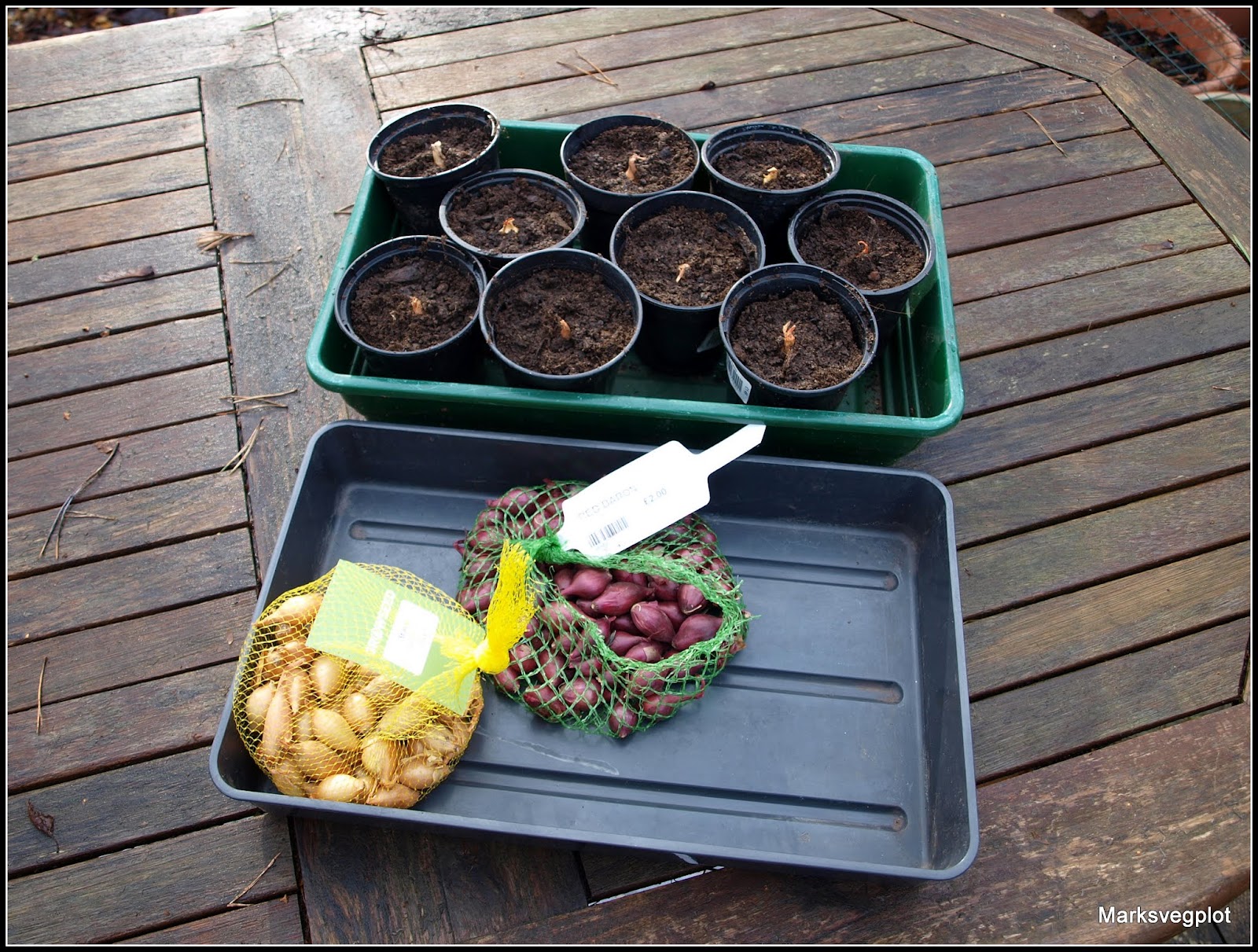
I have two different varieties of onion. One is "Red Baron", which I bought last weekend at the Hampshire Potato Day.
I reckon there must have been about a hundred sets in that bag, but I certainly can't afford the space to grow that many! Since this is my first attempt I have planted just a few, to try them out.
The other variety is "Sturon", a white type. These are the sets kindly given to me by Gerry from GrowSeed.
The planting technique is dead easy. Just push the sets into the soil (either in the open or in pots / modules), so that just the tips stick out, like this:-
My trays of little pots have now gone into the coldframe, where they will be protected from the weather, until it's warm enough to plant them outside (probably late April).
I have also sown some onion seeds today, though there is nothing much to see so I'm not showing a photo. They are seeds for "Long Red Florence", whose name is self-explanatory! I have sown 4 or 5 seeds each in plastic 5-inch pots, and when the plants are big enough I will transplant them as a clump.
As I said, I have been reading-up on growing onions, and I note that they do best in full sun, so I'm a bit worried, since my garden never gets as much direct sun as I would like. One of the jobs I have done today is removing a couple of the lower branches of my big Bronze Maple tree, hoping to let in some more light.
So, let's see how it goes...
| The coldframe (photo from just after assembly) |
I have zero experience with growing onions - either from sets or from seed - but I have read up on it, and it seems easy enough (famous last words...).
I have two different varieties of onion. One is "Red Baron", which I bought last weekend at the Hampshire Potato Day.
I reckon there must have been about a hundred sets in that bag, but I certainly can't afford the space to grow that many! Since this is my first attempt I have planted just a few, to try them out.
The other variety is "Sturon", a white type. These are the sets kindly given to me by Gerry from GrowSeed.
The planting technique is dead easy. Just push the sets into the soil (either in the open or in pots / modules), so that just the tips stick out, like this:-
My trays of little pots have now gone into the coldframe, where they will be protected from the weather, until it's warm enough to plant them outside (probably late April).
I have also sown some onion seeds today, though there is nothing much to see so I'm not showing a photo. They are seeds for "Long Red Florence", whose name is self-explanatory! I have sown 4 or 5 seeds each in plastic 5-inch pots, and when the plants are big enough I will transplant them as a clump.
As I said, I have been reading-up on growing onions, and I note that they do best in full sun, so I'm a bit worried, since my garden never gets as much direct sun as I would like. One of the jobs I have done today is removing a couple of the lower branches of my big Bronze Maple tree, hoping to let in some more light.
So, let's see how it goes...
Sunday, 29 January 2017
Stocking up with seeds
The other day I wrote that I had been looking at good-value seeds, and intending to avoid buying the highly-priced seeds that many of the Big Names offer. Well, I was delighted to receive an email from Gerry at Grow Seed, who had seen my post and offered to let me have some of his seeds for free, in return for a little publicity. How could I refuse?! This is the generous selection I received - 11 packets of seeds and 250g of "Sturon" Onion sets:
I'll confess that I have not previously bought seeds from Grow Seed, because there are just so many suppliers out there and you can't give your business to all of them. However, having seen what Grow Seed offer, I may well become a regular customer. They have a very respectable range of seeds for vegetables, herbs and fruit, as well as a few plants. Most of the seeds are sold at £0.99 per packet, which is pretty good by today's standards - especially since the number of seeds you get is generous. Beetroot "Cylindra", for example, comes in a pack of 500 seeds, which is surely plenty for any amateur grower.
There are some other aspects of this business that sound very attractive to me too - for instance, they strive to minimize the use of packaging materials (though I'm a bit wary of their use of plastic bags for the seed packs), and the postage rates are very reasonable - starting at £1.00, with UK orders over £25 being completely postage-free. I shall definitely be growing some of the seeds that Gerry sent me, and I'll report back on how they perform.
On a related theme, this weekend I have been stocking-up on seed potatoes too. Yesterday I went with my daughter Emma to the Hampshire Potato Day at Whitchurch (about 20 miles from here). I have been several times before, and described the event here on my blog, so I won't go over it again. If you want to see the details, have a look HERE and HERE. For today though, let me just show you what I got:
That is 22 potato tubers of 10 different varieties, some Broad Beans ("Witkiem Manita"), some Runner Beans ("Scarlet Emperor"), and some "Red Baron" Onion sets.
For the record, my potato varieties are:-
Charlotte
Nicola
Juliette
Lady Christl
Belle de Fontenay
Orla
Accord
International Kidney
Ratte
Kestrel
It's a mix of First Early, Second Early and Maincrop types. Interestingly, when researching these varieties I found that some of them can be grown as different types. For instance, at the Potato Day "Orla" was being sold as a maincrop, but it is also often described as suitable for cultivation as a First Early.
I bought 2 of each variety, except "Charlotte" (my favourite), of which I bought 4. This is the joy of going to a Potato Day - you can buy as few or as many tubers as you like. This year the price was still 17p per tuber, or 10 for £1.50. Excellent value, I think.
Monday, 23 January 2017
La Cloche baking dome
Over the years Jane and I have tried many kitchen gadgets (many of them ones that she has won in competitions), and to be honest a lot of them have been rubbish. A gadget has to be good to earn its place in our kitchen! This post is about one of the good ones.
You probably know that I have got keen on baking bread - particularly the sourdough type. My skills have been gradually improving, but until recently I seldom seemed to be able to get a crisp crackly crust on a loaf, and that is despite using the time-honoured method of placing a roasting-tray full of ice-cubes in the oven as a way of generating steam. Now, a "gadget" has transformed my loaves.
As a Christmas present, Jane bought me a "La Cloche baking dome", available in the UK via Bakery Bits. In the words of the supplier "A La Cloche will give your bread the wood-fired oven treatment, trapping steam with the rising dough to give you a loaf with a beautifully golden, crackly crust and soft, evenly baked crumb." It does, too.
As you can see from the photo above, the La Cloche comes in two parts: a base and a dome. You put the whole thing in the cold oven and allow it to heat up as the oven heats. Then when the oven has come up to temperature you remove the La Cloche, tip your dough into the base unit, quickly cover it with the dome and return it to the oven. The dome is removed for the last 10 minutes of cooking time in order to let the loaf develop a nice golden-brown colour.
I am very pleased indeed with this item. I have used it several times already, and the result has been perfect bread each time. This is one gadget that I have no hesitation in recommending. It's not cheap, (£47.99), but if you are serious about bread-making it will soon earn its keep. The only disadvantage I can see is that it is quite bulky and takes a lot of storage-space.
Incidentally, some of my bread-making friends have told me that they use an inverted cast-iron Dutch Oven for the same purpose, but cast-iron is very heavy and a blazing hot Dutch Oven can be very dangerous to use!
Thursday, 19 January 2017
Plans for 2017
Hello again, I've re-surfaced! To be honest with you, for a few weeks I completely lost interest in blogging and (even worse), gardening. Maybe I had a severe dose of Seasonal Affective Disorder or something? Fortunately I have recently begun to consider some plans for my garden during 2017, so I thought it would be a good time to put together a blogpost...
Plan No.1. At this time of year in both 2015 and 2016 I was getting ready to build more raised beds, replacing old decaying timber planks with much more substantial constructions.
In theory I should be doing that again this year, because I have two more beds very much in need of attention. However, I have decided not to replace the old beds at all, but to remove them altogether. The main reason for this is that I have felt over the last few years that my garden has become overcrowded. It has been jammed full of pots and containers hosting tomatoes, chillis, potatoes, blueberries and miscellaneous other fruit and veg at various stages. Now the plan is to create a flat (shingle-surfaced) open space where those two raised beds currently sit, and use it for positioning the pots of potatoes etc, which will of course leave more space elsewhere. There's an obvious problem here: I'll have to be disciplined enough not to fill this new space AS WELL AS the places where the pots used to go!
Plan No.2 is to grow fewer types of fruit and vegetables, but to grow them better. I am going to avoid all the things that have performed poorly for me in the past and concentrate on the ones that do well, or have high Value For Space Rating (VSR). The Raspberries are Out; the Strawberries are Out; Kale and Summer Broccoli are Out; Dwarf Beans are Out, as are Cabbages other than Red ones. Definitely In though are Runner Beans, Parsnips, Carrots, Lettuce and Beetroot. Marginal ones include Leeks and Brussels Sprouts. (My Brussels sprouts this Winter have been pathetic). We'll see if I can find space for them, but I won't be too upset if I can't. I'm not planning to grow anything radically different this year either (e.g. the Cucamelons I tried last year but was uninspired by). At present the only new-to-me crop I am planning to grow this year is Red Onions.
Plan No.3 is to spend less money on seeds - though I don't think I have ever been particularly extravagant in this respect (especially over the last two years, when I have had the luxury of lots of free Trial seeds from Marshalls). Still, I am going to sow some of the really cheap seeds from shops like Wilkos, and see how they fare. Only this week I bought a selection of seeds from Wilko's, priced in some cases as low as 25p per pack. They will probably be OK. I'll also have a look in places like Aldi, Lidl and The Range whenever the opportunity next arises, without making a special trip.
Plan No.4 is to spend less time on blogging - and the attendant photography. I hope my regular readers won't feel too let down by this, but I really think that my posts had begun to get a bit "samey", since my basic gardening approach differs little from year to year. I shall attempt to post something at intervals of about a week or so, or whenever something significant occurs. For instance, this year I am going to use bean-poles made of Hazel instead of the bamboo I have been using for many years, so I'll let you know how that goes. I got the beanpoles from my local Countryside Services department (who very kindly delivered them to my doorstep!), so I may have to return the favour by doing a bit of volunteering for them.
Plan No.5 is to get more "into" fungi - both in terms of studying them and in terms of foraging them for culinary purposes. I expect that a book I was given for Christmas will be a big help in this respect. It is called "Edible Mushrooms - A forager's guide to the wild fungi of Britain, Ireland and Europe" by Geoff Dann. The best fungi don't appear until later in the year (Autumn is the best time for them), so this will be something for Summer-time and beyond, I expect - once all the sowing and planting has been done.
My post is beginning to sound too much like Teresa May's 12-point plan for Brexit, so I'm going to leave it there for now!
Plan No.1. At this time of year in both 2015 and 2016 I was getting ready to build more raised beds, replacing old decaying timber planks with much more substantial constructions.
| Old beds in the foreground, new beds in the background |
In theory I should be doing that again this year, because I have two more beds very much in need of attention. However, I have decided not to replace the old beds at all, but to remove them altogether. The main reason for this is that I have felt over the last few years that my garden has become overcrowded. It has been jammed full of pots and containers hosting tomatoes, chillis, potatoes, blueberries and miscellaneous other fruit and veg at various stages. Now the plan is to create a flat (shingle-surfaced) open space where those two raised beds currently sit, and use it for positioning the pots of potatoes etc, which will of course leave more space elsewhere. There's an obvious problem here: I'll have to be disciplined enough not to fill this new space AS WELL AS the places where the pots used to go!
Plan No.2 is to grow fewer types of fruit and vegetables, but to grow them better. I am going to avoid all the things that have performed poorly for me in the past and concentrate on the ones that do well, or have high Value For Space Rating (VSR). The Raspberries are Out; the Strawberries are Out; Kale and Summer Broccoli are Out; Dwarf Beans are Out, as are Cabbages other than Red ones. Definitely In though are Runner Beans, Parsnips, Carrots, Lettuce and Beetroot. Marginal ones include Leeks and Brussels Sprouts. (My Brussels sprouts this Winter have been pathetic). We'll see if I can find space for them, but I won't be too upset if I can't. I'm not planning to grow anything radically different this year either (e.g. the Cucamelons I tried last year but was uninspired by). At present the only new-to-me crop I am planning to grow this year is Red Onions.
Plan No.3 is to spend less money on seeds - though I don't think I have ever been particularly extravagant in this respect (especially over the last two years, when I have had the luxury of lots of free Trial seeds from Marshalls). Still, I am going to sow some of the really cheap seeds from shops like Wilkos, and see how they fare. Only this week I bought a selection of seeds from Wilko's, priced in some cases as low as 25p per pack. They will probably be OK. I'll also have a look in places like Aldi, Lidl and The Range whenever the opportunity next arises, without making a special trip.
Plan No.4 is to spend less time on blogging - and the attendant photography. I hope my regular readers won't feel too let down by this, but I really think that my posts had begun to get a bit "samey", since my basic gardening approach differs little from year to year. I shall attempt to post something at intervals of about a week or so, or whenever something significant occurs. For instance, this year I am going to use bean-poles made of Hazel instead of the bamboo I have been using for many years, so I'll let you know how that goes. I got the beanpoles from my local Countryside Services department (who very kindly delivered them to my doorstep!), so I may have to return the favour by doing a bit of volunteering for them.
| My Hazel bean-poles |
Plan No.5 is to get more "into" fungi - both in terms of studying them and in terms of foraging them for culinary purposes. I expect that a book I was given for Christmas will be a big help in this respect. It is called "Edible Mushrooms - A forager's guide to the wild fungi of Britain, Ireland and Europe" by Geoff Dann. The best fungi don't appear until later in the year (Autumn is the best time for them), so this will be something for Summer-time and beyond, I expect - once all the sowing and planting has been done.
| Parasol mushroom |
My post is beginning to sound too much like Teresa May's 12-point plan for Brexit, so I'm going to leave it there for now!
Subscribe to:
Posts (Atom)