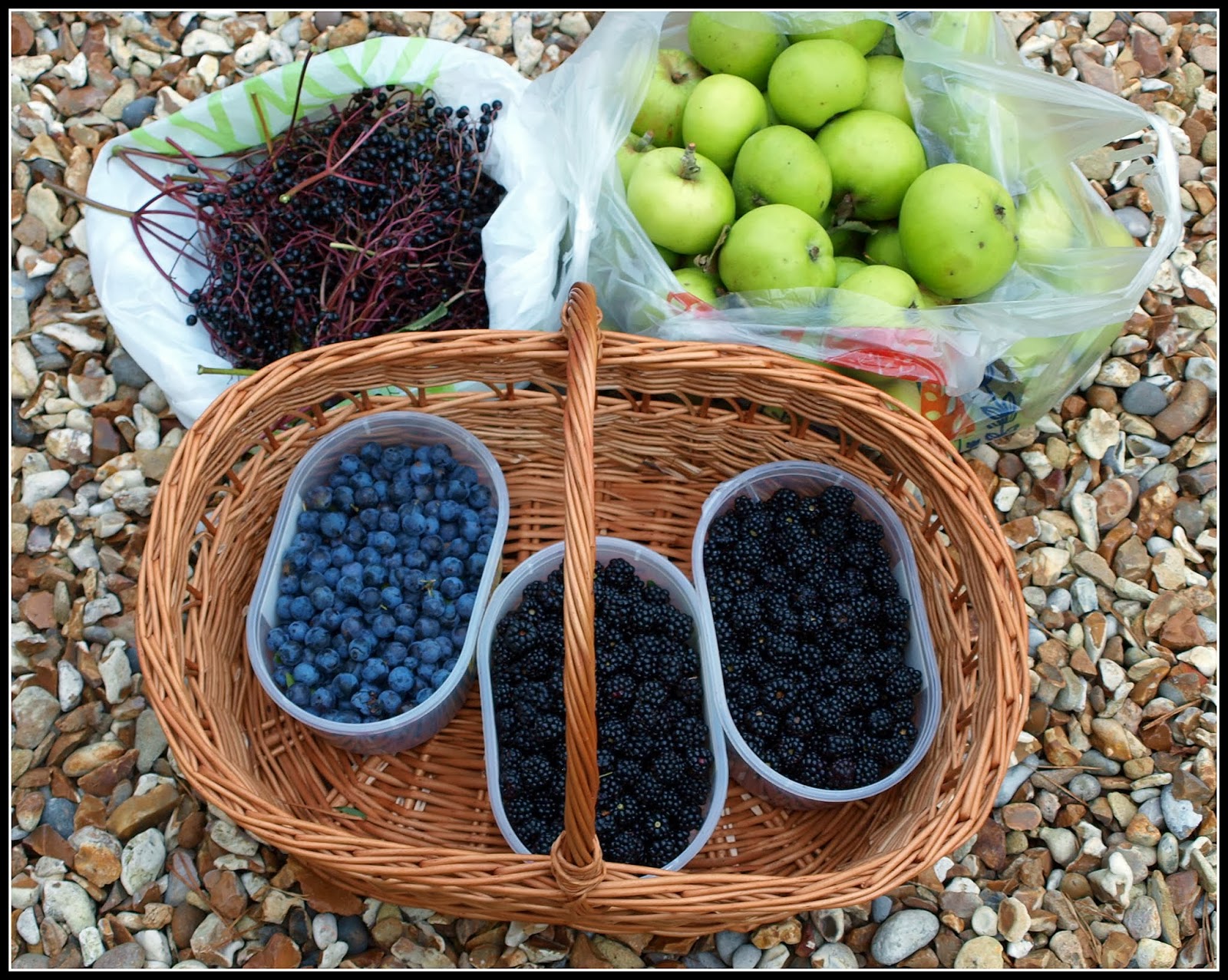
I'm not sure whether there is an official recipe for Hedgerow Jelly. In my opinion, the essential criterion is that it must contain ingredients foraged from the hedgerows. I associate it with early Autumn, when the hedgerows round us are teeming with free fruit. Here in Hampshire, the weather this past Friday afternoon was glorious - blue sky, sunshine, temperature about 18C - ideal conditions for foraging! Within the space of an hour I had gathered this:
Well actually not ALL of that. The apples are Bramleys from a domestic garden, which were given to me by a friend. (Thanks, Rosemary!)
These are the fruits, in close-up. First, Blackberries:
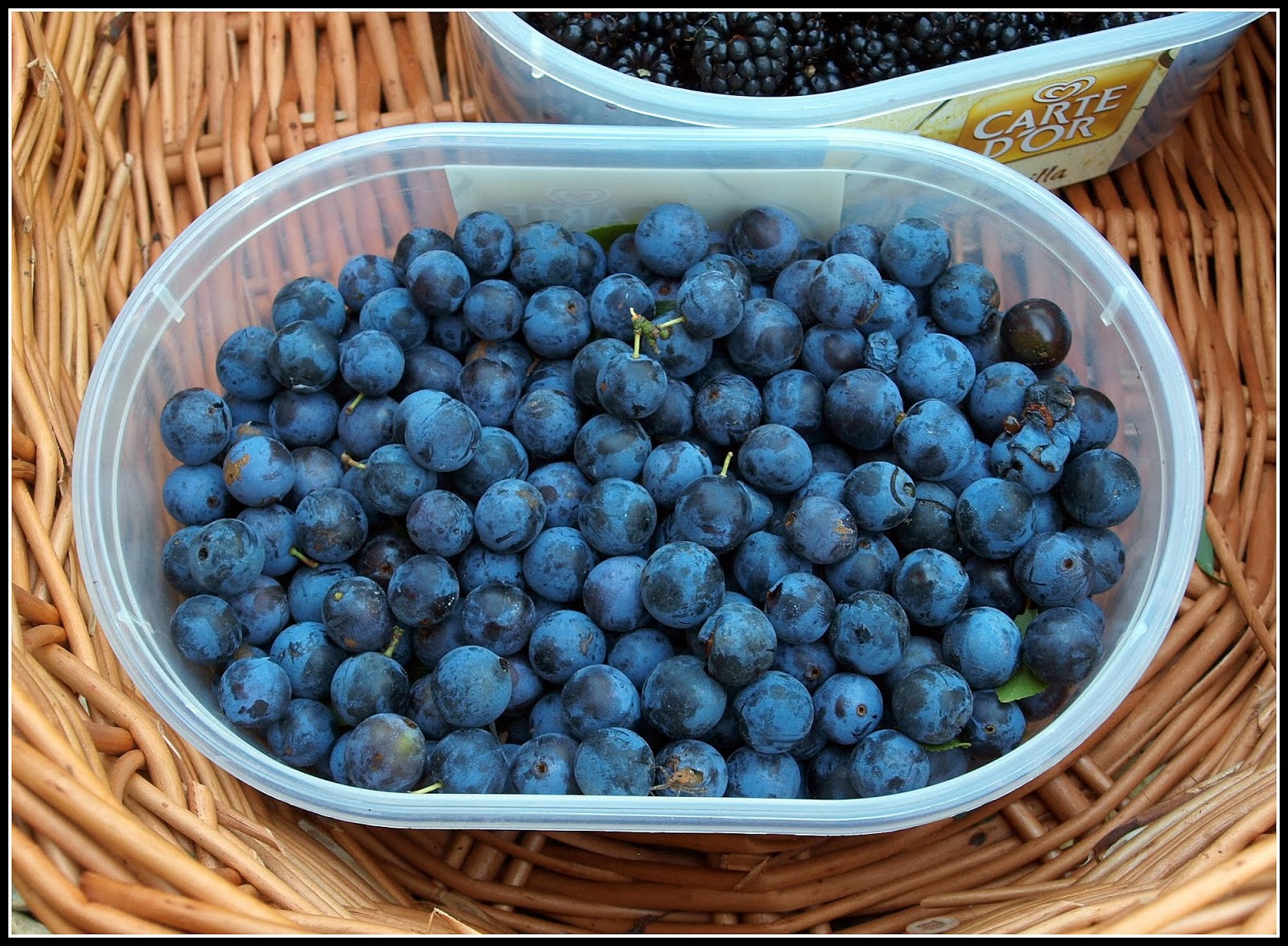
Then Sloes:
Then Elderberries:
And not forgetting the Apples...
I had a total of about 1.75kg of Blackberries, Elderberries and Sloes, and I matched that with an equal quantity of Apples. After washing, the fruit all went into our big preserving-pan, along with a litre of water. It's important to put all parts of the apples in, including the skin, cores and pips, because these contribute high levels of pectin (which Blackberries lack). It is the pectin that makes the jelly set.
Then the fruit was simmered gently for about half an hour until very soft.
Next the fruit has to be strained to separate the juice from the pulp. Fortunately we have a purpose-made jelly-bag, but if you haven't got one of these you could use a piece of muslin. Now the difficult bit - finding a means of suspending the jelly-bag above a bowl in which to collect the juice. I excercised my ingenuity and tied some pieces of string to the loops on the jelly-bag and then hung the whole thing from the handles of the overhead cupboards in our Utility-Room, like this:
"Necessity is the Mother of Invention" they say...
After straining the fruit overnight, this is the juice I had collected. It was 1.25 litres.
The next stage of the proceedings was to return the juice to the (washed) pan and add sugar. You need 450g of sugar to 500ml of juice (or a pound of sugar to a pint of juice). Heat the pan gently, stirring constantly, to dissolve the sugar crystals.
Then bring the mixture to the boil and boil it hard for as long as it takes to reach "setting point". This depends on the fruit, but could be anything between 5 and 45 minutes! Definitely an area where judgement is required... If you need advice on this, I suggest consulting Mr.Google. More conveniently, I had Jane to guide me!
It is very important to have a BIG pan (such as a purpose-made preserving-pan) if you are intending to make jam or jelly, because when the sugar comes to the boil the mixture expands about 100% (imagine what happens when your pan of milk boils over. See what I mean? With sugar it would be a lot worse!).
While the mixture is cooking, heat some jars in the oven so that you are not putting boiling-hot jelly into cold jars (which could cause them to crack). Heating the jars also sterilises them. Then, when the jelly has reached setting-point, let it cool slightly (only slightly; you don't want it to set just yet), and then pour it into the jars:
The final stage is to cover the tops with waxed-paper discs (you could use greaseproof paper, I suppose) and leave the jelly to cool. The waxed-paper discs help to prevent the jelly going mouldy during storage.
So there we are then. I now have five jars of beautiful dark, extremely tasty jelly. I'm tempted to describe it as "unctuous"!
Jelly like this is lovely to eat on toast, but is also a nice accompaniment to roast meat, especially game. I think I might just pop down to the butchers' and see if they have any pheasants...
Afterthought: poor old Jane will not be able to enjoy this jelly with me. Products that are 50% sugar are not good for diabetics! :-( She took her revenge today, by eating Tuna-fish for lunch. Yuck!