Friday, 24 September 2010

Granville Market

Earlier this month we went on holiday to Vancouver, in Canada. The holiday was a prize won by my wife Jane, who is a very active "comper". She runs a business connected with entering and winning competitions http://www.compersgrapevine.co.uk/ so she does enter a lot of competitions -- and wins a fair few too! This time we went for a week in Canada, courtesy of Blockbuster Video. 5 days in Vancouver, and 2 days in Whistler, including flights, accommodation in top-class hotels and transfers. Brilliant!

Our hotel -- the Fairmont Vancouver Hotel
To be honest, we were not particularly impressed with Vancouver -- especially on the food front, where we had some very disappointing meals at some very high prices -- but there were some redeeming features. High on the list was a 20-minute seaplane flight around the city area. We were lucky enough to do this on an afternoon of perfect weather, with wonderful visibility.

The seaplane in which we had the tour
Biggest problem with Vancouver was the very obvious poverty and unemployment. Never, in the "developed" world have we ever visited a city with so many beggars, drug addicts and down-and-outs on the streets. And right next door to some hugely opulent mansions too.

View of Vancouver city centre from the seaplane
Another highlight of the Vancouver element of the holiday was a visit to Grouse Mountain, about 30 minutes drive out of the city centre, calling en route at the Capilano suspension bridge (240 wobbly feet above a mountain torrent).

Me holding on for Grim Death at the centre of the scary bridge
 Grouse Mountain was nice though. Accessed by an 8-minute cable-car ride, and offering opportunities to see at close quarters Timber Wolves, birds of prey and Grizzly Bears.

Grizzly Bear on Grouse Mountain
 In top spot for Vancouver though was our visit to Granville Market. This is a high-profile attraction that is a mixture of functional market for local people and tourist attraction for foreign visitors. It is a big complex, situated on a virtual  island at the southern extremity of downtown Vancouver -- a 5-minute taxi-ride from the centre, where our hotel was. It is normally accessed by a pedestrian ferry. We visited it on a Wednesday, when it was fairly quiet (which suited us well) but it hosts a weekly Farmers' Market on a Thursday, when I suspect it gets a lot busier. The site has lots of shops and stalls selling all manner of attractive items, including arts, handicrafts, food and drink. Obviously, my main interest was in the food area!

The food market was very interesting. It had lots of "basic" commodities, such as the standard fruit and veg that you would expect to find in a Western market -- potatoes, cabbages, carrots, apples and pears -- but also a lot of exotic and oriental fruits (like mangosteens, rambutans, longan, dragon fruit, fresh dates, physalis etc), and huge quantities of whatever was in season locally (mainly tomatoes, to my intense delight!).

Oriental  ingredients-- mangosteen, rambutan, longan etc
All the stalls were exceptionally neat and well-presented. Many of the stall-holders evidently sprinkled their fruit and veg with water at frequent intervals to keep them fresh, and they were constantly tidying and re-arranging their stock to make it look more attractive. In contrast to the market we visited in Ferney-Voltaire in France (described in my Food / Gardening Philosophy blogpost), this market was comprised mainly of permanent stalls belonging to retailers rather than producers. What this means of course is that they were able to stock a wider variety of goods. One stall with which we were particularly impressed was called The South China Seas Trading Company. It was run by a Filipina lady, but sold food and related gadgets from all around the world. This rather dim picture shows some of the extensive range of dried chillis on offer.

Dried chillis on sale
Here's a close-up of some Chipotle chillis that we bought. Some of these are going in a Mexican-style pork and black-bean casserole tomorrow...(along with some of my fresh chillis and tomatillos)


From this stall we also bought an authentic made-in-Mexico tortilla-press. Made of cast iron too! We did have a few moments of hesitation when we considered the implications of this on our baggage allowance for  the return journey, but we have been looking to acquire a tortilla-press for ages and the doubts were soon dispelled when I declared that I would rather leave behind all my shoes rather than forego this rare opportunity.  Here is a picture of it.

Tortilla-press

The tortilla afficionados amongst you will know that Mexican tortillas are traditionally made with a type of cornmeal called Masa Harina. This is now on our shopping list, though I think it may be hard to find in our part of the world. For the time being we will be using "Island Sun Fine Cornmeal" from the supermarket (look in the West Indian foods section at Tesco). Never having made tortillas from scratch before, we will have to experiment a bit, so we are prepared for less-than-perfect results the first time round. I'll keep you posted.

Ready-made corn tortillas
 Some of the corn on sale was for ornamental rather than culinary purposes.

Ornamental corn-cobs
Regular readers of my blog will know that this year I have produced vast quantities of green tomatillos, another key ingredient in Mexican cuisine. Well, on Granville Market they were $1 Canadian for 100g. I could have been a rich man if I had been able to sell my crop there!

Green Tomatillos
 Whilst on this theme, perhaps I should mention the crab apples? You don't often see crab apples on sale (at least, not in England), but on Granville Market several stalls had them. If I remember rightly they were about $2.50 for a punnet containing approximately 500g of fruit. The crab apple tree at our house probably produced about 50 kilos of fruit this year = £250!

Crab apples (centre)
Another curiosity we bought was a pair of cedarwood barbecue planks. These appear to be very popular in Canada, and there were lots on sale in Granville Market. We bought ours from a fishmonger, who explained how to use them for grilling Salmon -- though I expect we will try them with chicken, since I don't eat any fish. You soak them overnight to stop them burning, then lay your food on top of them, either in the oven or on the barbie. They impart a sort of smoky flavour, we hear. A bit like adding Hickory chips to your barbecue coals. I shall report on their efficacy in due course!

Cedar planks
 You all know that I am obsessive about tomatoes, so here are some photos of some of the many types that were on sale at Granville Market.


This next picture is of fresh dates, and physalis (Cape Gooseberry - closely related to the tomatillo)

Dates (left) and physalis (right)
These are some gourds and squashes, mainly ornamental I think.

Ornamental gourds
What about these Patty Pan style summer squashes, spotted on a florist's stall?

Summer Squash
There were also lots of different types of mushrooms available, including the usual button types, chestnut ones, some absolutely vast Portobello ones, and these impressive-looking things, which I think may be Chanterelles. [For one of my meals I had a lovely veal chop which was served with a ridiculously huge quantity of chanterelles. Nice, but just too many]. We did notice that they are very keen on mushrooms in Canada -- they seem to be served at every possible opportunity.

Mushrooms
Olives. You like olives? Then take a look at this... What type would you like? They have 'em all.

Part of the amazing array of olives on sale
The bread stalls were visually and "olfactorily" wonderful too. I didn't take many photos of them I'm afraid, because at the time I was a bit overwhelmed by the multiplicity of foodie delights, but here's one representative item -- little cornbread muffins with cheese and chives:- (Sorry about the reflection of the camera flash; this is taken through glass)

Cornbread muffins
There was some less healthy but equally tempting stuff on offer too

Some stunning chocolates!
There was even a postcard stall. You can see what caught my eye...

The postcard stall
We were tempted to buy a cute little pair of Indian moccasins for our grandaughter Lara

Moccasins
Or a Panama hat for our son-in-law Juan....

Panama hat
Most of these items were VERY expensive -- not the sort of thing for an impulse buy -- but we did add one more small dish to our Round-The-World collection. It is officially a Brie-baker (and I'm sure it will be good for this), though we will probably use it as a general purpose dish. Have you tried baked cheese? We once had a baked Tunworth cheese (it's from Hampshire, where we live) which had been lightly scored before baking and sprinkled with honey and thyme. It was served with miniature granary baguettes to dip into the oozy unctuous cheese. Superb! Good for sharing, because it cannot be eaten elegantly.

The Brie-baker
Well, you can see that Granville Market was a true Foodie Paradise then. It's presence rescued for us what might otherwise have been a fairly disappointing stay in Vancouver city.

Finally, a few words about, and a couple of photos of, the second part of the holiday. We travelled up to Whistler on the Rocky Mountaineer train. It is a very scenic journey, that takes about 3 hours (it goes very slowly so that you can enjoy the views). Here's a picture of the train.

The train to Whistler
The high spot of our stay in Whistler was a ride on the Peak-To-Peak cablecar, which connects Whistler Mountain to Blackcomb Mountain. Here are some facts about it...

The "stats" about Peak-To-Peak
And here's a view of the ride itself - though the picture hardly does justice to the huge distance to the far hillside!

The Peak-To-Peak cablecar
The vegetation on the hillsides was just beginning to show its Autumn colours; not yet at its best I suspect, but still impressive in places.

Autumn colours on the Whistler hillsides
Best of all though was the fact that we saw a real live, wild, black bear! OK, we were hundreds of feet up in a cablecar at the time, and we have only one very rushed and out-of-focus picture to prove it (you really have to know where to look), but WE know we saw it!

From the Foodie perspective, what were the highs and lows of this holiday? As regards the lows -- I had better not name the restaurant where mice were running about all over the place, and in which the same (completely inappropriate) accompaniment of Pak Choi in sesame sauce was served with both my Mediterranean chicken, and with Jane's Cajun Prawns Diane! This is what we call CONfusion food. We also encountered the worst Beef Rendang we have experienced anywhere, in a so-called "Award-winning" Malaysian restaurant. It was tough, gristly, grey and practically tasteless -- a huge disappointment when you know that this is usually one of our favourite dishes.

Granville Market obviously has to be No.1 of the highs, but I also enjoyed:- the veal chop mentioned above (though it was hideously expensive); a salad that had semi-dried cranberries and feta cheese in amongst the mixed "field greens"; Jane had a starter one evening that was bite-sized pieces of fillet steak wrapped in bacon, which was apparently very good; on this occasion I had a salad of baby iceberg lettuce with crispy bacon and blue cheese dressing, which was also excellent. Yes, in retrospect we did have a few reasonable meals.

My final point concerns drinks. The price of alcoholic drinks in Canada is outrageous. Even a very ordinary bottle of plonk wine was about $30 - $50 in the restaurants. In the one in which we ate on our first evening, which was not exactly posh -- spirits were $17.50 a go -- that's about £12! Luckily we had had the foresight to buy a bottle of Duty-free Scotch whisky on the way out, which we consumed over the course of the week back in our hotel room. The whole bottle cost only £12.50. Nuff said!

Rain is not always a good thing

Earlier this week I was bemoaning the fact that I had had to water the garden with the hosepipe because we had had a spell of dry weather. Well now it's the opposite. Over the last 24 hours a lot of rain has fallen, and while some of my plants will no doubt welcome this (the perpetually-thirsty climbing beans, for instance), others will not.  Take a look at this truss of Black Cherry tomatoes...

Tomatoes splitting in the wet conditions
You can see that some of the riper fruits are splitting. This often happens when you get a lot of rain after a dry spell. Apparently the soft inside of the fruit, rapidly absorbing the moisture through the stem, swells quicker than the outside skin can grow, and so the whole thing comes apart. In the case of fruits that are nearly ripe, this is not a major issue because you can harvest them and ripen them indoors in about a day or so. They do need to be used promptly though, because they will soon begin to go mushy. But if you leave them on the plant they are vulnerable to air-borne deseases like mildew, and they will rapidly deteriorate beyond useability. If you're planning to make anything with green tomatoes (chutney maybe) these will be good candidates.

As long as the temperature remains fairly high, the cucumbers will like the rain. They are growing so rapidly that I reckon if I had a webcam trained on them we could see them grow! I think Nature adapts well to conditions. The cucumbers seem to know that in the Summer they can take their time, but this late in the year they need to get a real move on. Look at these two pictures, taken only 4 days apart...(Compare the size of the fruit in relation to the leaf just to its right)


18 September
 
22 September

 I would say that the fruit has pretty much doubled in size.

I had been planning to cut down the vines from the big Ferline tomatoes this weekend, since I have harvested all the fruits (many of which have either been converted into sauce for Winter use, or are still ripening on the Dining Room table), but I'm not doing this if it continues to rain. There is really no rush, since it's no longer a question of clearing one crop to make space for a following one.

The advent of more typical September weather has reminded me that I need to give my Sprouting Broccoli plants a bit more support. I tied them in against some stout hardwood stakes when I first planted them, but they have already grown a huge amount and they need some more ties further up the stakes, otherwise the gales that we are bound to get soon may knock them over. With only 6 plants to do, this is only a 10-minute job, but I'll probably avoid doing it in the rain if I can!

Sprouting Broccoli -- getting quite big now


Thursday, 23 September 2010

Chillis in profusion

I have read on a number of websites recently that some people have experienced a slow ripening of their chillis this year. No such problem here in Fleet! We have had a steady succession of ripe chillis for many weeks now, with plenty more coming on. The benefit of growing several different varieties is that they mature at different speeds, and you can have a supply of fresh fruits over a longer period.


Chillis in close-up!
 Here's the same batch of chillis viewed from a greater distance.

This is a mix of the types I have had to call "Long Fat" and "Long Medium"
Last night we had the first of the "Long Thin" (Cayenne??) type of chillis in the Beef Rendang that Jane made. Whilst the dish was absolutely delicious, the chillis were not as hot as we had expected. Nice, but not fiery...

We do actually have more chillis than we can keep up with at present, so Jane is planning to use one of Nigella Lawson's recipes to make some chilli jam. Here's a link: http://www.nigella.com/recipes/view/chilli-jam-2692

Chillis do freeze OK by the way, though frozen ones are never as good as fresh ones. They tend to go a bit soft when you de-frost them (therefore it is best to de-seed, and slice frozen chillis before they de-frost).

If anyone reading this knows of a really good all-rounder chilli (defined by me as: red, good-looking, medium-sized, fairly hot) that they can recommend growing, I would like to know about it please!

Wednesday, 22 September 2010

Garden update -- 22 September

I got home from work earlier than usual today, so I had a bit of time to have a proper look around the garden... Incidentally, I also got the hosepipe out and gave the garden a good drink, because it was looking very dry. Most in need of it were the climbing beans, which do always need a lot of water. It looks as if I will get a decent crop of Borlotti, so I am particularly keen to look after them.

The "Tundra" cabbage seedlings have been under attack, and today I found the culprit (or one of them?) -- a big (well-fed) green (well-camouflaged) caterpillar. Anyone know what butterfly this one comes from? I don't think it is the Cabbage White, is it? Their caterpillars are black and yellow.

Caught red-handed!

  How about this for re-cycling... I killed the offending caterpillar, then put it on the bird-table, and I confidently expect my friendly young Robin to consume it. (The Food Chain in action!).

The chilli plants are still going strong. Some of them have already produced masses of fruit, but there is a new batch coming on, and lots more flowers.

A heavy crop of "Medium Long" chillis
Chilli "Long Fat" producing a second crop
The "Long Thin" chillis are ripening now. Jane is using the first ones in an Indonesian Beef Rendang tonight. We're hoping the chillis will be a bit hotter than the other varieties I have grown this year.

Chilli "Long Thin" has some ripe fruits now
The Greek Oregano is nearly finished for the year. With the advent of some cooler conditions, the plants have now turned a sort of pinkish / purple colour.

The Greek Oregano has turned pink
I also picked nearly a kilogram of tomatoes this evening, most of which were the little yellow "Ildi" ones. They are certainly stunning to look at!

Ildi tomatoes in profusion...
Some of the "Black Cherry" tomatoes are on the menu for a pre-dinner appetiser snack.


"Black Cherry"
 The observant ones amongst you will notice that there is an uneven number of tomato halves in the picture. This is because I simply couldn't wait to sample them -- I just HAD to eat one as soon as I had sliced them.

I had a close look at the parsnips too. I reckon that it's worth harvesting the first ones, so I'll probably do this at the weekend .(They wouldn't really go with tonight's Beef Rendang, would they?). Cavolo Nero will also be on the menu very soon. There a still a few beetroots and carrots as well. It never ceases to amaze me how many roots you can get from a single 2.4 metre row, if you try hard enough.

Invasion of the Daleks

Well, not really Daleks -- more like compost bins. But when you look at these photos I'm sure you will see the resemblance...

Compost bin No.1 -- in a convenient position close to the back door
Compost Bins No2 and No3 -- at the bottom of the garden
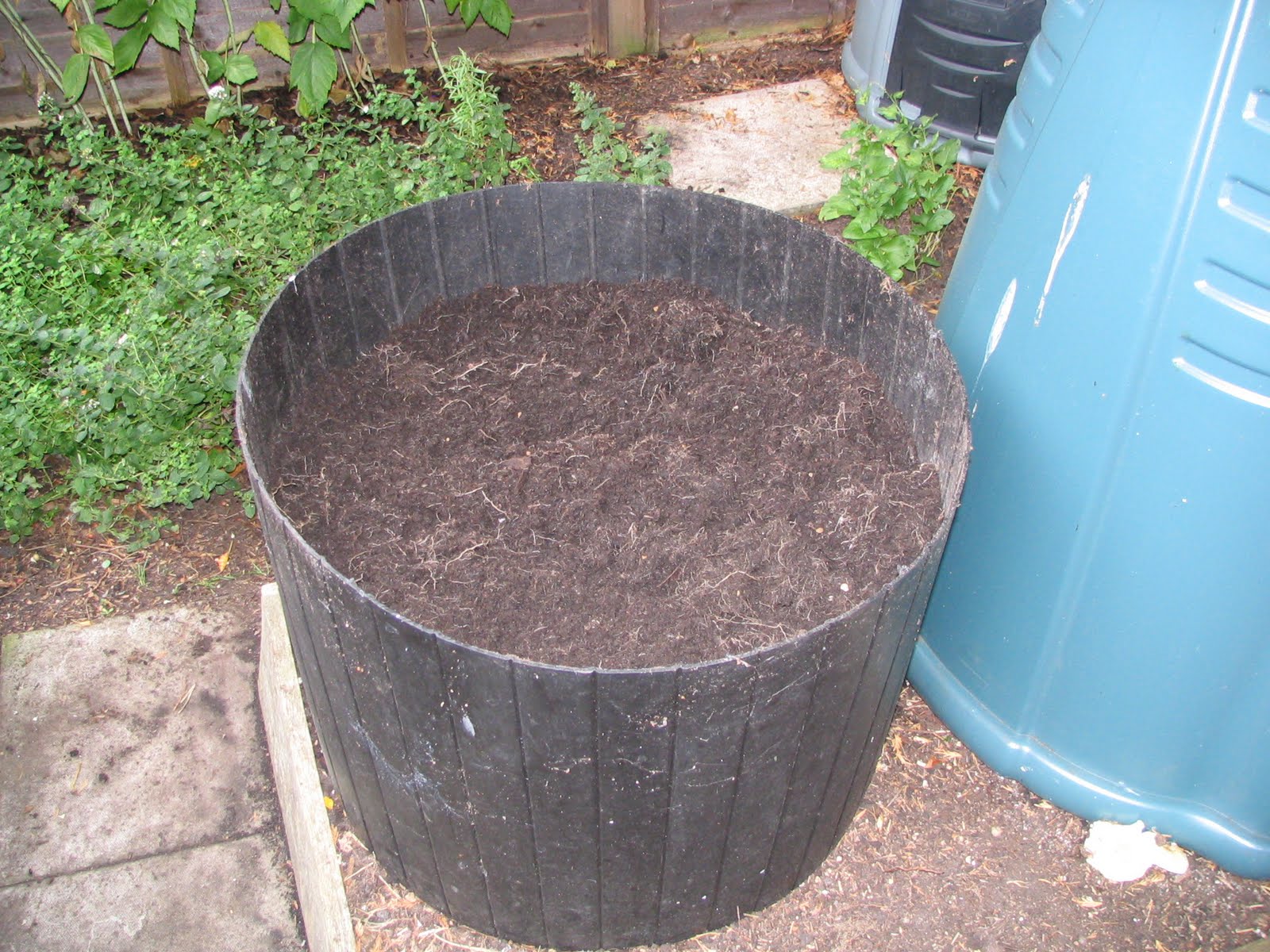
Another view of Nos 2 & 3 -- plus the remaining half of my first plastic one, now converted to a tub

Anyone who grows their own veg is almost certainly a convert to the concept of home composting. For me it's almost like a religion. It's an article of faith that anything suitable  - absolutely everything, no matter how small - gets recycled into the compost bin. All the veg trimmings from the kitchen; all the dead leaves and prunings from the veg in the raised beds as well as those from the ornamental plants; all the "spent" commercial compost used in the pots and tubs; all the weeds that I dig up, etc, etc. I have even been known to go out scouring the lanes for comfrey plants and horse poo to use as activators!

All the experts say that if you want good quality plants (especially veg) you need to feed the soil, not the plants. So I make as much home-made compost as I can, and add it to my raised beds as often as possible, in the hope of improving the soil. This has, over the years, benefitted the soil in my garden enormously. It  is still, despite the addition of all that "bulky organic matter" sandy and dry (often euphemistically described as "free-draining"), but it's a lot better than it used to be. It is certainly fertile, and I get some really fantastic crops from it, again and again. I think if you were to crop the beds as intensively as I do without adding copious quantities of compost, the soil would soon be exhausted.

Many years ago, when we first moved in to our current property, we inherited an old dilapidated shed. I replaced this one with a new one, and saved some of the wood from the old one. With this I built my first ever compost bin. It is about a metre cubed. In the early days, it held as much compost as I could reasonably make, but you know how things are -- you always end up wanting more, so I then bought a commercial one to augment it. This was a 330 litre plastic one with a hinged lid. It was really good, and served us well, but it eventually succumbed when my neighbour's fence fell on it during a winter gale. The lid was destroyed and no longer fitted, and the top of the bin was split. I then sawed it in half, retaining the bottom portion, which (inverted) now serves as a large pot for growing marrows. The home-made bin has gone a bit "wonky" now, and is on its last legs, but these days I use it as a container for growing cucumber plants, which love the 50cm + depth of rich soil it offers.


The old home-made bin, now used for growing cucumbers

The "re-cycled" plastic compost bin now serving as a tub for growing marrows
When the first of the plastic bins died, I went on to accumulate three more. This means that I can always have one "on the go" whilst another is being gradually filled, along with a third one which is converting fallen Autumn leaves into leafmould. This latter process does take a long time -- two years approximately - so ideally you would have two bins for this purpose. OK, so the fact is, you can never have enough compost bins. The deciding factors are basically 1) how much space you have, and 2) how much you can afford to spend. Actually, plastic bins are not too expensive these days. The last one I bought cost about £30.

I have not been particularly scientific about making the compost. I just bung stuff in as and when it is available. Subsequently I mix it all together, using a long piece of wood as a stirrer, at frequent intervals. In theory, you need the "correct" balance between the woody "browns" and the sappy "greens", but I have never found this to be all that vital. Perhaps I have been lucky, but year on year my bins have produced copious quantities of rich friable compost, in appearance very much like soil.  If it is properly done, the compost will be relatively dry and completely odourless. Bad compost is sloppy and nasty-smelling. I generally use the matured compost from each bin all in one go, rather than digging it out in small batches using the twee little flap that most of the commercial bins include. I usually do this task during the Christmas holidays, when I can reckon on getting a whole day to myself to "play compost" as Jane describes it -- this is not a job you can rush. I remove the plastic bin by lifting it off vertically, leaving the compost itself in-situ. I then use a spade to fill up a trug-tub with manageable quantities of the stuff and distribute it around the beds manually with the aid of a trowel, to a depth of about 5cm. The worms then take over and gradually incorporate the compost into the soil over the next couple of months, without the need for digging.

A word now about the siting of compost bins. You have to admit they are not particularly lovely to look at, so it makes sense to put them in an unobtrusive postion if you can. Also, bear in mind that you are going to be accessing the bins quite frequently, so it might be best to site the bin close to the back door, so you can easily pop out to it with the kitchen scraps, even in the depths of winter. It hardly needs to be said that the bin needs to be sited on top of soil, not a hard surface such as concrete. This is to allow access to worms and other beneficial organisms that will help to break down the material and convert it into compost. Furthermore, don't devote good growing space to hosting the bins(s). Two of my bins are in a dry, shaded spot at the bottom of the garden which is competely unsuitable for growing anything, so I have no qualms about using this otherwise unproductive space for the compost bins. Finally, consider using your bins as windbreaks. It sounds odd, but my house has what I describe as windtunnels at both sides - narrow gaps between our property and the next, through which the winter winds fairly whistle. Putting a compost bin in such a position as to shield my crops from at least some of the potentially-damaging winds is certainly worthwhile.

One other thought about compost bins occurs to me: my first commercial one was acquired via an arrangement between my local Council and the manufacturer of the bins. This meant that punters like me could buy the bins at a really cheap (subsidised) price. If I remember rightly my first bin only cost me £5, which was about 20% of the price I would have had to pay in my local Garden Centre. Deals such as this are fairly rare these days, because home-composting has caught on in a big way, and no longer needs to be so actively promoted, but it does no harm to ask your Council if anything like this is on offer.

In respect of the plastic bins I currently own, I have one major criticism. Unlike the first one I had, the lids are not of the hinged variety. They just detach competely, held in place purely by their curved profile. This is less convenient than I would like. Nipping out from the kitchen in a howling gale, I have to remove the lid completely -- and put it down somewhere - while I scrape the contents of my kitchen compost box into the bin (which needs two hands). Inevitably the bin lid blows away whilst you do this, and has to be chased around the garden before it can be replaced. I preferred the hinged version! But Hey Ho, it's worth the odd niggle like this for the results you get at the end...