Thursday, 25 August 2011

The tomatoes are getting into their stride...

Since this Summer has been very much under-par in terms of sunshine, I can hardly blame them, but my tomatoes are only just beginning to produce a significant quantity of ripe fruit.

This is "Ferline", one of my favourites for the last few years. It consistently produces a heavy crop of big, firm fruits with little in the way of pips and pulp, so it is a really good one for making into sauces. Probably its greatest attribute though is its blight resistance. It will produce a crop when all other types have succumbed. Fortunately this year we have not (yet) had any blight!


There are lots of fruits on the vines, though not many of them are ripe yet:


The big "Rainbow Beefsteak" ones are still swelling. They are going to be pretty big. At least one plant looks as if its fruit will be yellow or orange:


I still can't tell what colour the other one will be. (Is it inevitable that both will be the same colour??)


This is the most advanced of the "Green Zebra" fruits. Is it just wishful thinking, or is it beginning to show a bit of yellow, indicating ripeness?


I am now harvesting a few of the "Tropical Ruby" baby plum tomatoes. The bush is very straggly but it has a huge number of fruit on it.


The "Maskotka" bush tomatoes have produced a decent, though not enormous, crop. I love these ones. They are one of my favourites. This year some of the fruits have been a fair bit bigger than usual. They are supposed to be "bite-sized", but I think some of them need two bites!


I have so far picked only about six of the "Sungella" ones - all fairly small - but the plant is laden down with huge trusses of fruit. So much so that I have had to give it a second bamboo stake because the first one was seriously bent over and looked fit to snap.


Growing tomatoes is a bit of an addiction, I think. I can't help noticing that (like me) lots of my blogging friends write about growing loads of different tomatoes, when they may perhaps grow only one type of lettuce or beetroot. The fact that there are so many different shapes and colours of tomato available seems to make us want ALL of them!

My final picture today is of "Wilma", a very compact variety which only grows to about 40cm tall. It has tiny red fruits. This particular plant is a volunteer that I transplanted from one of my raised beds.


Great for growing where space is limited - like a balcony or patio.

Wednesday, 24 August 2011

Berrington Hall

This post is about one of the gardens we visited during our recent holiday in Hereford.

The place we stayed is in the village of Pembridge, about 20 miles West of Hereford, and it is very conveniently situated for the keen horticulturalist, with many interesting gardens within easy reach.

On our very first day we visited Berrington Hall, an imposing stately home maintained by the National Trust. It was a very interesting property, and the guided tour we joined was clear and informative. Now, whilst I'm interested in History (I studied Modern History at Oxford), I have to say that my chief interest was actually in the gardens. Even your first sight of the property as you come round the corner from the car-park is dominated by the really striking avenue of neatly-trimmed Golden Yew bushes. The day we were there the weather was poor, and the black clouds added an extra level of drama to the scene:


We had some time to kill before the guided tour, so we made a diversion into the walled garden, which was devoted about 50:50 to flowers and fruit/veg. The floral borders contained a huge variety of plants, many of them in "soft" pastel colours:


There were some very impressive individual specimens, like this deep burgundy-coloured Hollyhock:


Personally, I prefer the "hot" colours, so my attention was attracted by these golden Crocosmia, much more yellow than the most common type, which is orange:


There were masses of these Day Lilies, in a wide range of colours:


This photo of a Hypericum is very much "my type of thing"! Raindrops on the leaves; insects posing etc...


In amongst the flowers were dozens of fruit trees, some of them quite unusual types, like these Medlars:


And these Quinces:


I won't show you pictures of Apples and Pears and Plums - you know what they look like - but take it from me, there were loads of them!

After admiring the flowers we went on into another part of the walled garden, in which there was a children's play area and a kitchen garden area. The play area contained these really appealing sheep models:


Elsewhere was this very dishevelled scarecrow:


Actually, the main Veg garden was also guarded by a different scarecrow:


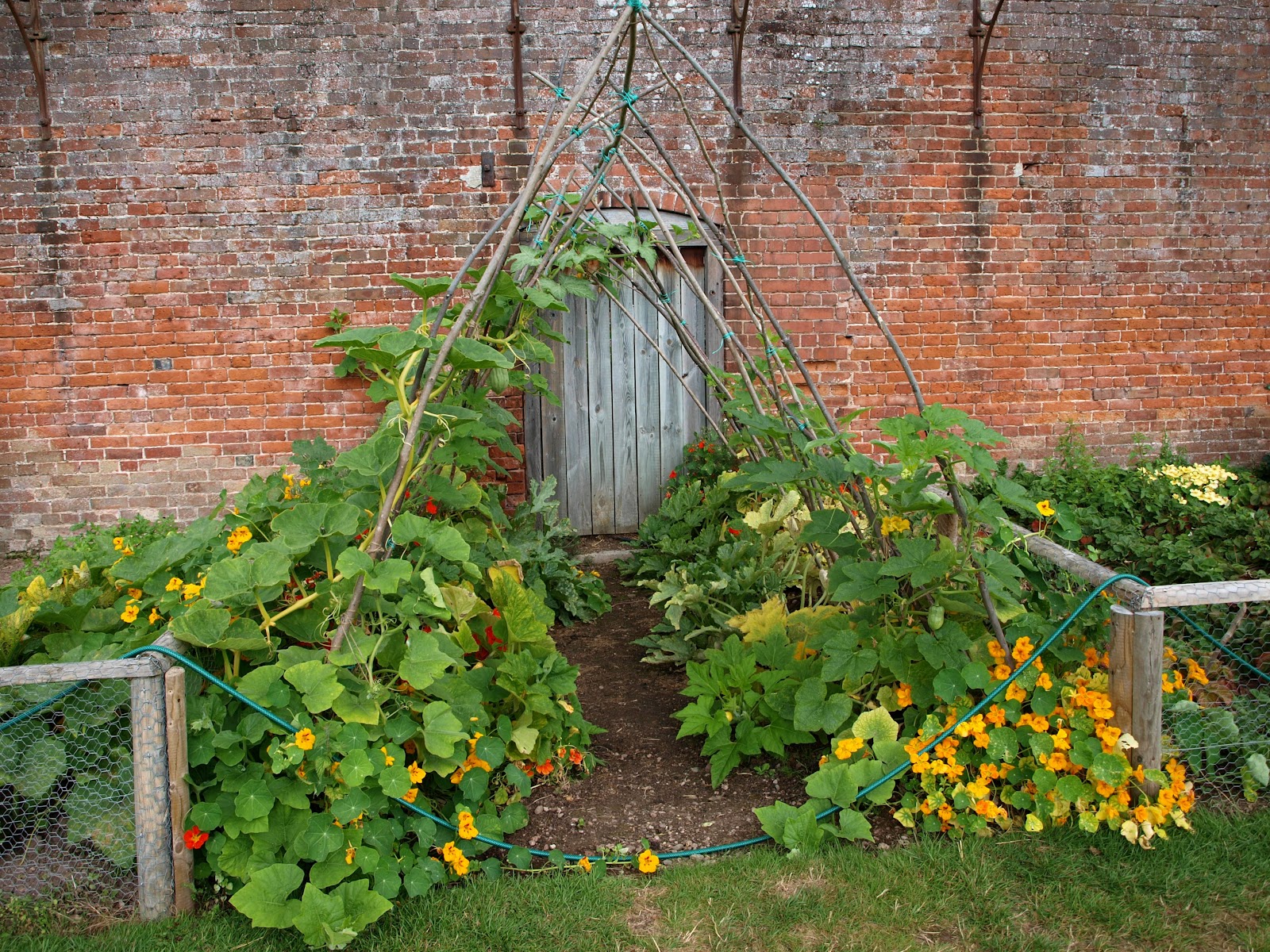
I liked this rustic archway made of hazel boughs, supporting several Squash plants and surrounded by colourful Nasturtiums:


I'm not sure what type of Squash they were, but perhaps they were "Acorn"?


Moving on from the kitchen garden, we went through a wooded area and I was thrilled to spot this fantastic Giant Puffball fungus. It was about 8 inches in diameter:


In the shaded area there were lots of different types of Hydrangea:


Emerging into the sunlight again, we saw this plant. I don't know what it is, but it was very much like a giant Sage. It had wonderfully complex seed-heads:


At this point we moved indoors to join the guided tour...

Later on I had a browse around the plants on sale at the gift shop. There were one or two outstanding specimens, like this Sedum:


So there we are then; that was Berrington Hall:


If you're interested in this, you can read more about our recent holiday in Herefordshire here

Tuesday, 23 August 2011

Late-August Chilli update

You all know that I'm very keen on growing chillis.... Here's an update on how things are going with mine.


I know it's a bit difficult to see this in the photo above, but most of my six plants are about 50cm or so tall. The one exception is "Pinocchio's Nose" (3rd from right), which is considerably taller. All of the different types have set a decent quantity of fruit. The one with the least quantity makes up for its deficiency in quantity by scoring the most points for "artistic interpretation":

This is "Pinocchio's Nose"
The "classic" chilli is represented by "Fuego F1". Most of the fruits are still green, but there are lots of them, and they are long and regular-shaped: This was the variety that produced the first fully red fruit - but just one so far.

"Fuego F1"

The "Hot Portugal" is the most advanced, in terms of ripeness. The first few of its fruits are all ripening together. Their colour is fantastic - really vibrant - but it has taken them a long time to get to this half-red stage. The first red colour showed nearly three weeks ago.


The fruits of "Short Fat" (my invented name for an unknown variety) have not grown in size for ages. They are still about the size of an average cherry. I think this is as big as they are going to get. Did I mention that I think they may actually be the variety called "Cherry Bomb"? The first one of the fruits is just turning red now.


The fruits of the one I call "Long Medium" are completely different this year. Last year they were much longer and thinner; this year they look just like small Bell Peppers / Capsicums - short and squat:


This is presumably as a result of hybridisation - or inter-breeding - between the various varieties, which are notoriously promiscuous at the best of times. The seed for this year's plant came from last year's plant, but it has very obviously not "come true".

Last of the set is "Serrano", grown from the free seeds from "Wahaca" restaurant. So far this plant is unremarkable. Not huge; not amazingly prolific; its fruits are so far small and insignificant. Will they make up for this by being brilliant in terms of flavour and/or heat? Who knows?


I always grow my chillis in big (12") pots, so that I can move them around at will - keeping them under cover in the Spring until they are well established, then being able to move them about the garden into sunny positions during the Summer (wishful thinking), and finally letting me bring them indoors in the Autumn if the fruits don't all ripen before the weather turns cold. It's easier for feeding them too. I give mine a weekly dose of tomato food..

Monday, 22 August 2011

Grandpa's little helper

At the weekend we looked after our granddaughter Lara, while her parents went up to London to watch the cricket (the England vs India Test Match).

Lara loves helping out in the garden, so we had a busy day. First off we harvested some more of the Pink Fir Apple potatoes.


Lara certainly understands where her veg comes from! We ate some of those potatoes at Dinner time. We all agreed that they were deee-licious.

Later on we picked the last of the Blueberries.


"Look at this one Grandpa!"


Of course, we had to try a few, just to check that they were OK...


We did end up with a viable quantity, though I think Quality Control accounted for about 25% of what was picked.

After making the rounds of the Tomato plants in much the same manner (One in the box, one for Lara...) we managed to find a fair few ripe fruits which joined the rapidly-increasing mound of them in the kitchen.


It wasn't all work and no play though. We had a walk down to the local park for Lara to play on the playground, hoping that this would tire her out (it didn't), and when we got home we had some quiet time (this is a figure of speech, you understand, not necessarily a statement of fact when a 2-year-old is involved).
Jane spent some time with Lara, doing some rubber-stamping, making some lions and crocodiles and things like that for Lara to colour-in with crayons and felt pens. Lara is very keen on this jigsaw puzzle too; she wants to play with it every time she visits us.


OK, quiet time over, back into the garden. Lara loves walking / running around the paths between my raised beds, hiding from us behind the various crops. This is always accompanied by shrieks of delight and much laughter. Her favourite path is the one between the tall climbing beans and the Asparagus. She seems to love the "tickly" feel of the Asparagus ferns against her face as she pushes through.

Picnic time. Grandpa gets to sit down for a few moments while Lara dishes up "tea and cakes" with her plastic tea-set:


This is Lara's "Pose for the camera" face:


Lara finally crashed out at about 8:30, just before her parents came to pick her up. Jane and Mark crashed out at about 10:00. It's easy to forget how exhausting looking after a toddler can be. For the lucky grandparents it is fun and enjoyable -- and occasional!

Sunday, 21 August 2011

Dunkerton's Herefordshire Cider and Perry

Another delightful little artisan factory which we discovered on our recent trip to Herefordshire is the Dunkerton's Cider Mill, just outside Pembridge.


As you can see from their sign, Dunkerton's specialise in the production of the traditional alcoholic beverages Cider (made from apples) and Perry (made from pears). This is not a big operation - quite the opposite: if you want to see inside the tiny, quaint little retail shop you have to ring a bell and someone will appear from the depths of the delightfully informal factory to attend to you. The emphasis is quite clearly on quality rather than quantity. I understand that they only make about 50,000 gallons of cider each year, which is pretty small for a commercial enterprise. About 60% of the raw materials (i.e. fruit) come from their own orchards, adjacent to the factory, and all the rest are sourced from farms within an 8-mile radius.

We found the staff here very friendly and knowledgeable, with a real passion for their product. It took little salesmanship on their part to persuade us to buy a few samples to take away. Regrettably there is no on-site tasting arrangement (which I must say I found surprising).

Our samples...
We bought two different types of cider - the Black Fox, a medium dry sparkling cider, and the 2009 vintage cider (made to celebrate 30 years of cider-production) - and some of their Perry (described as "fragrant and delicate").


Did you notice the jar of pickled walnuts? Jane loves pickled walnuts (which you eat much like the more well-known pickled onions), so she couldn't resist buying these. They are doubtless destined to be consumed alongside some of our Monkland cheese...


These were also made at the Dunkerton's premises, using walnuts from the trees dotted around their car-park. So this could be the tree that produced the walnuts that went into that jar. How about that for minimising the Food-miles?


Green walnuts - past the stage at which they would be nice pickled!
If you can't get all your food from your own garden / farm, I think the next best thing is getting food whose provenance you know - and it should be local wherever possible, I feel. Unfortunately in our country it is often difficult to know exactly what happens to foodstuffs before you buy them. One of our supermarkets advertises "all the milk in each of our stores comes from within 50 miles of that store". 50 miles is actually quite a long way for us in Britain in any case, but what they don't tell you is that the milk produced within 50 miles of the store all gets shipped off to a centralised processing plant hundreds of miles away and then shipped back again. What nonsense!